PRODUCTIVITY AND WAGE EFFECTS OF FIXED-TERM EMPLOYMENT: EVIDENCE FROM SPAIN* por Juan F. Jimeno** y Luis Toharia***
Documento de Trabajo 92-11
Octubre 1992
* We wish to thank Marta Campillo for excellent research assistance.
** Universidad de Alcalá de Henares and FEDEA
*** Universidad de Alcalá de Henares
ABSTRACT
This paper investigates the possibility that the large-scale use of fixed-term employment contracts in Spain since 1986 may have induced productivity and wage effects. For that purpose, we develop simple theoretical models to illustrate the reasons why such productivity and wage effects might arise. As for productivity, we identify both "efficiency" and "cooperation" effects and derive the conditions under which the use of fixed-term contracts reduces labour productivity. As for wages, there are two channels through which fixed-term contracts may have effects. First, the co-existence of both fixed-term and permanent employees affects the collective bargaining process and, consequently, the determination of wage rates. Secondly, given the more "precarious" situation of workers under fixed-term contracts, there might be wage discrimination against them. We present some evidence on the productivity and wage effects of fixed-term employment in Spain using available statistical sources. Although this evidence is not totally conclusive, there appears to be some grounds to believe that both type of effects have been at work in Spanish labour markets in recent times.
JEL Codes: D24, J31, J51.
1.- Introduction
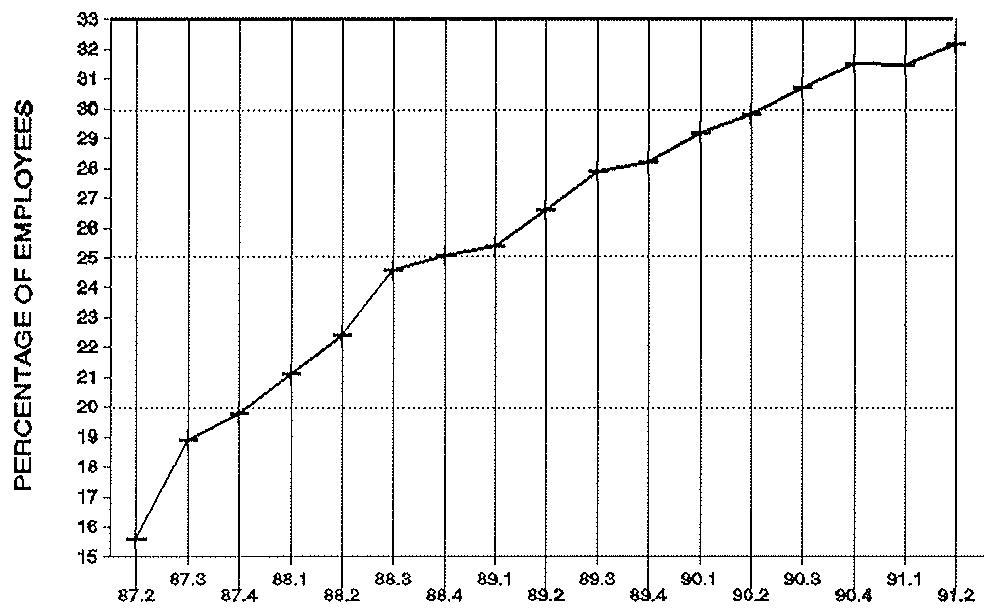
In Spain, as in most Western European countries, the usual employment contract establishes a permanent and full-time employment relationship between employers and employees. However, in 1984, in a desperate move to try to curb unemployment, which by then had reached over 20 percent of the labour force, the government introduced several reforms in the main law regulating the labour market -the Estatuto de los Trabajadores (Worker's Charter)-, whose purpose was to facilitate the use of "atypical" labour contracts, that is part-time contracts and, more importantly, temporary and fixed-term contracts. These reforms were an extension of earlier measures, giving them the full force of law. As a result, currently more than 30% of Spanish wage-earners workers are employed under temporary and fixed-term labour contracts (up from about 10% in 1984). Roughly, all this increase can be attributed to the widespread use of fixed-term contracts.
The main argument in favour of the existence of fixed-term employment contracts is that the possibility of hiring workers under them, which involve substantially lower firing costs than permanent employment contracts, increases employment. Thus, the job security regulations which apply to permanent contracts (across most continental Western European countries), which take the form of severance payment in case of dismissal and are thought to restrict hirings, can be avoided, to some extent, by firms. This is precisely the case in Spain, where these severance payments depend on seniority and the type of contract, being lower (per year of seniority) in the case of fixed-term employment contracts. Additionally, there are some other legal provisions protecting dismissed permanent workers which do not cover workers employed under fixed-term contracts. For instance, after a permanent worker is fired, she might sue the employer and obtain significantly higher severance payments depending on whether the labour court declares the dismissal "fair" or "unfair". Obviously, the uncertainty of this outcome and the administrative costs involved in the process are important for the employer when considering dismissing a permanent worker. However, dismissed fixed-term employees do not enjoy this right to suit. This difference in pecuniary and non-pecuniary firing costs with respect to workers employed under different employment contracts introduces a rather peculiar two-tier system in employment relations. Although similar arrangements exist in other Western European countries, the high percentage of workers employed under fixed-term contracts in Spain has no parallel case. Because of this reason, the evolution of fixed-term employment in Spain constitutes an interesting experience to analyze to help our understanding of the effects of firing costs, not only on employment, but also productivity and wages.
Properly, a temporary employment contract is one of determined duration, which is justified by the seasonality of the job. A fixed-term contract also has a determined duration but independently o the characteristics of the job. We will use both terms interchangeably to refer to the latter.
It is often argued that the possibility of entering into fixed-term employment arrangements has been the basic cause of the increase in employment which took place in Spain since 1985 until 1990. This would come as no surprise when one looks at the evolution of labour force and employment presented in Figure 1. During the period 1975-85, the Spanish economy suffered an employment crisis unknown in other Western European countries where unemployment soared because of lack of job creation but, unlike in Spain, aggregate employment did not decrease substantially. From 1985 until 1990, aggregate employment has increased at an average annual rate over while the percentage of fixed-term employment soared (see Figure 2). One explanation of both the employment crisis and the employment recovery relies on the high "employment rigidity" imposed by compulsory severance payments in the case of dismissals of permanent workers. This argument sustains that these type of payments discourage hiring of new workers. Two reasons are mentioned. When workers are homogeneous, the expected wage of a new worker includes the expected cost from firing her in case of a decrease in labour productivity, which is obviously increasing in the magnitude of severance payments. Additionally, when workers are heterogeneous and their abilities are unknown at the moment of hiring, the probability of hiring a low ability worker is an important component of the expected probability of a future dismissal, so that when average ability is perceived to be low by employers, the significance of firing costs for the hiring decision increases.
If a permanent worker is fired, the severance payment is established by law at 20 or 45 days-wages per year of seniority depending on whether the dismissal is ruled "fair" or "unfair" by a judge. In the case of temporary workers, this payment is established at 12 days-wages per year of seniority.
However, the effects of firing costs on the firm's hiring decision is a controversial issue. They have been analysed by different authors within the literature of labour demand under linear adjustment costs. It is obvious that firing costs affect the variability of employment over the business cycle but they are not necessarily decisive regarding hiring and the long-run aggregate level of employment. Bentolila and Bertola (1990) present a model of firing costs where the magnitude of severance payments has only a small effect on hiring and, thus, the effects of firing costs on long-run average employment are small too. On the contrary, Saint-Paul (1990) shows that the existence of firing costs combined with a low and procyclical workers' rate of voluntary quits might cause "a high unemployment trap" (proving Blanchard and Summers' (1988) conjecture). Bentolila and Saint-Paul (1992a) show that a rise in firing costs reduce both the firm's marginal propensities to hire and fire, so that average steady-state labour demand normally decreases with firing costs, when these are small, but will increase when they are high enough. With another model specially designed to analyse the macroeconomic implications of fixed-term employment, Bentolila and Saint-Paul (1992b) estimate that these type of contracts contributed to increase employment by one and half per cent during a period of three years (in Spain after 1984).
We do not pursue the issue of the employment effects of fixed-term contracts further in this paper. Instead, we focus on the (less investigated) productivity and wage effects of a two-tier labour contract system where workers differ in terms of tenure (as implied by the distinction between permanent workers and workers employed under fixed-term contracts). The structure of this paper is as follows. In section 2, we present a theoretical model which focus on the productivity effects of fixed-term employment. This model illustrates two reasons why fixed-term employment may have productivity effects: adverse selection/moral hazard considerations (we shall labelled "efficiency effects" to the productivity effects arising from them) and those effects arising from the relationships between permanent workers and other production factors, on one hand, and workers under fixed-term contracts, on the other (we refer to these effects as "cooperation effects"). In section 3, we present a simple collective bargaining model of wage determination that illustrates the effects of the coexistence of permanent and fixed-term employees on wages rates. We show that, under plausible assumptions, wage rates are higher the higher the percentage of fixed-term employees. Section 4 contains some empirical evidence aimed at offering support to the existence of both productivity and wage effects of fixed-term employment. Finally, section 5 concludes.
2.- Productivity Effects of Fixed-Term Employment
It is somehow surprising that the issue of the productivity effects of fixed-term employment has received so little attention since there are several theoretical results within the literature on optimal labour contract which suggest that the characteristics of employment contracts (an among them, their tenure) and labour productivity might be related. For instance, when effort monitoring is incomplete (in the sense of being either perfect and discontinuous or continuous and imperfect), a bond (negative severance payment) will be present in the efficient contract. Alternatively, it is also known that efficient employment insurance contracts might involve severance payments (in this case, strictly positive). These observations lead to ask for the productivity implications of the adverse selection/moral hazard aspects of fixed-term employment.
In this section we develop a simple model to illustrate the productivity effects arising from adverse selections/moral hazard aspects of the employment relationship (we shall call them efficiency effects) and analyze whether fixed-term contracts, under which workers can be dismissed at no (or negligible) costs, are superior, regarding labour productivity improvements, to contracts imposing higher severance payments. Alternatively, when both permanent and fixed-term employees co-exist, there is another source of productivity effects which is stressed, for instance, in the insider-outsider literature (see Lindbeck and Snower (1988a)). This literature has emphasized the possibility of harassment and lack of cooperation between different types of workers. In particular, the working conditions of permanent workers might be affected by the hiring of fixed-term workers, so that the former might react by withdrawing cooperation with the latter. This behaviour is likely to reduce the productivity of both permanent workers and workers employed under fixed-term contracts. Moreover, when investment in specific human capital, team production activities and learning-by-doing are important, it is plausible that the hiring of workers under fixed-term contracts affects productivity negatively since investment in specific human capital is discouraged, the productivity of other workers involved in team production activities is, therefore, diminished, and learning-by doing is not fully exploited. (We refer to all these effects as cooperation effects). In this case, we limit ourselves to show the implications of this latter type of productivity effects for the steady-state distribution of employment by contract status.
See Parsons (1986) and the references cited there.
Adverse selection aspects are important when analyzing fixed-term employment since this is the typical contractual relationships for new entrants in the labour market (at least, in Spain). For a descriptive study of the types of fixed-term employment contracts existing in Spain and their incidence and distribution, see Segura et. al. (1991).
2.1.- "Efficiency Effects"
We turn now to sketch a simple model to illustrate the efficiency effects of fixed-term contracts. Suppose that there are two periods and that firms may employ workers under fixed-term and permanent contracts during the first period and rehire them in the second period, but in this case only under permanent contracts. Workers have an inelastic supply of labour, are of different ability and may or may not exert effort when employed. For simplicity, worker ability, , is either high (an equal to 1), or low (an equal to 0), and effort, e, is either 1 or 0, as well. Ability is privately observed by workers but not by employers. The population distribution of ability across workers is common knowledge and described by . Thus, average ability is z. Employers do not observe workers effort directly but the output produced by each worker employed under fixed-term contract separately. The output produced by each worker is . The utility cost of exerting effort e is given by and all workers are paid the same wage, w. The monitoring technology can be described by the probability of being found not exerting effort. We will assume that this probability is for fixed-term workers and for permanent workers. A worker is rehired in the second period with probability one if she proves to be within the "high ability" class and is not found "shirking", and with probability zero if found "shirking" or reveals "low ability". Additionally, in case of a recession, the firm will dismiss a certain fraction of workers. We call and the firing probabilities in case of recession, for fixed-term and permanent workers, respectively, being s the severance payment to be paid to a dismissed permanent worker. The value of having an employment in the second period is . For ease of notation, we assume that the discount factor is one.
A simpler version of this model (without adverse selection), can be found in Jimeno and Toharia (1992b).
This latter assumption is made, not only for the sake of simplicity, but also to capture an important aspect of the regulation of fixed term employment, namely, the fact that after a legally determined period of time (a maximum of three years in Spain) temporary contracts must become permanent.
We will compare the effects of permanent and fixed-term contracts on workers' effort choice. For simplicity, we assume that the firm can choose only one type of contract (either permanent or fixed-term). We do so to leave aside the possibility of monitoring workers under fixed-term contracts by comparing their productivity with the productivity of permanent workers, which complicates the analysis without offering further insights.
Consider first the effort choice of workers employed under fixed-term contracts. It is easy to show that, depending on the parameter values, there are three possible equilibria:
There are reasons to believe that these comparisons can not reveal true abilities, given the heterogeneity of personal characteristics of the workers. In particular, the seniority in the firm of permanent workers is higher than that of temporary workers (normally, new entrants into employment) and this difference in seniority could be the reason for the perceived differences in productivity rather than different abilities.
i) A pooling equilibrium where high ability workers exert no effort and low ability workers exert effort. In this equilibrium no information is revealed about workers' ability, since the production of both type of workers is one and the employer cannot distinguish them (that is, fixed-term employment contracts do not solve adverse selection problems). Hence, the rehiring probability for all fixed-term workers is z if not found "shirking" and there is no recession (and the firm does not desire to change the proportion of fixed-term employees). The conditions for this equilibrium are: High ability workers prefer not to exert effort, that is
\[w - 1 + (1 - r ^ {t}) V ^ {p} < w + \frac {z (1 - f ^ {t}) (1 - r ^ {t})}{1 - z f ^ {t}} V ^ {p}\tag{1}\]
Low ability workers prefer to exert effort, that is
\[W - 1 + \frac {z (1 - r ^ {\prime})}{1 - z f ^ {\prime}} V ^ {p} > W\tag{2}\]
Inequalities (1) and (2) imply
\[\frac {(1 - z) (1 - r ^ {\prime})}{1 - z f ^ {\prime}} < \frac {1}{V ^ {p}} < \frac {z (1 - r ^ {\prime})}{1 - z f ^ {\prime}} \quad (s o t h a t z > \frac {1}{2})\tag{3}\]
The second term of the right-hand-side of this inequality is obtained as follows. In this equilibrium, firms will rehire a fraction z of the workers under fixed-term employment contracts in the second period. A fraction is found "shirking" and are fired so that the ex-ante rehiring probability of a high ability worker is
ii) A separating equilibrium with high ability workers exerting effort and where low ability workers exert no effort (since they will not be rehired anyway). This equilibrium arises when:
High ability workers prefer to exert effort, that is
\[w - 1 + (1 - r ^ {\prime}) V ^ {p} > w + (1 - f ^ {\prime}) (1 - r ^ {\prime}) V ^ {p}\tag{4}\]
which implies
\[\frac {1}{V ^ {p}} < f ^ {\prime} (1 - r ^ {\prime})\tag{5}\]
iii) Finally, there is another separating equilibrium with no worker exerting effort. The conditions for this equilibrium are
High ability workers prefer not to exert effort, that is
\[w - 1 + (1 - r ^ {\prime}) V ^ {p} < w + (1 - f ^ {\prime}) (1 - r ^ {\prime}) V ^ {p}\tag{6}\]
Low ability workers prefer not to exert effort, that is
\[w - 1 + \frac {z (1 - r ^ {\prime})}{1 - z f ^ {\prime}} V ^ {p} < w\tag{7}\]
which implies
\[\frac {1}{V ^ {p}} > \max \left[ f ^ {\prime} \left(1 - r ^ {\prime}\right), \frac {z \left(1 - r ^ {\prime}\right)}{1 - z f ^ {\prime}} \right]\tag{8}\]
Among these equilibria, there is some sense in which the second equilibrium is the best one (The adverse selection problem is solved and high ability workers exert effort).
Notice, however, that this equilibrium arises only for small values of , given and . Alternatively, if is high (because a recession is very likely or because firms find profitable to keep a certain proportion of the workforce employed under fixed-term contracts, so that they must fire workers each period) or and are small, either the first pooling equilibrium, where no information about the ability of the workers is revealed, or the last separating equilibrium, with no workers exerting effort, is likely. This is the case discussed in Lindbeck and Snower (1988b). As they put it, low (microeconomic) job security (that is, high in our model) reduces workers effort. Two more comments ought to be made. First, when firms hire workers under both permanent and fixed-term contracts, the rehiring probabilities of fixed-term employees depends on the actual proportion of them in the firm's labour force. In steady state, when the firm has the optimal distribution of workers by contract status and employment is constant, the probability of rehiring fixed-term employees must be equal to the probability of a permanent worker quitting, which is zero in our model and small, in practice. This is so because under the assumption that fixed-term workers must be rehired under permanent contracts, rehiring them will change such optimal distribution. Secondly, as noted by Lindbeck and Snower (1988b), the firm faces a time consistency problem which can be described in the following terms. When hiring a new worker under a fixed-term contract, the firm would like this worker to believe that the probability of rehiring, if the worker is of high ability and exert effort, is close to one, as this belief will motivate the employee to exert effort. However, if redundancies occur, the firm has the incentive to dismiss fixed-term employees, instead of dismissing permanent employees of similar characteristics, as dismissals of the former are less costly.
See note 6 for a justification of this assumption.
We wow consider permanent workers. The difference between permanent workers and workers employed under fixed-term contracts is the existence of severance payments in the case of dismissal of permanent workers. A permanent worker might be fired if found "shirking" (and that occurs with probability ) or, with probability where s is the severance payment in case of dismissal. The reason why this probability depends on the magnitude severance of payments should be obvious. If severance payments are high enough, dismissals are more costly and, hence, workers feel that their job is more secure (so is decreasing in s).
As before, three type of equilibria are possible. A pooling equilibrium (as in i) above) arises when:
\[w - 1 + s r ^ {p} (s) + [ 1 - r ^ {p} (s) ] V ^ {p} < w + s + \frac {(1 - f ^ {p}) [ 1 - r ^ {p} (s) ]}{1 - z f ^ {p}} (V ^ {p} - s)\tag{9}\]
and
\[W - 1 + S r ^ {p} (S) + [ 1 - r ^ {p} (S) ] V ^ {p} > W + S\tag{10}\]
which implies
\[\frac {f ^ {p} (1 - z) [ 1 - r ^ {p} (s) ]}{1 - z f ^ {p}} < \frac {1}{V ^ {p} - s} < 1 - r ^ {p} (s)\tag{11}\]
Similarly, a separating equilibrium of type ii) arises when:
\[w - 1 + s r ^ {p} (s) + [ 1 - r ^ {p} (s) ] V ^ {p} > w + s + (1 - f ^ {p}) [ 1 - r ^ {p} (s) ] (V ^ {p} - s)\tag{12}\]
that is,
\[\frac {1}{V ^ {p} - s} < f ^ {p} [ 1 - r ^ {p} (s) ]\tag{13}\]
and a separating equilibrium of type iii) arises when:
\[W - 1 + s r ^ {p} (s) + [ 1 - r ^ {p} (s) ] V ^ {p} < W + s + (1 - f ^ {p}) [ 1 - r ^ {p} (s) ] (V ^ {p} - s)\tag{14}\]
and
\[w - 1 + s + \frac {1 - r ^ {p} (s)}{1 - z f ^ {p}} (V ^ {p} - s) < w + s\tag{15}\]
which implies
\[\frac {1}{V ^ {p} - s} > \max [ f ^ {p} [ 1 - r ^ {p} (s) ], \frac {1 - r ^ {p} (s)}{1 - z _ {f} ^ {f p}} ]\tag{16}\]
As can be seen, severance payments play an important role. They have two effects. First, they increase the second period utility in the case of dismissal which disincentivates effort. Secondly, they reduce the firing probability in case of recession which incentivates effort. Therefore, it should be obvious that the absence of severance payments, s=0, is not necessarily a characteristics of the optimal labour contract. Consider, for instance, the case where the second equilibrium is optimal. It is perfectly possible to have
\[\frac {1}{V ^ {p}} > f ^ {\prime} (1 - r ^ {\prime})\]
and, hence, fixed-term contracts do not achieve this equilibrium, and, simultaneously,
\[\frac {1}{V ^ {p}} < f ^ {p} [ 1 - r ^ {p} (s) ] \frac {V ^ {p} - s}{V ^ {p}}\]
for some strictly positive s, and, therefore, a severance payment must be introduced to achieve this equilibrium. Compulsory severance payments, by increasing (microeconomic) job security, induce worker's effort. Additionally, they help to solve the time consistency problem that employers face and that we described above, since severance payments constitute a credible commitment technology with regards to job security.
We have shown that the form of employment contract have some efficiency effects. The model we have used is rather simple but illustrates the possibility of some interesting results suggesting that fixed-term employment contracts are not necessarily superior to permanent contract when dealing with adverse selection and moral hazard problems. It is true, however, that there are situations under which fixed-term employment contracts might improve labour productivity. For instance, consider the case when the monitoring technology depends upon the contractual relation, in the sense that . In this (conceivable) case, fixed-term employees are more likely
\[g (s) = f ^ {p} [ 1 - r ^ {p} (s) ] \frac {V ^ {p} - s}{V ^ {p}}\]
Let
Then,
which is positive if
to exert effort. In any case, the existence of productivity effects is an empirical question that we address by providing some evidence from the Spanish case in section 4.
2.2.- "Cooperation Effects"
If adverse selection and moral hazard considerations were the only source of productivity differentials between permanent workers and workers employed under fixed-term contracts, then, in steady state equilibrium (and without legal restrictions), only one type of employment contracts would be used, namely, firms would employ only those workers using contracts that yield the lowest expected unit cost. This occurs because efficiency effects, in the terms that we have described them, determine the average productivity rather than the marginal productivity of each type of worker. Hence, if we are to have a (steady-state) distribution of employment by contracts differing in tenure terms, it must be the case that there are another sources of productivity differentials affecting not only average but marginal productivities of each type of workers. It is not difficult to think of causes for the latter type of effects to be at work. For instance, this would be the case when employed permanent workers use uncooperative behaviour against workers employed under fixed-term contracts (as in the insider-outsider example and other examples cited at the beginning of section 3). We are not pursuing this analogy further to model how these cooperation effects arise. Instead, we turn, by using a simple example, to derive the steady-state distribution of labour demands by type of employment contracts when both efficiency effects and cooperation effects are present.
Suppose, for simplicity, that the firm has a Cobb-Douglas production function:
\[Y = N ^ {\gamma}. K ^ {1 - \gamma}\]
where Y is production, N is labour input and K is capital input and
\[N = N ^ {p} + (1 - m) N ^ {T} - \frac {\alpha}{2} [ N ^ {t} ] ^ {2}\]
being the number of permanent workers, the number of workers employed under fixed-term contracts, m is a parameter measuring the efficiency effects of the later type of contracts (effects on average productivity and that can be positive or negative) and is a positive parameter representing the magnitude of the cooperation effects cited above (i.e., effects implying different marginal productivity of workers depending on the distribution between permanent workers and workers under fixed-term contracts).
The cost minimization problem is given by:
\[\min _ {[ N ^ {p}, N ^ {\prime}, K ]} \qquad N ^ {p} [ w ^ {p} + s r ^ {p} (s) ] + N ^ {\prime} w ^ {t} + c K\]
\[s. t. \quad Y = N ^ {\gamma}. K ^ {\gamma}, \quad N = N ^ {p} + (1 - m) N ^ {t} - \frac {\alpha}{2} [ N ^ {t} ] ^ {2}\tag{21}\]
where c is the cost of capital, is the wage paid to permanent workers, is the wage paid to workers under fixed-term contracts and, as before, is the firing probability of a permanent worker and s is the corresponding severance payment.
For simplicity, we assume that is given and the firing probability of a permanent worker is given by
\[r ^ {p} = \rho [ 1 - \frac {1}{N ^ {p}} ]\]
where is the probability of a recession and the firm employ only one permanent worker in case of recession. Thus, the first-order conditions for a solution to this problem are
\[\frac {w ^ {p} + \rho S}{w ^ {\prime}} = \frac {1}{1 - m - \alpha N ^ {\prime}}\]
\[\frac {w ^ {p} + s \rho}{c} = \frac {\gamma K}{(1 - \gamma) N}\tag{23}\]
which yields
\[\begin{array}{c} N = Y [ \frac {\gamma}{1 - \gamma} ] ^ {1 - \gamma} [ \frac {c}{w ^ {p} + s \rho} ] ^ {1 - \gamma}, \\ N ^ {p} = Y [ \frac {\gamma}{1 - \gamma} ] ^ {1 - \gamma} [ \frac {c}{w ^ {p} + s \rho} ] ^ {1 - \gamma} - \frac {(1 - m) ^ {2}}{2 \alpha} + \frac {(w ^ {t}) ^ {2}}{2 \alpha (w ^ {p} + s \rho) ^ {2}}, \\ N ^ {t} = \frac {1 - m}{\alpha} - \frac {w ^ {t}}{\alpha (w ^ {p} + s \rho)} \end{array}\tag{24}\]
Thus, demand for workers under fixed-term contracts is decreasing in , increasing in , in the severance payment s and the probability of a recession . Demand for permanent workers is decreasing in , in the severance payment s and the probability of a recession , and increasing in .
Assuming that there is no wage discrimination , demand for workers under fixed-term contracts is decreasing in w. However, the wage-elasticity of the demand for permanent workers is smaller, in absolute terms, than in the case when no fixed-term workers are hired since:
\[\frac {\partial N ^ {p}}{\partial w} = (\gamma - 1) Y \left[ \frac {C \gamma}{1 - \gamma} \right] ^ {1 - \gamma} (w + s \rho) ^ {\gamma - 2} + \frac {w s \rho}{\alpha (w + s \rho) ^ {3}}\tag{25}\]
(assuming that production, Y, is given). The first term is negative (usual substitution of labour by other non-labour inputs when the wage increases). However, the second-term is positive: workers under fixed-term contracts are substituted by permanent workers as the marginal productivity of the former decreases at a faster rate than the marginal productivity of the latter.
To sum up, we state the main conclusions from this simple model. In steady state, the proportion of workers hired under fixed-term contracts is increasing in the average productivity of this type of workers (decreasing in m, that is, smaller the more negative the efficiency effects that fixed-term employment might imply), decreasing in the magnitude of the cooperation effects, , and increasing in the severance payments to dismissed permanent workers. When both type of workers are hired at the same wage, the hiring of fixed-term workers decreases the wage-elasticity of labour demand for permanent workers. This latter conclusion play an important role in next section.
Alternatively, we can assume that , for some constant, without significant change in the conclusions to be reached. In Spain, the law forbids discrimination in wage rates. However, as we shall see in section 4.3, there is some evidence indicating that fixed-term workers receive lower earnings.
3.- The Effects of Fixed-Term Employment on Wages
Regarding wage determination, there are two reasons why a two-tier employment system with permanent and fixed-term contracts may have significant effects. First, if that wages are determined by collective bargaining (the usual procedure in Spain), a rise in the percentage of workers employed under fixed-term contracts may increase wage rates. As standard collective bargaining models teach us, the outcomes of this procedure depend on the trade-off between wages and the workers' "survival probability" at each wage level. The distinction between permanent and workers under fixed-term contracts also involves, de facto, a ranking regarding dismissals since the latter type of workers will be fired first after excessive wage increases. Thus, it follows that when permanent workers are majority in the collective bargaining procedure and all workers are paid at the same rate, wage rates will be higher the more workers under fixed-term contracts are employed. This perverse effect of fixed-term labour contracts induces negative effects on aggregate employment.
The second reason why the widespread use of fixed-term contracts might have an effects on wages is the possibility of wage discrimination, namely, wages being dependent upon the contractual status of the worker, which may imply lower average wages as the percentage of fixed-term workers increases. This possibility does not exist, de iure, in Spain, since the law forbids collective bargaining agreements specifying different wage rates for permanent and fixed-term employees. However, there are less legal provisions protecting workers under fixed-term contracts which implies that, de facto, fixed-term employees might feel obliged to accept lower wages. Whether or not this is the case constitutes an empirical question that we defer to next section, where we present some empirical evidence regarding wage effects, arising from both collective bargaining and wage discrimination considerations.
We now show the first effect on wage rates, through collective bargaining, more formally. Suppose that wages are determined by collective bargaining between employers and workers representatives. Assume that there is a constant positive relation between permanent workers' wages and those of temporary workers (say, for instance, that ). Permanent workers are majority and enjoy more institutional recognition, so (we shall assume) that they are majority in the corresponding work council involved in collective bargaining. Following the insider-outsider literature, we also shall assume that permanent workers care only about their own utility when bargaining over wages. Furtehremore, we assume that the firm has the production function used in previous section and that the utility function of the workers is the expected wage bill. We follow the standard practice of using the Nash-maximand to find the wage rate resulting from collective bargaining.
For comparison purposes, we first derive wages when there is no employment under fixed-term contracts. In this case,
\[w \in a r g \max [ N (w) (w + s \rho (1 - \frac {1}{N (w)})) ] ^ {\delta} \Pi (w, c)\tag{26}\]
It is conceivable that fixed-term workers should ask for higher (and not accept lower) wages than permanent workers since their job security is much lower. However, when labour supply is rationed (as indicates an almost 19% unemployment rate), the employers can impose the type of the contract as a "take-or-leave-it" offer.
A=1
To simplify notation and without loss of generality, we take A=1.
where is the firm's profit function (the output price is normalized to be 1), is a measure of workers bargaining power and the reservation wage is normalized to be zero. This program yields:
\[w = - s \rho + \frac {\delta \gamma Y + s \rho (Y + \delta \gamma)}{Y (1 + \delta) (\gamma c) ^ {1 - \gamma} (1 - \gamma) ^ {\gamma - 1}}\tag{27}\]
(where, for simplicity, we have assumed constant).
We now suppose that firms may hire both permanent worker and workers under fixed-term contracts but only permanent workers bargain over wages. Assuming that the production function is like in section 2.2 and as long as
\[(1 - m) s \rho - m [ \frac {\delta \gamma Y + s \rho (Y + \delta \gamma)}{Y (1 + \delta) (\gamma c) ^ {1 - \gamma} (1 - \gamma) ^ {\gamma - 1}} ] > 0\tag{28}\]
fixed-term employment contracts would be used to hire some workers at the wage that would result from collective bargaining in the absence of the former type of workers (since the expected unit cost of permanent workers is higher than that of permanent workers). However, it is no longer possible to get a closed-form solution relating wages and the percentage of fixed-term employment to the parameters of the model. Nevertheless, the first-order condition can be written as follows:
\[w = - s \rho + \frac {\delta \Pi \sigma (1 + \epsilon^ {s}) + s \rho}{N ^ {p}}\tag{29}\]
where is the percentage of permanent workers and is the wage-elasticity of the survival probability function of permanent workers , being the initial number of permanent workers involved in collective bargaining). From this expression we can conclude that
i) immediately after the introduction of fixed-term contracts, employment of permanent workers and their wages will fall, since the employer will substitute permanent workers by fixed-term workers at the initial wage, permanent workers will be willing to take a wage cut and reduce the number of newly hired fixed-term workers. However, this cut will not be large enough to prevent hiring of workers under fixed-term contracts (in general, will be strictly less than one). Notice that permanent worker can prevent the hiring of new workers under determined duration contracts by setting . This will not be optimal in general as they will find profitable to trade-off wage increases over this level against lower "survival" probabilities. However, in successive period, wages will be higher.
ii) Once fixed-term workers are hired, the wage-elasticity of the survival probability function for permanent workres is smaller, in absolute terms, than in the case of when no fixed-term workers are employed, an more so the larger the percentage of fixed-term workers employed (see previous section). Thus, the resulting wage is an increasing function of the percentage of workers employed under fixed-term employment contracts.
4.- Empirical Evidence on Productivity and Wage Effects of Fixed-Term Employment
In this section, we present some evidence on productivity and wage effects of employment under fixed-term contracts. Measuring these effects is a complicate task because of the limitations of the available data which do not permit a sufficient control of labour composition effects. In any case, we present a cross-sectional analysis that indicates the existence to some extent of both productivity and wage effects.
4.1.- Evidence on Productivity Effects
Given the obvious difficulties of measuring labour productivity for a specific-workers and the complications introduced by the heterogeneity of personal characteristics, we document the existence of productivity effects of fixed-term employment presenting some results on the (total) and (partial) correlations between changes in labour productivity and changes in the percentage workers employed under fixed-term contracts, in a sample of industrial sectors. Thus, using the National Accounts data, we have computed the change in labour productivity in 34 sectors of the economy between 1987 and 1988 (the last year for which definitive information at the required level of dissaggregation is available). On the other hand, from the Labour Force Survey we have computed the change in the percentage of fixed-term workers between 1987 (the first year for which the survey offers information on temporary employment) and 1988 in each one of those sectors. (Thus, by taking differences, all sector-specific reasons for different levels of productivity are excluded). Figure 3 plots the resulting data. As can be seen in this figure, there is a negative correlation between changes in labour productivity and changes in the percentage of fixed-term workers (the correlation is -.1911, the (Spearman's) rank-correlation is only -.0843, though). However, this negative relation can arise from other reasons than the productivity effects of fixed-term employment contracts. Since fixed-term workers might have different personal characteristics (skills, levels of education, firm-specific human capital, etc.), it is reasonable to expect different labour productivity even when the tenure of the contract have no productivity effects. Hence, for each sector considered, we have computed several indexes aimed at measuring the change in the personal characteristics of workers employed. Concretely, we have computed a age-index (percentage of workers aged under 24), a skill index (percentage of workers unskilled and middle-skilled, according to the classification of occupations) a level of education-index (percentage of workers with at least secondary education) and a seniority-index (percentage of workers with seniority less than 12 months). To estimate the productivity effects of fixed-term employment controlling for the productivity effects of the change in labour composition, we have performed the regressions presented in table 1. The first column of this table presents the OLS regression, where the coefficient of the change in the percentage of fixed-term workers is negative and clearly significant. (The estimates of the other coefficients are less significant and, in some cases, present an unexpected sign. The reason for this is the multicollinearity among the regressors). Given the low number of observations available and looking for robustness, we have estimated these coefficients with an alternative method (the Minimum Absolute Distance estimator). The results (presented in the second column of table 2) show that a significant negative relation between changes in productivity and in the percentage of temporary workers persist.
We have used second quarter figures.
We have excluded three sectors (Radioactive Minerals, House Renting and Rail Transportaion) because the change in labour productivity was unplausible or temporary employment was nil. The list of the rest of the sectors, which corresponds to the NACE/CLIO R.56 classification, is available from the authors upon request.
See Amemiya (1985), chapter 2. We have used the iterative procedure proposed by Huber (1973).
4.2.- Wage Rates and fixed-term employment
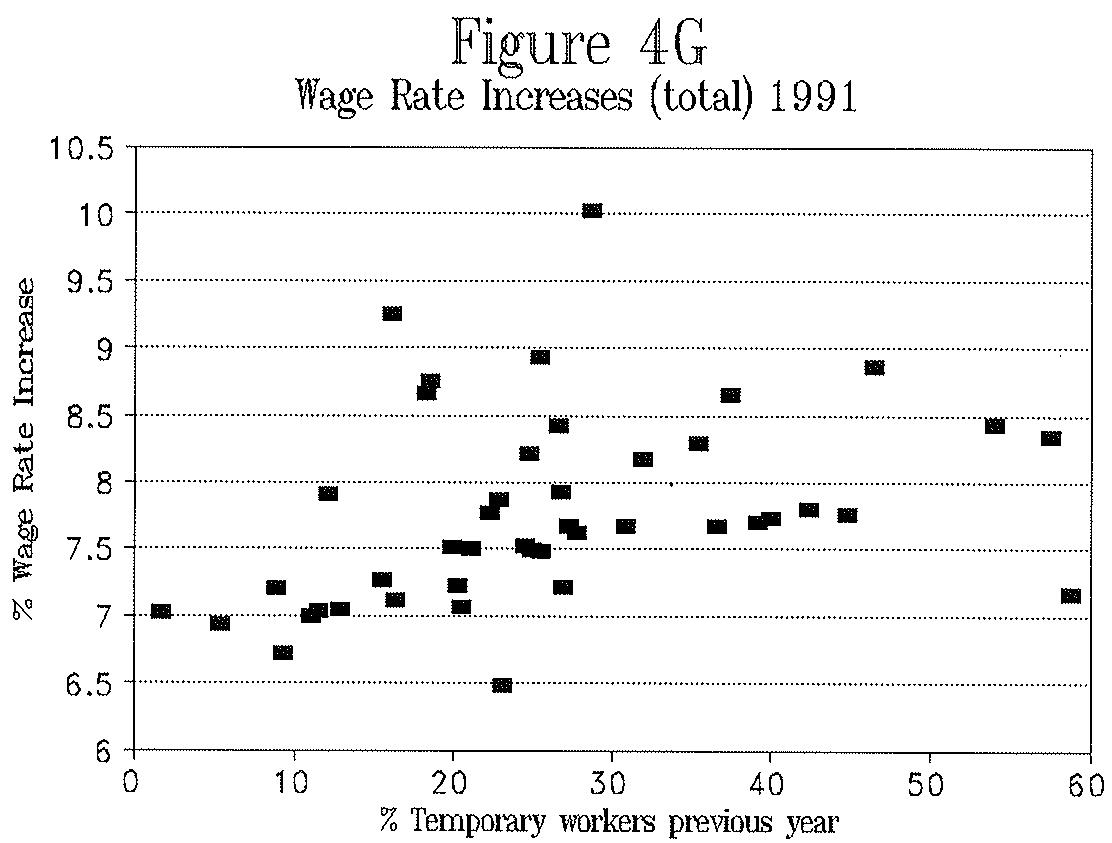
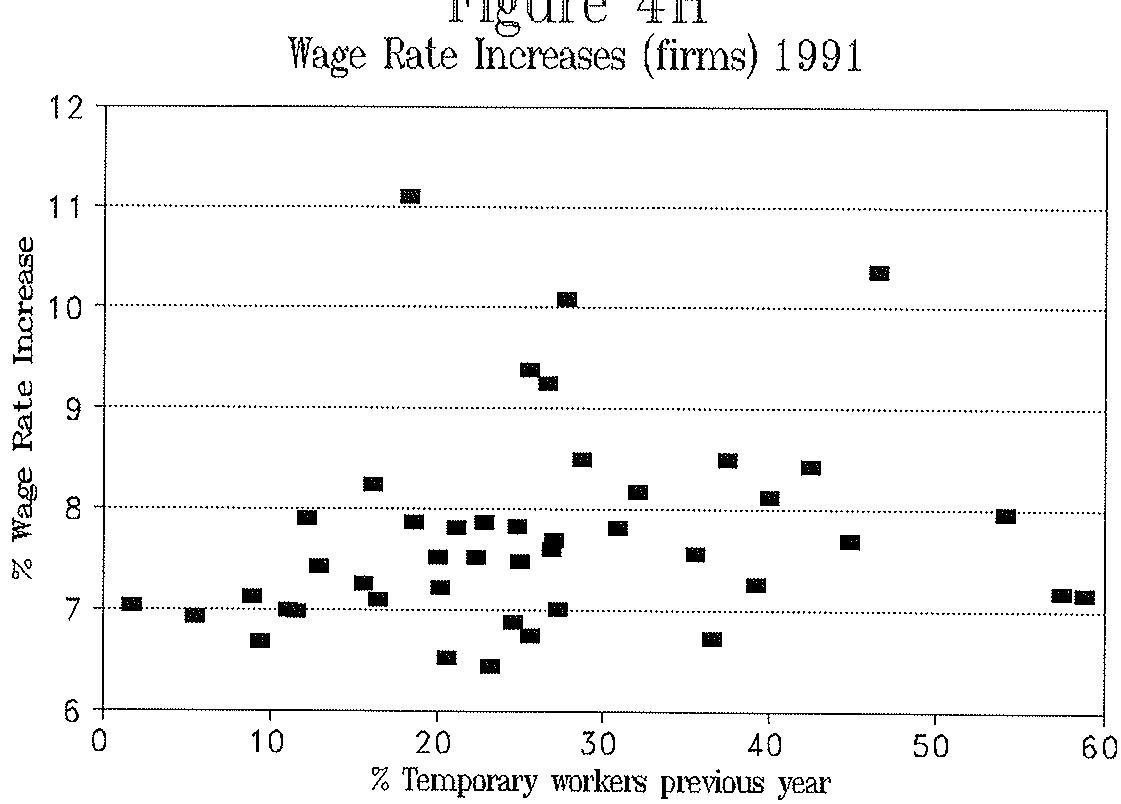
To investigate the existence of a positive relation between wage rates and distribution of employment by type of contracts, we construct another sample of 44 industrial sectors (manufacturing and non-manufacturing, at roughly 2 SIC-digits level of disaggregation) combining data from the Labour Survey and from the Ministry of Employment Statistical Office in charge of producing collective bargaining statistics. covering the 1987-91 period. As the model presented in previous section makes clear, these two variables are determined endogenously, so that, to find a positive relation between the percentage of temporary workers to wage rate increases (with causality running from the former to the latter), we focus on the correlations between wage rate increases and the percentage of temporary workers in the previous year. Figures 4A to 4H present the data so-related, distinguishing between total wage rate increases and wage rate increases in firms agreements. Table 2 show the correlations between these variables for each year. As can be seen in that table, there is such a positive relation in all years and type of agreements (maybe, with the exception of 1989). Furthermore, the pooled regression of wage rate increases on the percentage of temporary workers in the previous year yields a positive and significant coefficient, for both all agreements and firms agreements (see tables 3A and 3B). To a first approximation, this coefficient may seem small. However, it implies that an economy having a 30% workers employed under fixed-term contracts (Spain, say) may experience a wage inflation of about .45 points higher than another economy with only 10% of temporary workers, which is not so negligible.
Collective bargaining in Spain takes place at two levels: industry and firms. For more information on the characteristics of Spanish collective bargaining, see Jimeno (1992).
4.3.- Do Fixed-Term Employees Receive Lower Wages?
As already commented, the Spanish law forbids wage rate discrimination by type of contract. However, it has been observed that while wage rate increases have been higher in recent times in Spain in the 1987-91 than previously, the wage drift (the difference between earnings increases and wage rate increases) have been declining. Some authors (Albarracín and Artola (1989)) argued that this can be explained by the increase in fixed-term employment, since this type of workers are in a more "precarious situation". Thus, their earnings will be lower and the increase of fixed-term employment would reduce labour costs.
To investigate this possibility, we analyse a sample of 1209 wage-earners covered by an experimental survey done by the Spanish Statistical Office (see Instituto Nacional de Estadistica, INE (1991)) which, with the same structure as the Labour Force Survey, also contains information on earnings (the reference period of the survey is the second quarter of 1990). There are 358 fixed-term employees in this sample. Table 4 presents the results of regressing the (natural logarithm of) wage per hour worked on some personal and job characteristics and the nature of the employment relationship (permanent or fixed-term). This regression shows that, on average, fixed-term employees earn about 11% less per hour worked than permanent employees of the same characteristics. This result, however, does not necessarily imply wage discrimination against fixed-term employees, as unobserved ability (and unobserved effort) might be correlated with contractual status and be the cause of such correlation between earnings and this later variable. In any case, this result shows that Spanish employers have found the way of linking fixed-term employment with lower wages so that the increase in the use of fixed-term employment contracts could have reduced aggregate labour costs.
Bentolila and Dolado (1992), using a panel of Spanish large firms from 1984 to 1989, cannot reject the hypothesis that permanent workers do not care about temporary workers when setting their employment targets (what they interpret as a buffer effect) and that a increase in the percentage of temporary workers raises the growth rate of permanent workers' wages.
See Bentolila and Dolado (1992).
5.- Concluding Remarks
After 1988, fixed-term labour contracts are widely used in Spain. In fact, given that about 30% of all wage-earners are employed under fixed-term employment contracts, it can be said that a two-tier employment relation system is in effect. We have argued that there might be substantial wage and productivity effects involved in the widespread use of fixed-term contracts. In particular, adverse selection and moral hazard problems, usually present in employment relations, are not necessarily improved by allowing employers hire workers under fixed-term contracts. Hence, there might be negative efficiency effects of fixed-term employment. There might also be cooperation effects which lead to higher wage rates (with the corresponding reduction in aggregate employment). However, the effects of fixed-term employment on aggregate wages are likely to have been negative since higher wage rates are compensated by the fact that fixed-term employees earn about 11% less than permanent employees of similar characteristics. Although our empirical analysis is somehow sketchy (because of the limitations imposed by the available data), it shows that are solid grounds to believe that these effects of fixed-term employment must be considered when proposing flexibilization of the labour market based on the promotion of such kind of employment arrangements.
Dependent variable: Change in Labour Productivity (1987-88)
| (1) | (2) | |||
| N = 31 | N = 31 | |||
| $R^2$ - adjusted | 0.190 | 0.183 | ||
| Constant | 0.056 | (0.022) | 0.0516 | (.023) |
| Δ Percentage Temporary Workers | -0.930 | (0.358) | -0.833 | (.370) |
| Δ AGE-INDEX | 0.009 | (0.006) | 0.006 | (.007) |
| Δ LEVEL OF STUDY-INDEX | -0.012 | (0.006) | -0.011 | (.006) |
| Δ SKILL-INDEX | -0.009 | (0.006) | -0.008 | (0.007) |
| Δ SENIORITY-INDEX | 0.002 | (0.003) | 0.002 | (0.007) |
(Heteroskedascity-robust standard errors in brackets)
TABLE 2
| Wage Rate Increase | Correlation | Rank-Correlation | |
| (with % workers previous year) | |||
| 1988 | Total | .837 | .156 |
| Firm Agreements | .845 | .098 | |
| 1989 | Total | .869 | .008 |
| Firm Agreements | .853 | .001 | |
| 1990 | Total | .902 | .238 |
| Firm Agreements | .914 | .471 | |
| 1991 | Total | .904 | .237 |
| Firm Agreements | 898 | .123 | |
TABLE 3A
| Dependet Variable: Wage Rate Increase (Total)Sample Period: 1988-1991Number of observationg: 176 | ||
| Coefficient | Standard-error(*) | |
| CONSTANT | 7.226 | 0.158 |
| D88 | -1.394 | 0.160 |
| D89 | -0.156 | 0.147 |
| D90 | 0.120 | 0.142 |
| % Temporary workers previous year | 0.021 | 0.005 |
| R2 Adjusted | 0.538 | |
(*) Heteroskedasticity-Robust Note: D88, D89 and D90 are year dummies.
TABLE 3B
| Dependet Variable: Wage Rate Increase (Firm Agreements) | ||
| Sample Period: 1988-1991 | ||
| Number of observationg: 174 | ||
| Coefficient | Standard-error(*) | |
| CONSTANT | 7.177 | 0.236 |
| D88 | -1.508 | 0.008 |
| D89 | -0.310 | 0.185 |
| D90 | 0.179 | 0.169 |
| % Temporary workers previous year | 0.022 | 0.008 |
| R2 Adjusted | 0.490 | |
(*) Heteroskedasticity-Robust Note: D88, D89 and D90 are year dummies.
TABLE 4
| Dependet Variable: Natural log of earmings per hour usually workerdNumber of observations: 1209 $R^2$ -Adjusted: 0.293 | ||
| Coefficient | Standard-error(*) | |
| CONSTANT | 7.639 | 0.269 |
| FEMALE | -0.200 | 0.045 |
| SENIORITY 1-3 years | 0.027 | 0.068 |
| SENIORITY 3-10 years | 0.126 | 0.070 |
| SENIORITY over 10 years | 0.204 | 0.068 |
| TEMPORARY CONTRACT | -0.108 | 0.059 |
Note: This regression also includes dummies by ages, occupation, levels of study, activity of the firm, institutional sector (public or private), and regions.
Figure 1. The evolution of employment, labour force and unemployment in Spain, 1970-90.
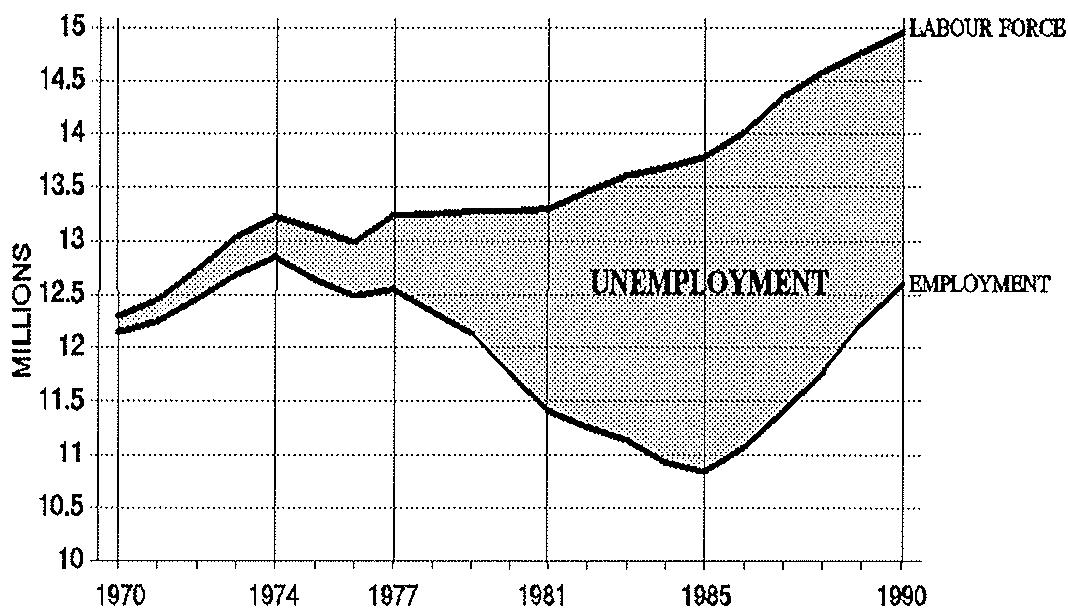
Source: Labour Force Survey, several years.
Figure 2. Percentage of employees with a fixed-term contract, Spain 1987-91 Source: Labour Force Survey
Change in % temporary workers, 1987-88
Figure 3
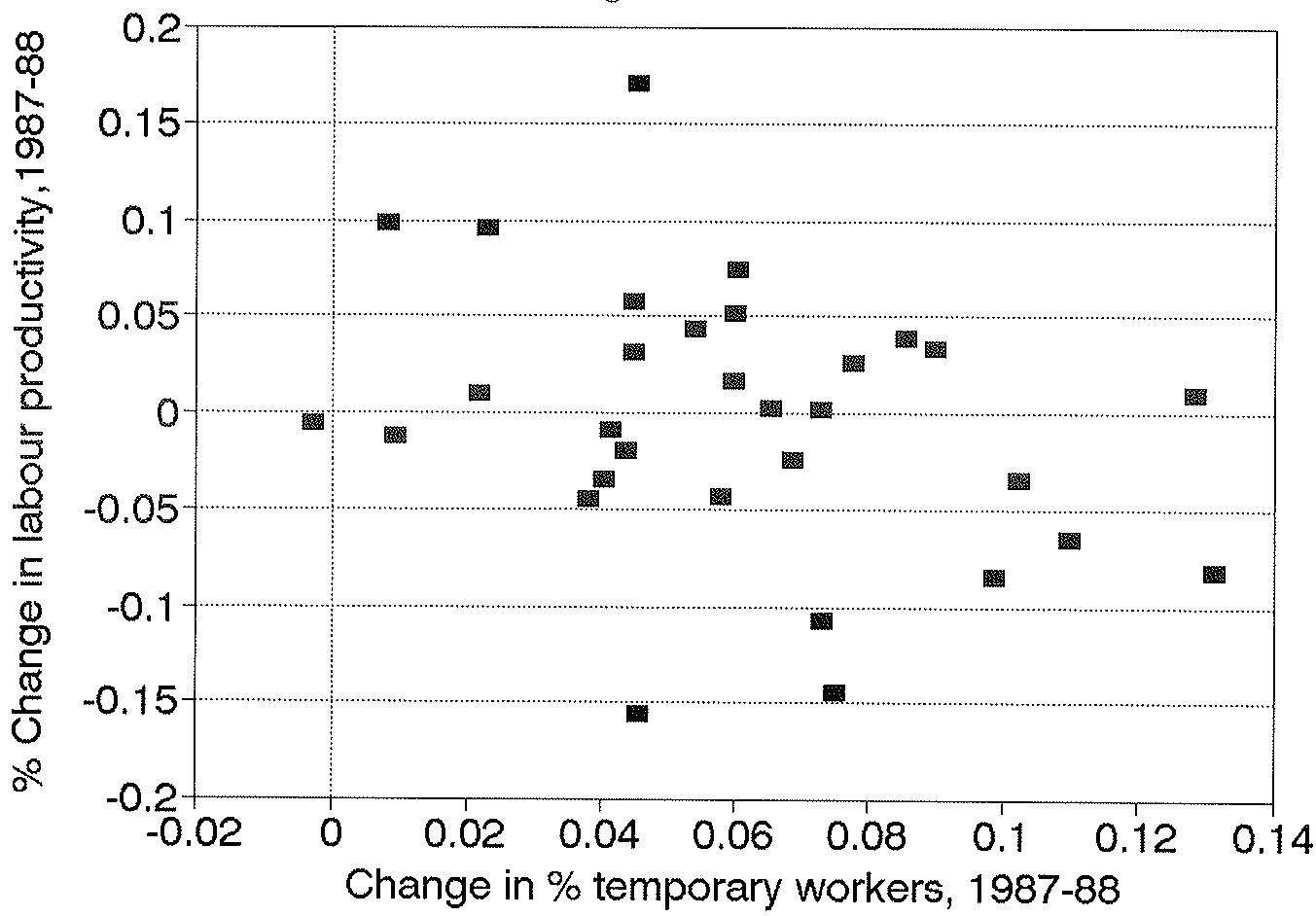
Figure 4A Wage Rate Increases (total) 1988
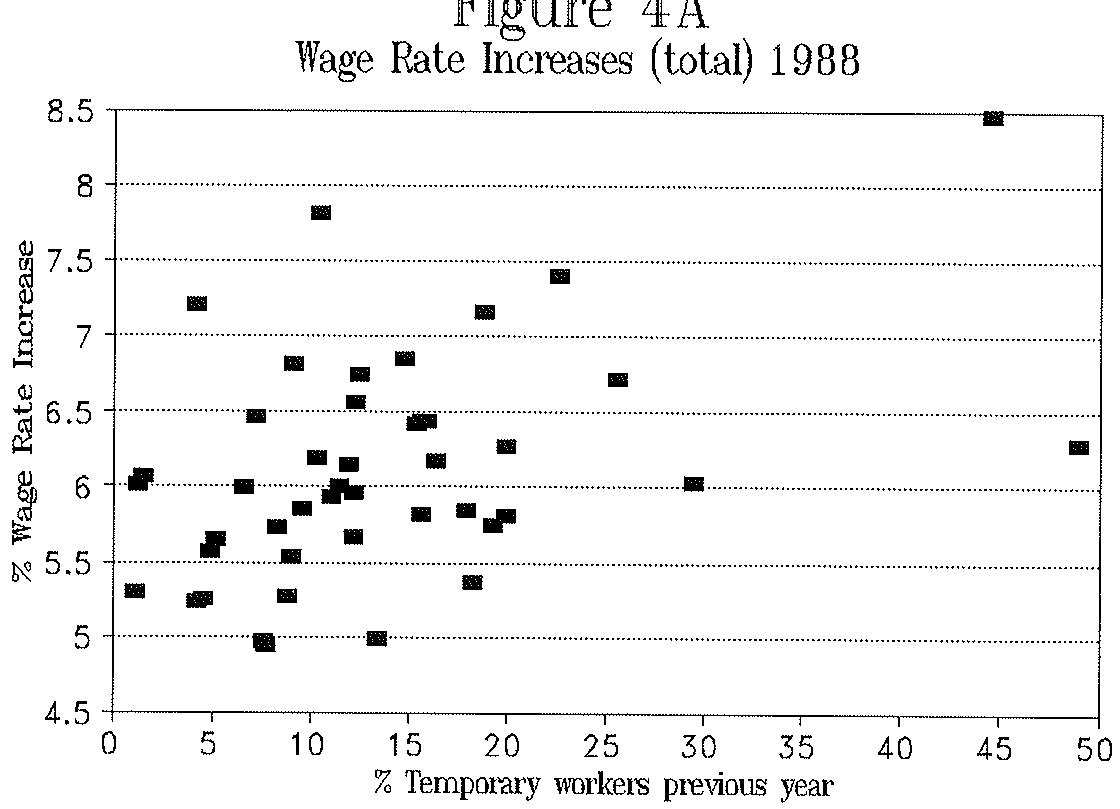
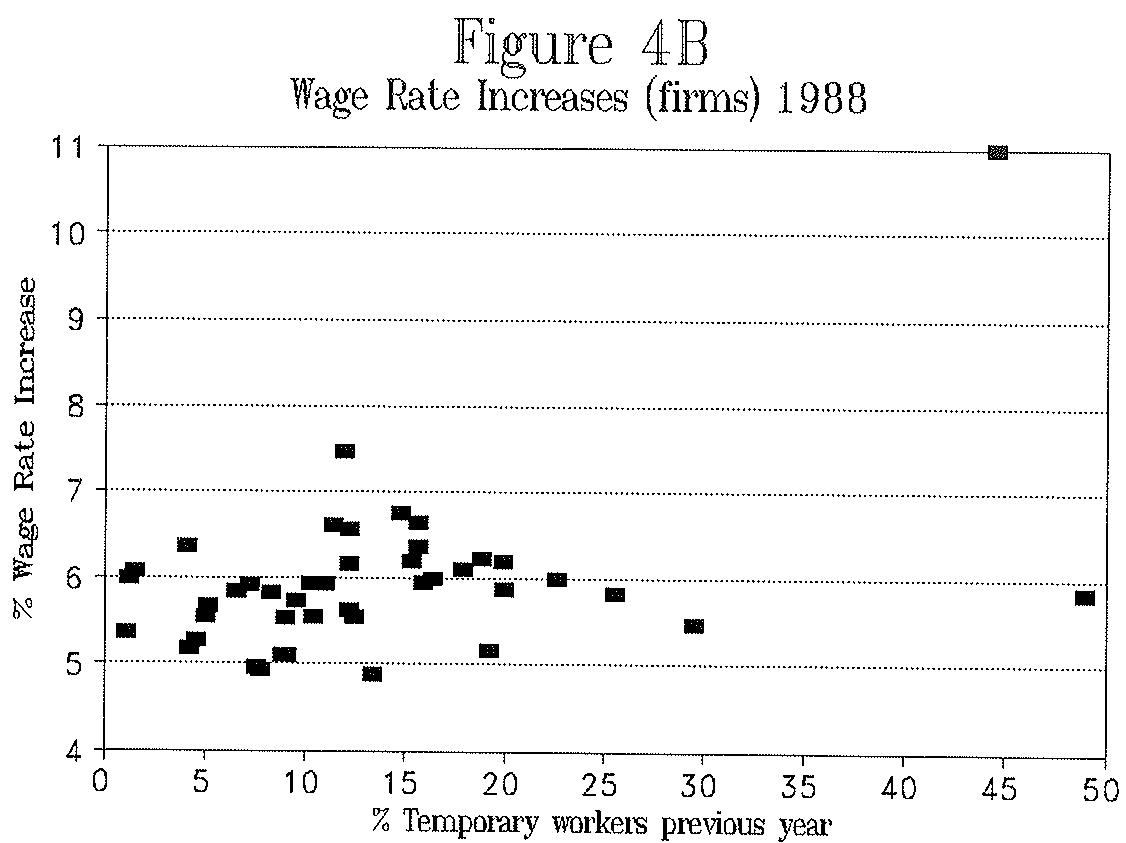
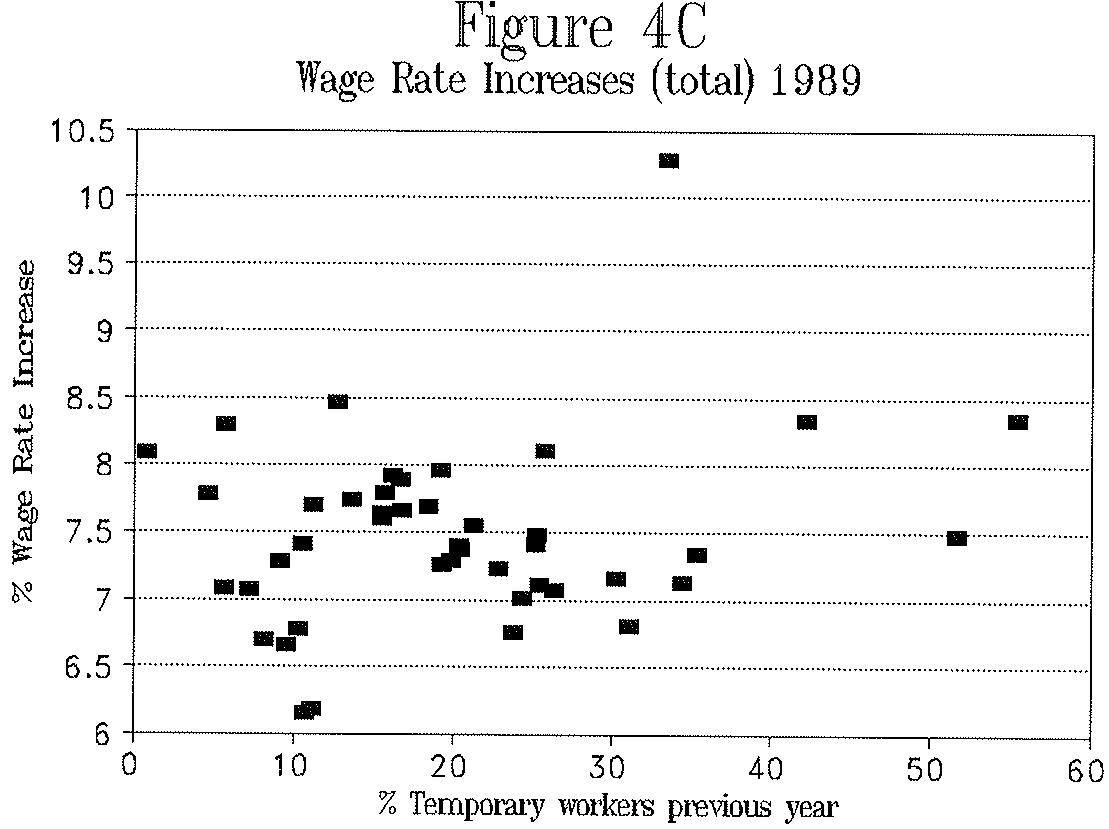
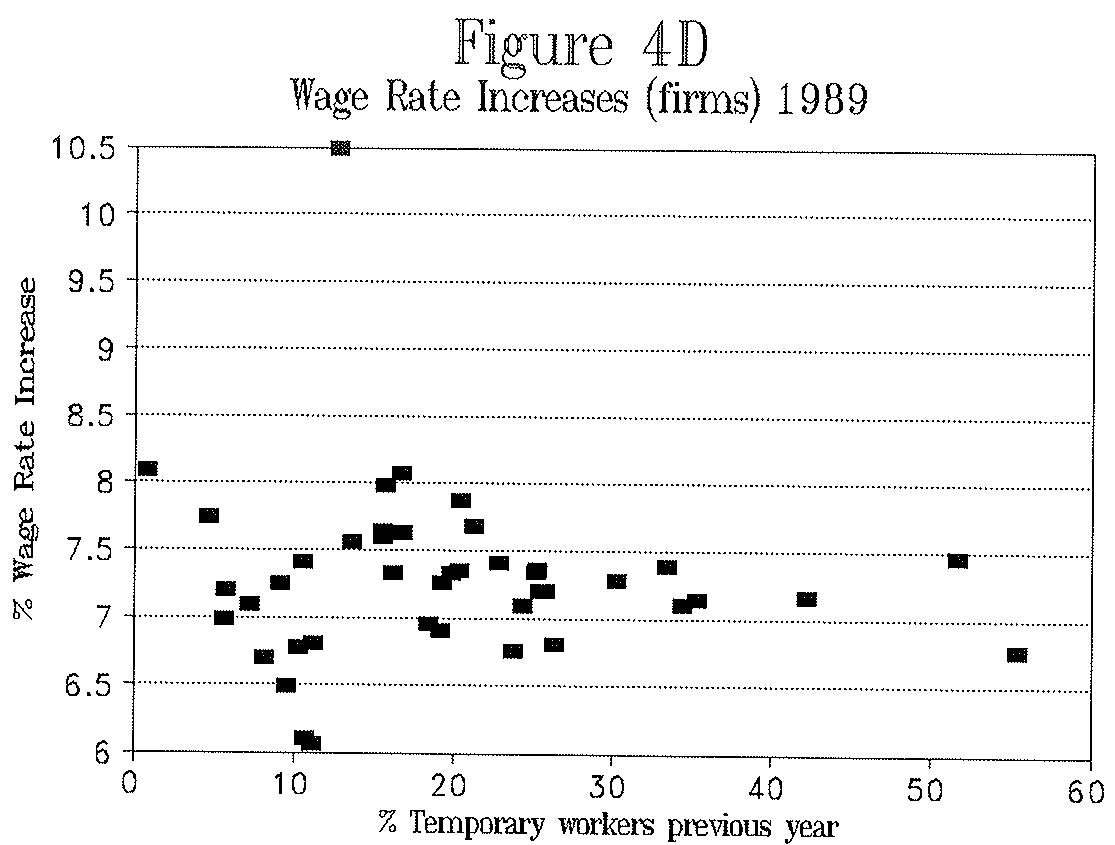
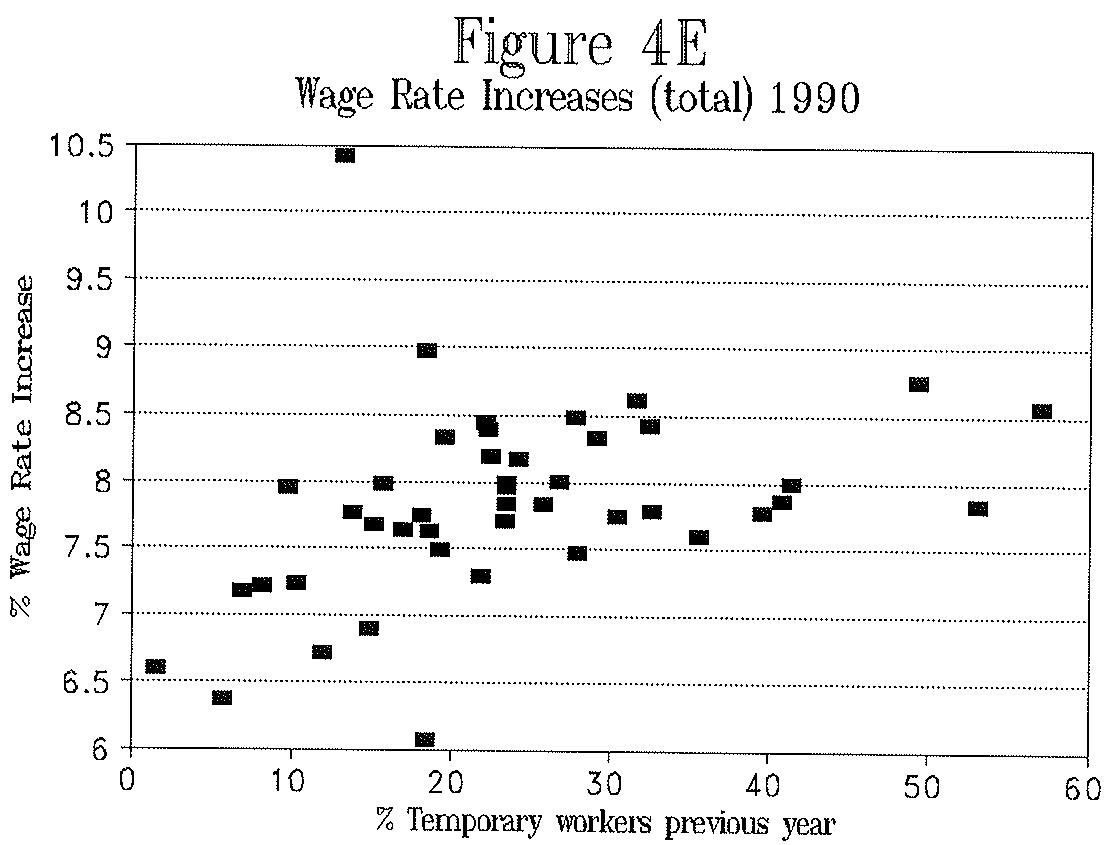
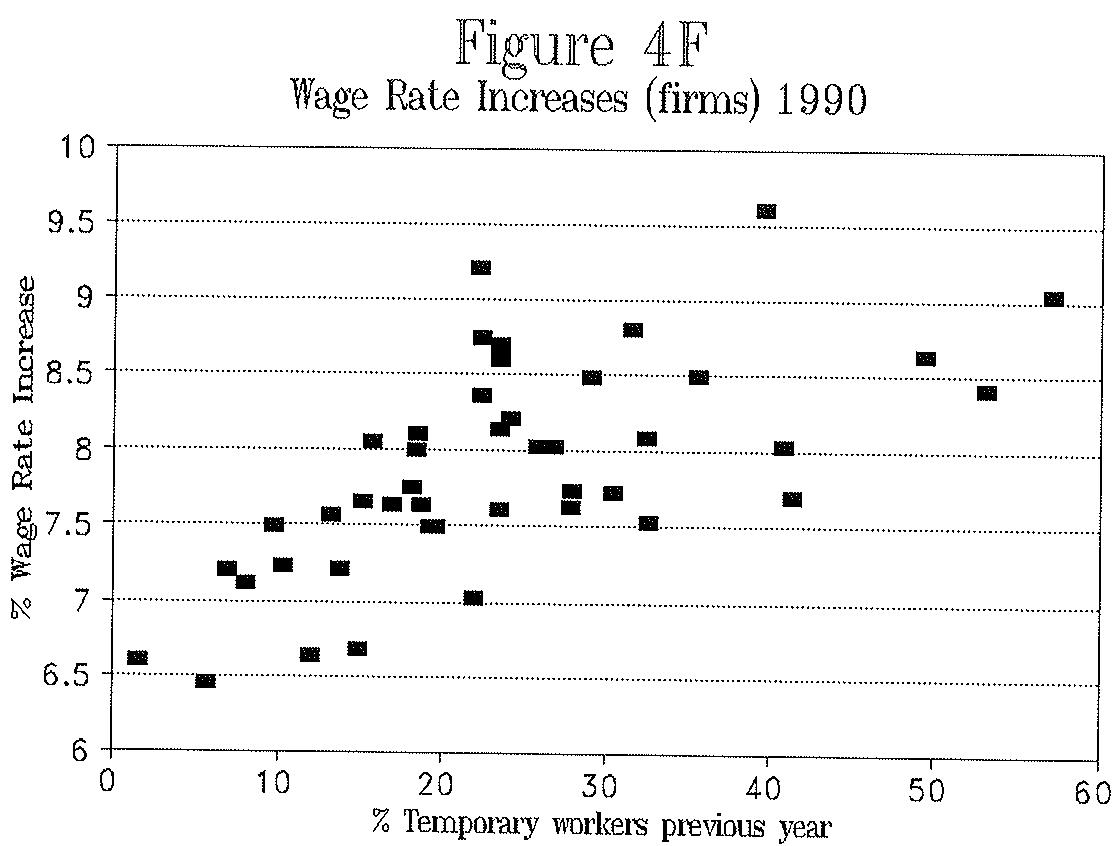
Figure 4H Wage Rate Increases (firms) 1991
REFERENCES
- Albarracín J. and C. Artola (1989): 'El impacto sobre los salarios del cambio ocupacional', Revista de Economía y Sociología del Trabajo, no. 6, 39-59.
- Amemiya, T. (1985), Advanced Econometrics, Harvard University Press: Cambridge.
- Bentolila, S. and G. Bertola (1990): 'Firing Costs and Labour Demand in Europe: How Bad is Eurosclerosis?', Review of Economic Studies, 57, 381-402.
- Bentolila S. and J.J. Dolado (1992): 'Who are the insiders?. Wage Setting in Spanish Manufacturing Firms', Bank of Spain, mimeo.
- Bentolila, S. and G. Saint-Paul (1992a): 'A Model of Labour Demand with Linear Adjustment Costs', CEMFI working paper no. 9210.
- Bentolila S. and G. Saint-Paul (1992b): 'The Macroeconomic Impact of Flexible Labour Contracts', European Economic Review, 36, 1013-47.
- Blanchard, O.J. and L. Summers (1988): 'Beyond the Natural Rate Hypothesis', American Economic Review, May.
- Instituto Nacional de Estadística, INE, (1991), Encuesta Piloto Sobre Ganancias y Subempleo, Madrid.
- Huber, P.J. (1973): 'Robust Regression: Asymptotics, Conjectures and Monte Carlo', The Annals of Statistics, vol. 1, no. 5, 799-821.
- Jimeno, J.F. (1992): 'Las Implicaciones Macroeconómicas de la Negociación Colectiva: El Caso Español', Móneda y Crédito, 195.
- Jimeno, J.F. and L. Toharia (1992a), Unemployment and Labour Market Flexibility: Spain, International Labor Office, forthcoming.
- Jimeno, J.F. and L. Toharia (1992b), 'The Productivity Effects of Fixed-Term Employment Contracts: Are Temporary Workers Less Productive than Permanent Workers?', Universidad de Alcalá de Henares, mimeo.
- Lindbeck, A. and D.J. Snower (1988a), The Insider-Outsider Theory, M.I.T. Press: Cambridge.
- Lindbeck, A. and D.J. Snower (1988b): 'Job Security, Work Incentives and Unemployment', Scandinavian Journal of Economics.
- Parsons, D.O. (1986): 'The Employment Relationship: Job Attachment, Work Effort and the Nature of Contracts', in O.C. Ashenfelter and R. Layard, eds., Handbook of Labour Economics, North-Holland: Amsterdam.
- Saint-Paul, G. (1990): 'The High Unemployment Trap', M.I.T., mimeo.
- Segura, J., F. Durán, L. Toharia y S. Bentolila (1991), Análisis de la contratación temporal en España, Ministerio de Trabajo y Seguridad Social: Madrid.
Este texto se ha extraído automáticamente del documento original. Para citarlo o leerlo con su maquetación, descargue el PDF.
Descargar en PDF