THE MANAGEMENT OF REDUNDANCIES IN SPAIN: ECONOMIC REPORT* by Juan F. JIMENO** and Luis TOHARIA*** DOCUMENTO DE TRABAJO 94-04
Mayo 1994
* Paper prepared for the International Forum on Income Protection Systems in the case of Unemployment and the Management of Redundancies in Europe, organised by the C.N.E.L., Rome, 3-4 December 1993.
** Universidad de Alcalá de Henares and FEDEA.
*** Universidad de Alcalá de Henares
ABSTRACT
We briefly review the Spanish legislation on firing restrictions and its relationship with income protection. We also focus on Spanish public policy instruments and analyze the revealed objectives of such public policy by looking at the resources devoted to them. As an overall conclusion, we pose the view that this legislation is not efficient in the sense that it does not provide a higher degree of achievement of the objectives while it introduces significant distortions in the functioning of the Spanish labour market.
JEL Codes: J53, J58, J59.
A. ECONOMIC SYSTEM. LABOUR MARKET AND REDUNDANCIES
A.1. Redundancies in Spain.
In Spain, a firm faced with a problem of adjustment of its workforce because of economic problems (i.e. needing to make some of its workers "redundant") has several possibilities:
i) it can simply let the contract of some of its fixed-term workers expire without renewal. In this case, it has to make an advance notice of one month and, in some cases , pay a severance payment of 12 days' wages per year of seniority. Given that the proportion of employees under fixed-term contracts is close to 40% in the private sector of the economy (32% for the economy as a whole), the adjustment via non-renewal of contracts is very important. However, firms may prefer to dismiss permanent workers, even if at a higher cost, because the former are younger and more promising, or because they can maintain production with a high turnover of fixed-term workers or simply because the adjustment by non-renewal may be insufficient.
ii) it can dismiss some of its permanent workers by simply giving each of them a letter explaining the causes of the dismissal and paying them a severance payment of 20 days' wages per year of seniority. The worker may accept the situation or sue the employer for "unfair dismissal", the latter being true in almost all the cases. When this happens, the two parties have to go through specific arbitration procedures to see if they can reach an agreement. Special administrative units of the Ministry of Labour (the so-called Unidades de Mediación, Arbitraje y Conciliación, hereafter referred to as "MAC units") exist to that effect. The "conciliatory act" may end up in one of the following three situations:
. There is a large variety of fixed-term contracts in Spain. The most interesting one for our purposes here is the so-called "employment promotion fixed-term contract" (contrato temporal de fomento del empleo), which enables a firm to hire a fixed-term worker to undertake its normal activities. This contract, which carries a severance payment of 12 days' wages per year of seniority) has been the most widely used contract. In 1991, for example, 1.1 million of such contracts were signed, representing 20% of all contracts registered by the Spanish National Employment Institute (INEM). The number and the proportion have fallen substantially in 1992 and 1993 as the result of both the recession and the tightening of eligibility conditions introduced in April 1992 for this contract -minimum length extended from six months to one year.
- an agreement is reached, stating some further severance payment. This implies that the employer accepts that the dismissal was unfair. According to the Unemployment insurance law (1984), the worker will have right to unemployment benefits if the minimum severance agreed is 35 days'wages . This has been happening in some 70% of the suits presented to the MAC units,
- an agreement is not reached, either because the employer does not show up at the conciliatory session (which happens in 15% of the times) or because no agreement in actually reached (this is so in 10% of the times). The case is then sent to the courts, whose decision may be one of the following:
* an agreement is reached there at a new conciliatory trial.
* the dismissal is declared unfair, in which case severance is set at a rate of 45 days' wages per year of seniority and the worker has the right to perceive the so-called "intervening wages" (i.e. wages corresponding to the time spent between the initial suit and the court decision). It these exceed 60 days' wages, the employer may claim the excess a refund from the state for the excess paid. Needless to say, the worker then goes to unemployment insurance. In addition, if the firm is unable to meet the payment because of financial bankruptcy, the state will pay them (with certain limits) through the so-called "Wage Guarantee Fund" (FOGASA).
* the dismissal is declared fair, in which case the worker has no further right to severance pay or intervening wages but can still go to unemployment benefit, after a waiting period of 3 months.
. The rationale for this condition is to avoid voluntary quits to be hidden as dismissals.
. In practice, the required severance has been interpreted as "35 days-wages per year of seniority". Needless to say, if this were true, it would create an absurd distortion in the system, as dismissed workers who do not sue the employer have the right to unemployment benefits while those who do not agree with the dismissal and are able, in the conciliatory session, to increase severance to 30 days' wages per year (a 50% improvement) would not have the right to the benefits.
. With a maximum of 42 months' wages.
- the sueing worker does not show up at the conciliatory session, this being so in some 5% of the cases, in which case the suit is cancelled.
It should be stressed that, although this way for dismissal is to be applied only in the case of disciplinary and "objective grounds" (which include workforce reduction only in the case of firms with less than 50 employees), the fact that so many dismissals are in fact accepted as unfair (either because an agreement in reached in the MAC units or because the judges declare them so) mean that they are being in fact used as a means to make workers redundant.
iii) finally, the employer may decide to initiate a so-called "Employment regulation procedure" (Expediente de Regulación de Empleo, hereafter ERE). There are three types of ERE: for dismissals, for temporary lay-offs and for temporary short-time working time (although one procedure may combine the different types). Legally, this should be the procedure used for any redundancy (no matter how many workers are affected) in firms with 50 employees or more, as the reason has been to be "economic or technological". The practice, however, has been that this procedure has been used for collective dismissals, especially in large firms. The procedure is as follows: to initiate an ERE, the employer has to open a 30-day-period of consultation with workers' representatives, in order to reach an agreement with them. At the end of this period, the following possibilities exist:
- an agreement in reached. In this case, it is so notified to the labour authority , which normally certifies it. The workers dismissed, laid-off or under part-time employment receive unemployment benefits. This is the most frequent case: some 75% of the total number of ERE are agreed and then accepted,
. This may be the provincial delegation of the Ministry of Labour or the regional authorities or the central Ministry itself, depending on the nature of the ERE and whether the region where the firm is established is responsible for handling labour matters.
- an agreement is not reached. In this case, the employer has to provide information on the situation of the firm to the labour authority, who has to decide, before 30 days, whether to accept or reject the ERE. If the ERE is rejected (this being so if no answer is given in the established period), the firm may go to the central Ministry, who has another 15 days to decide the case. At this stage, if no answer is given, the ERE is accepted. If the ERE is rejected, it is sent back to the firm with the recommendation that an agreement should be reached with the workers. The percentage of ERE accepted by the labour authority is approximately 80% of the ERE not agreed, equivalent to 20% of the total number of ERE. In all cases, any dismissal carries a minimum severance of 20 days' wages per year of seniority (with a maximum of 12 months' wages). It should be added that the delays are half as before in the case of firms with less than 50 employees and when the ERE involves less than 5% of the current workforce of the establishment. Also, workers under layoffs or short-time working receive benefits against their total benefits; it could thus happen that a worker, when dismissed, might have already exhausted most of his/her benefits in previous short-time or layoff episodes. Finally, in the case of firms with less than 25 workers, the state pays, through the wage guarantee fund (FOGASA), 40 percent of the legal severance payment .
A.2. Outline of the economic context and labour market institutions since 1980
a) the economic context
The Spanish economy has experienced three major economic periods in the last 20 years or so:
- from the mid-1970s to 1985, where a strong economic crisis followed the two oil crises, compounded in Spain by the undertainties and turmoil generated by the political change brought about by the death of General Franco,
. The ET established that the State would pay 40% of the severance pay agreed. This was corrected in 1984 to become 40% of the legal severance pay, because of the obvious perverse incentives created by the initial system.
- from 1985 and 1990, when the economy boomed, recovering most of the ground lost during the earlier recession,
- from 1990, when a new, stronger recession has set in,
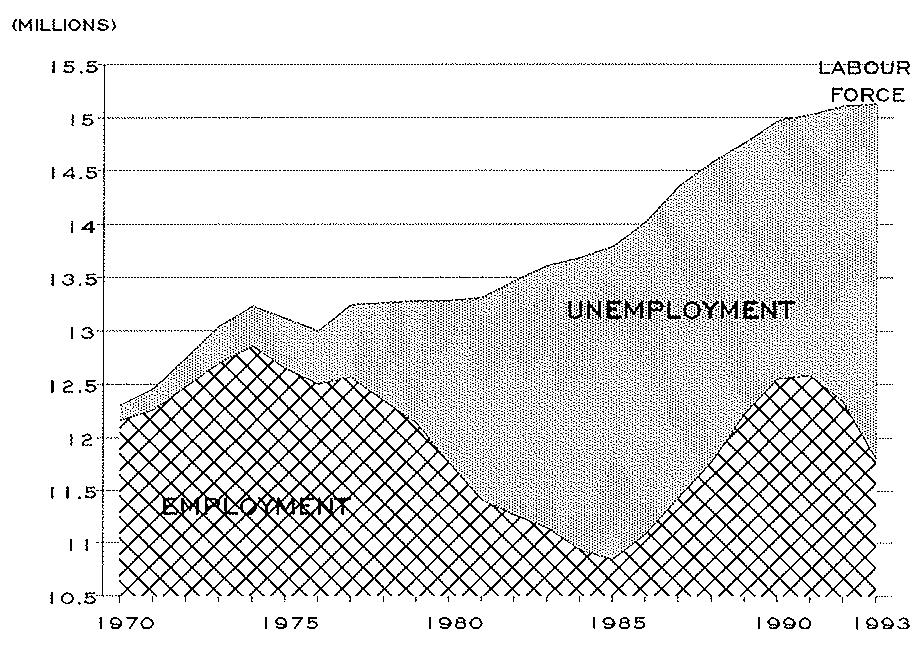
Table 1 summarises the main figures for these three periods in terms of output and employment, and for the economy as a whole and for the manufacturing sector. Figure 1 presents the results of this evolution in terms of employment and unemployment. As can be seen, unemployment reached a maximum in 1985. Later on, despite the strong employment growth, the catching-up of the labour force (most notably the female labour force) prevented unemployment from decreasing but moderately. The recent crisis has brought back again record unemployment levels, despite its discouraging effect on labour market participation.
Table 1.- Yearly average percentage variation of GDP, employment and productivity in Spain, 1975-93. Total economy and manufacturing [Source: Dolado and Bentolila, 1994 and estimates for 1993]
| Period | Value added (GDP) | Employment | Productivity per employee |
| ECONOMY AS A WHOLE | |||
| 1975-85 | 1.7 | -1.7 | 3.5 |
| 1985-90 | 4.5 | 3.2 | 1.2 |
| 1990-93 | 0.7 | -2.2 | 2.9 |
| MANUFACTURING | |||
| 1975-85 | 0.7 | -2.5 | 3.3 |
| 1985-90 | 3.9 | 2.7 | 1.1 |
| 1990-93 | -1.8 | -5.1 | 3.5 |
Figure 1. The evolution of labour force, employment and unemployment in Spain, 1970-1993 (Source: Labour Force Survey).
b) Labour market institutions
In terms of labour market institutions, with a special view on the regulations of redundancies, the following points are worth being mentioned as basic developments:
- at the end of 1979, arbitration procedures previous to court trials were established for dismissals, in order to ease the enormous amounts of cases blocking the courts. To that effect, the IMAC (Instituto de Mediación, Arbitraje y Conciliación) was created as an autonomous agency dependent on the Ministry of Labour. This agency was later one eliminated, becoming a service of the Ministry (the "MAC units" mentioned in section A.1),
- in 1980, the Workers' Charter (Estatuto de los Trabajadores, hereafter ET) was approved by Parliament. This created the basic structure for the operation of the labour market. Regarding dismissals, it created the basic structure described in section A.1.
In 1984, the ET was reformed, facilitating the use of fixed-term contracts, which existed since 1976 but were given a formal and strong impulse at this time.
- in 1980 also, a so-called basic employment law (Ley Básica de Empleo, LBE) was passed, regulating the notion and instruments of employment policy, including unemployment compensation. This second part was given a new treatment in 1984, when a new law of unemployment compensation (Ley de Prestaciones por Desempleo, hereafter LPD) was passed. In general terms, the 1984 law clarified and extended unemployment benefits. This law was amended in March 1989 widening the coverage of the assistance benefits, and again in April 1992 by decree (later to become a law), in the sense of tightening eligibility conditions and reducing benefits to be paid.
c) Quantitative information on redundancies
As already mentioned, in Spain redundancies can take place in various ways. This makes it difficult to get good estimates of their quantitative importance. It is clear that not all job separations can be seen as redundancies, i.e. motivated by economic problems of the firm involved. The problematic situations arise in the case of voluntary quits and in the case of expiry of temporary activities. Regarding the former, it is safe to assume that they represent a small proportion of the declared dismissals; as for the latter, they can only be regarded as redundancies inasmuch as the worker is carrying out activites which the firm considers "normal", i.e. which are not of temporary nature. As already mentioned (recall note 1), this situation is very frequent in Spain.
There are two basic sources from which one can obtain quantitative information on redundancies. The first one is the recollection of the different administrative sources for dismissals. The main problem with this source is that it only provides information on dismissals of permanent employees; its advantage, on the other hand, is that it allows some further disaggregation, mostly by size of the firm. The second one comes from the inflows into the unemployment insurance system, which provide a breakdown of the way through which the separation took place, including the end of a temporary contract. Given that the regulations of unemployment insurance require a minimum length of work to be eligible for benefits, it can be safely assumed that most of the workers entering the unemployment benefit system due to an "end of contract" were under a CTFE, i.e. a fixed-term contract allowing the worker to carry out the normal activities of the firm.
Figure 2 presents the distribution of dismissals of permanent employees since 1980 as well as the evolution of the total number of dismissals. Several features emerge from this figure:
- the total number of dismissals peaked in 1981, declined thereafter and has again risen significantly since 1990, especially in 1993. The figure of 350 thousands is equivalent to of total private sector dependent employment,
1993 [Source: Ministry of Labour, Boletín de estadísticas laborales]. 1993: estimates; 1980-81: proportion of ERE agreed estimated by authors. Figure 2. Number of dismissals and their percentage distribution by the institutional method used, 1980-
![1993 [Source: Ministry of Labour, Boletín de estadísticas laborales]. 1993: estimates; 1980-81: proportion of ERE agreed estimated by authors. Figure 2. Number of dismissals and their percentage distribution by the institutional method used, 1980-](/text/dt-1994-04/images/b8aec04fca7b20e9ab63c5aaeb4c20409be38878b08a4e35e9163fd8ee776a8c.jpg)
- the most important way through which dismissals take place is by far through the MAC units. However, its weight has tended to move counter the total number of dismissals. In particular, in the last few years, the proportion of dismissals going through the MAC units has decreased rapidly, dropping from 70% in 1990 to a bit over 50% in 1993,
- agreements reached in courts have represented a small, more or less constant, share of total dismissals (with the only exception of 1980, due to the fact that the MAC units were created at the end of 1979),
- the collective redundancies process (ERE) has been representing some of total dismissals; its importance has grown considerably in the last two years. In general, a very high proportion of these ERE have been agreed with the workers' representatives. The increased weight of dismissals through ERE in recent years have been reached though agreement. Needless to say, given the procedures described above, firms have strong incentives to reach such an agreement,
- finally, the court decisions plus the ERE not agreed represent the share of non-agreed dismissals. Figure 2 clearly shows that this share has tended to decrease over time. Between 1980 and 1983, it rose from 20 to almost , and it dropped until 1989 (with the only exception of 1988) to level at a figure lower than .
Two further pieces of evidence are needed to complete the picture of redundancies: first, the proportion of ERE rejected by the labour authorities; secondly, the proportion of court decisions favouring workers (i.e. declaring the dismissals "unfair").
Regarding the first issue, there is no information distinguishing the type of ERE involved (i.e. dismissals, layoffs or short-time). On the whole, the cases rejected plus the cases abandoned (by the firms promoting them) have been representing some 5% of the total ERE initiated. The relevant comparison in order to estimate a "rejection rate" is not with the total number of cases, though, but only with those not agreed. The proportion rises in this case to 25%. The presumption, based on information on the average number of workers per ERE (which tends to be higher in the case of temporary layoffs and short-time working, and also in the case of rejected EREs), is that this the rejection rate for dismissals cases might be somewhat lower (between 15 and 20%). An interesting feature of the data is that in 1993 when the number and proportion of agreed ERE have increased substantially, the rejection rate has increased to over 28%.
As for the proportion of court decisions favourable to workers, considering only the cases in which the court gets to dictate a decision, it is very high although consistently decreasing over time: it was around 90% in 1983, and had dropped to about 70% ten years later. Including the cases abandoned, the proportion of cases reaching the courts and ending in an "unfair dismissal" was 78% in 1983 and has decreased to 50% by 1993.
Turning now to some qualitative information on dismissals, we have data on the distribution by firm size of the two main institutional ways for dismissals, namely MAC and ERE. Table 2 presents such information for the most recent dates available. The figures in this table clearly suggest that small firms tend to prefer the use of individual dismissals (let us recall that for firms under 50 employees, economic reasons are included among the "objective grounds" for dismissal): more than 80% of dismissals correspond to firms with less than 50 employees. On the contrary, the collective procedure is more used by larger firms: 60% of workers dismissed through this procedure work in firms with more than 50 employees. It is thus possible to infer that in general the MAC units are mostly used by small firms while the ERE are used by large firms.
Table 2.- Distribution of dismissals carried out through the MAC units and through ERE by firm size, 1991 and 1992
| Number of employees | E.R.E. | M.A.C. | ||
| 1991 | 1992 | 1991 | 1992 | |
| 1-25 | 30.0 | 32.5 | 68.1 | 68.1 |
| 26-50 | 10.1 | 10.7 | 13.0 | 13.8 |
| 51-100 | 13.1 | 10.9 | 6.5 | 6.3 |
| 101-500 | 22.5 | 21.5 | 7.9 | 8.3 |
| 501-1000 | 7.3 | 5.3 | 2.1 | 1.8 |
| 1001-5000 | 6.7 | 9.5 | 1.8 | 1.4 |
| >5000 | 10.3 | 9.6 | 0.6 | 0.4 |
| TOTAL | 100.0 | 100.0 | 100.0 | 100.0 |
Source: Ministry of Labour, Anuario de Estadísticas Laborales, 1992.
So far we have analyzed the relative importance of the different ways for dismissing workers. However, as already mentioned, it is likely that many firms adjust their workforce as needed by simply letting their fixed-term workers expire their contracts. In order to compare the relative importance of the different ways of adjustment, including end of contract, Table 3 presents the estimated distribution of entries into the unemployment insurance system by reason of separation from the firm. Assuming that all end of contracts correspond to "employment promotion temporary contracts", an assumption which appears to be rather realistic, the figures in the table provide a quite good approximation of the relative weight of the different ways of making workers redundant.
As can be seen in the table, end of contract has been an increasing reason for entering the unemployment insurance system. Part of these entries correspond to workers who might be recalled by the same firm later on, but this is only a presumption based on casual observation, as there is no hard evidence of the magnitude of this phenomenon.
One interesting feature in the table is the increased weight of entries through MAC and ERE in 1992. This may be due to two reasons: first, the tightening of eligibility conditions to receive unemployment benefits introduced in April 1992, when a requirement of 1 year of contribution ; and secondly, the strongest need experienced by firms to replace permanent workers in the face of economic restructuring . At any rate, the first of these two factors is probably stronger, although once again no hard evidence exists.
One final point regarding redundancies is that the extent of fixed-term workers is not equally distributed across firms of different sizes. The different surveys available suggest that small firms tend to have a much higher proportion of fixed-term workers (as much as 50% for firms under 25 employees) than their larger counterparts (20% in the case of firms with more than 250 employees). Hence, while all firms have a substantial amount of temporary workers through which to adjust their workforce, this possibility appears to be even more relevant in the case of the smaller firms.
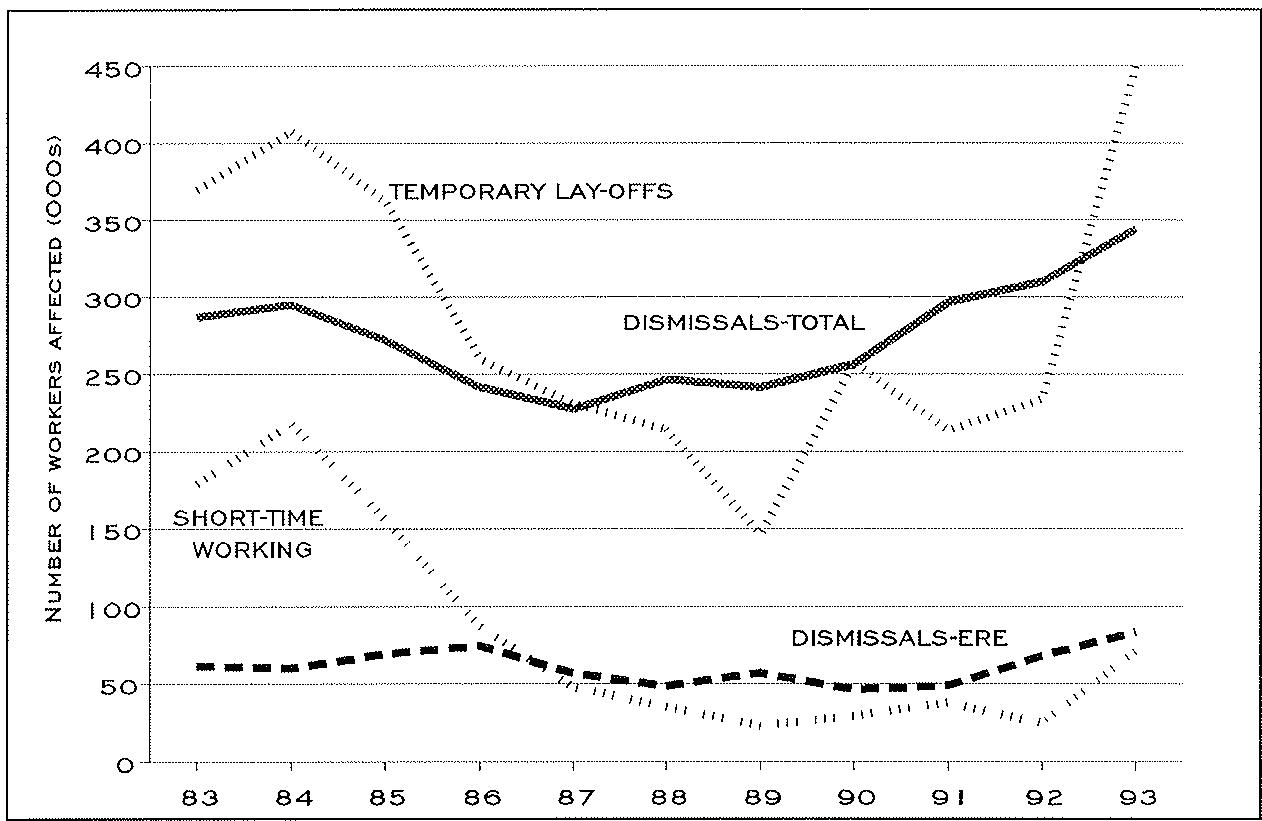
As a final point, we provide some information on the number of workers affected by temporary lay-offs and short-time working measures over the last few years. Figure 3 presents the evolution since 1983 (the first date for which information is available). The number of workers affected by temporary lay-offs appears to have a more cyclical evolution than the total number of dismissals, the total number involved being similar. This suggests that this is a rather important way through which may adjust their economic activity.
7. Paralelling the already mentioned increased minimum length of employment promotion contracts from six months to one year.
. Composition effects may be at work here, as firms adjusting their workforce through MAC or ERE might have a small number of fixed-term workers, if at all.
Table 3. Estimated distribution of entries into the unemployment insurance system, by reason of separation from firm, Spain, 1984-92. Note: (a) "other" includes retirement or death of the employer; voluntary quits in special cases; end of administrative relation; dismissal during the probatory period; and disciplinary dismissals. Source: sample of unemployment benefit recipients provided by INEM.
| End of contract | MAC units | Labour courts | Objective grounds | E.R.E. | Other(a) | TOTAL | |
| 1984 | 61.3 | 20.1 | 8.9 | 0.3 | 8.2 | 1.3 | 100 |
| 1985 | 60.6 | 22.0 | 6.8 | 0.3 | 9.1 | 1.1 | 100 |
| 1986 | 76.9 | 14.2 | 3.4 | 0.3 | 4.4 | 0.8 | 100 |
| 1987 | 81.6 | 11.6 | 2.2 | 0.3 | 3.5 | 0.8 | 100 |
| 1988 | 82.8 | 10.9 | 2.1 | 0.3 | 3.0 | 0.9 | 100 |
| 1989 | 83.7 | 11.1 | 1.5 | 0.3 | 2.5 | 0.9 | 100 |
| 1990 | 85.0 | 10.7 | 1.1 | 0.3 | 2.0 | 0.8 | 100 |
| 1991 | 83.7 | 11.1 | 1.3 | 0.3 | 2.9 | 0.8 | 100 |
| 1992 | 78.2 | 13.3 | 1.7 | 0.4 | 5.7 | 0.8 | 100 |
Figure 3. Number of workers affected by temporary layoffs and short-time working, 1983-1993 (1993: estimation based on mid-year data)
A.3. Philosophy of intervention
In the preceding sections, we have sketched the situation existing in Spain regarding redundancies. It clearly appears that a three-tiered organisation has developed through the 1980s, with the main impulse coming from the 1984 reforms. To each of these tiers is associated a different government intervention:
- "non-intervention" in the case of fixed-term workers,
- judiciary intervention in the case of "objective" dismissals. This in principle excludes economic reasons except in the case of firms smaller than 50, although in practice probably any reason may be used since most dismissals are in the end either declared unfair by the courts or accepted as such in the agreement reached in the MAC units,
- administrative intervention in the case of "economic and technological" (usually collective) dismissals.
The main thrust of intervention in the last two cases has been to favour consensus for dismissals of permanent employees. If it is agreed between employer and worker, the public authorities will deem it correct (in general). As we have seen, 85% of dismissals (not counting end of contract of fixed-term workers) have been agreed. This implies the existence of a substantial machinery to make these agreements possible. These procedures may be considered efficient from the point of view of reducing worker resistance and alleviating possible tensions and conflicts which might arise in their absence. Their effect from the viewpoint of the costs to firms of dismissing workers is much less clear.
The situation can be seen as a bargaining game in which the relative power of the two parties to the game depends, in the last instance, of the behaviour of the courts (in the case of MAC) and of the labour authorities (in the case of ERE). In the case of individual dismissals, if workers and firms perceive that the judges will tend to favour more or less systematically, say, the worker, they may prefer to reach an agreement and save costly time and also save on the expenses involved in any judiciary process. Only firms lacking enough cash flow may have to resort to the courts to solve their difficulties. If this is so, the determining factor of severance pay actually agreed is the rate of 45 days' wages per year of seniority which the law indicates in the case of unfair dismissal.
B. ECONOMIC PROBLEMS. OBJECTIVES AND INTERVENTION TOOLS
B.1. Most important intervention tools
a) Unemployment benefits
In Spain, the regulation of redundancies and unemployment benefits are mostly considered two independent tools. The unemployment compensation system is based on a mixture of the insurance and the assistance principles, although it is in all cases linked to a previous work experience. Thus, any worker who has contributed during the legally established minimum period is entitled to a clearly determined amount of benefit, no matter his financial situation and, more important for our purposes here, no matter how s/he got unemployed.
Despite the general rule just described, there are a few instances in which the way in which the workers enters unemployment affect his/her right to unemployment benefit:
- voluntary quits are excluded from benefits,
- if the worker is dismissed and does not sue the employer, with the exception of dismissals "on objective grounds". This apparently tries to exclude hidden voluntary quits,
- when the dismissal is agreed in the MAC units, the law requires that a minimum of 35 days-wages should be agreed for the worker to be entitled to unemployment benefit. The law does not specify that this amount ought to be per year of seniority, although there seems to be a belief that this is so . Once again, this appears to be justified in order to exclude hidden voluntary quits. This creates a contradictory situation in the case of dismissals "on objective grounds". The spirit of the law was probably that these workers would not sue the employer. The practice, however, as seen in part A of this report, is that almost all workers dismissed sue their employer,
- if the dismissal is declared fair by the courts, as already mentioned, the workers is subject to a waiting period of three months before the worker is entitled
. This is, for example, clearly expressed so in a recent report on dismissals by OCU (Organización de Consumidores y Usuarios), one of Spain's most prestigious consumers' association.
to benefits.
Given the figures presented in part A of the report, one can safely argue that virtually all workers declared redundant are entitled to unemployment insurance.
The amount and duration of benefits are established using common rules for all workers. These rules were established by a 1984 law, which basically enlarged and clarified the situation stemming from the 1980 Basic Employment Law. They were modified in April 1992.
The amount of insurance benefit is calculated as a proportion of the "regulatory base", which is equal to the average tax base used for social contribution over the 6 months preceding the situation of unemployment. Un til 1992, this proportion was during the first 6 months, during the next 6 months and thereafter. Since that date, it is during the first 6 months and thereafter. Benefits are tax-exempt, although this will probably change starting in 1994.
The duration of the insurance benefit depends on the number of days contributed during the last 6 years (4 until April 1992). It is calculated using the following formulae:
\[\begin{array}{l l} \text {DUR} = 3 \text {x INT (CONT / 6)} & \text {until April 1992} \\ \text {DUR} = 4 \text {x INT (CONT / 12)} & \text {since April 1992,} \end{array}\]
where DUR is the duration in months, CONT is the number of months contributed and INT is the integer operator. Thus, prior to 1992, 6 months of contribution entitled a worker to 3 months of benefits; since 1992, a minimum of 12 months is required to get 4 months of benefits.
The amount of insurance benefit is subject to a minimum of 75% of the legal minimum wage (SMI) and to a maximum of 170% of this SMI (increased to 195% and 220% when the workers has one child or two children or more to support).
Over their working lives, workers can be entitled to successive unemployment benefit periods, provided they have contributed the minimum period established. If a worker does not exhaust his/her benefit because of accession to a job, should s/he become unemployed once again, s/he may choose between the older incomplete benefit or the new one, although the two cannot be cumulated.
Workers under short-time or temporary layoffs have also right to benefits established with the same rules.
In addition to the insurance benefit, workers having exhausted it or not having contributed enough to be entitled to it, may receive an assistance benefit equivalent to 75% of the SMI (which in some cases may be increased to 100 or 125% of this SMI). The duration varies depending on the circumstances. In the case of a worker having exhausted the insurance benefit, the duration is 6 months, which may extended to a total of 24 months if the worker has family responsibilities and may become indefinite for those over 52. The exhaustion of the insurance benefit is the most important cause for assistance benefits, at it represents 70% of the total number of beneficiaries.
b) Subsidies to redundancy costs
As already discussed under paragraph A.1., there are two instances in which the State partly finances the costs of redundancies:
- in the case of dismissals declared "unfair", the employer has to pay the "intervening wages", i.e. wages corresponding to the time elapsed between the dismissal and the court decision. However, if this period is longer than 2 months, the employer may sue the State in demand of the excess wages paid,
- in the case of EREs involving dismissals in firms smaller than 25 workers, the wage guarantee fund (FOGASA) pays 40% of the legal severance payment (prior to 1984, this Fund financed 40% of the total severance payment corresponding to unfair dismissals in firms with less than 25 workers).
c) Objectives to be reached
In principle, interventions in the process of redundancies and the ensuing protection mechanisms may be understood in terms of the following five objectives:
- income protection
- job security
- employment protection
- maintenance and development of human resources
- social consensus.
In the case of Spain, it is clear that income protection and social consensus have been the two most important objectives to be reached. Provided there is agreement with the workers, an employer may declare redundant as many workers as wished. In addition, the state has played a role of providing further income during relatively long periods of time. Both the severance payments and the unemployment compensation have acted as important income redistribution mechanisms. They have certainly eased the process of workforce adjustment within firms, although at a considerable financial cost for them and for the budget.
The 1992 reforms did not change this philosophy. Their main thrust was to reduce the high costs of a system which favoured high turnover and recurrent unemployment spells, with workers being hired for 6 or 9 months and then going to unemployment benefits for the remainder of the year.
B.2. Resources activated by such policies
The unemployment benefit system is financed with an employment levy at a rate of 7.3% of the wage bill . The Wage Fund (FOGASA) is financed by a levy of 0.4% of the wage bill. The rate was 1.1% until 1987 and then decreased progressively to reach its current level in 1990. The INEM (National Institute for Employment), the Spanish Public Employment Service, is in charge of the management of the unemployment compensation system.
Figure 4 presents the evolution of total expenditure on unemployment compensation as a proportion of GDP, dividing it between the insurance and the assistance elements. Figure 4 also represents the evolution of the part of total expenditure financed by the public budget (i.e. the part not financed by the social contributions). As can be seen in this figure, the proportion of GDP dedicated to unemployment compensation experienced a downward trend until 1988 and then started increasing, more rapidly in the last three years, with the upcoming of the economic crisis. The final figure for 1993 (as the figure in the graph is an estimate from mid-year information) could well approach 4% of GDP. This is enormous and makes of Spain the leading country in its proportion of GDP spent on passive policies (as revealed, e.g. in the OECD's Employment Outlook).
. This was raised one point in 1992. In theory, 6.3% is paid by firms and 1% by workers.
Figure 4. Expenditure on unemployment benefits as a proportion of GDP, and contribution of public budget, Spain, 1985-1993.
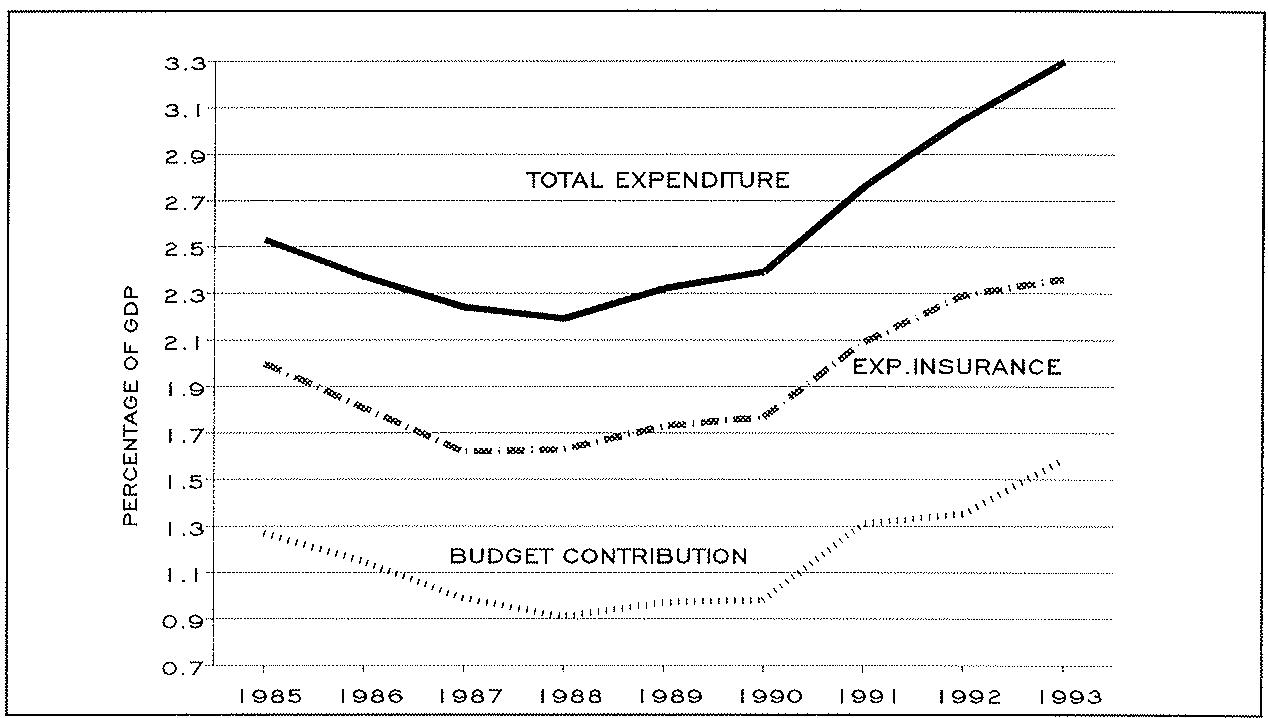
A closer look at the composition of expenditure reveals that assistance benefits appear to be to a large extent behind such large increases, particularly in the last two years. This may be partly due to the change in the system introduced in 1992, whereby the minimum contribution period to get insurance benefit was extended to 12 months, and those who had contributed for shorter periods were given access to assistance instead.
Compared to the unemployment benefit system, the amount of funds activated by the Wage Fund (FOGASA) is much smaller. In 1992, it represented 3% of the total expenditure on unemployment benefits.
B.3. Evolution of the number of beneficiaries
The number of beneficiaries of unemployment compensation has been increasing steadily over the past few years. Figure 5 presents the evolution since 1981 of the coverage rates of the unemployment compensation system. The two rates represented in the graph vary in their coverage, as the net rate excludes those beneficiaries who are agricultural workers and also unemployed registered as agricultural unemployed. The denominator is registered unemployment. This is an administrative concept which is plagued of problems, although its evolution, at least in the case of males, used to be similar to that derived from the Labour Force Survey's equivalent figure (unemployed declaring being registered at the State employment offices). However, since 1990, the two series have behaved very differently, and the number of unemployed currently derived from the LFS is almost 1 million higher than the figure derived from unemployment registers.
Figure 5. Gross and net (i.e. excluding agriculture) coverage rates of the unemployment benefits system with respect to registered unemployment.
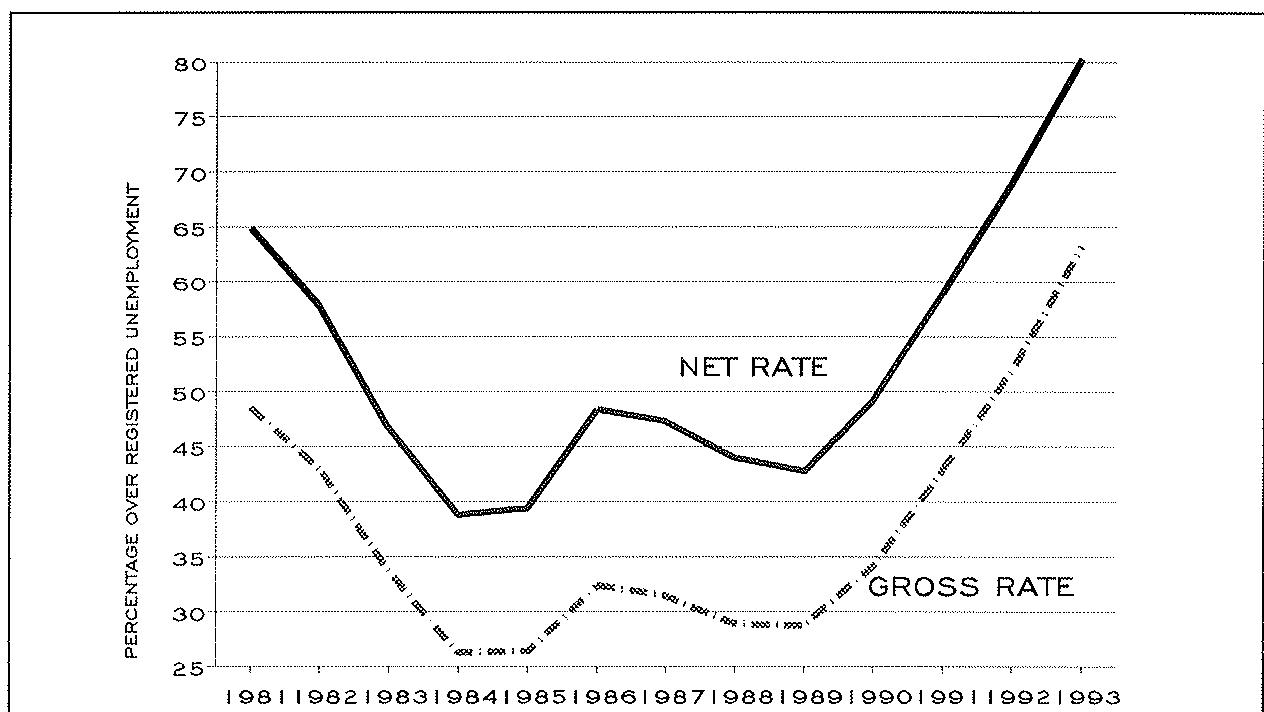
Turning to the evolution of the rates, it can be observed that they were falling until 1984, as a consequence of the long crisis of the Spanish economy which had led to a situation where many of those unemployed had exhausted their benefits and were unprotected. The approval of the 1984 law implied a sharp rise in the rates, although the recovery of the Spanish economy meant a new fall until 1988. The modifications passed in 1989 in the wake of the December 1988 General Strike turned up again the series, which started growing more intensely in the last three years, as a consequence of the recession.
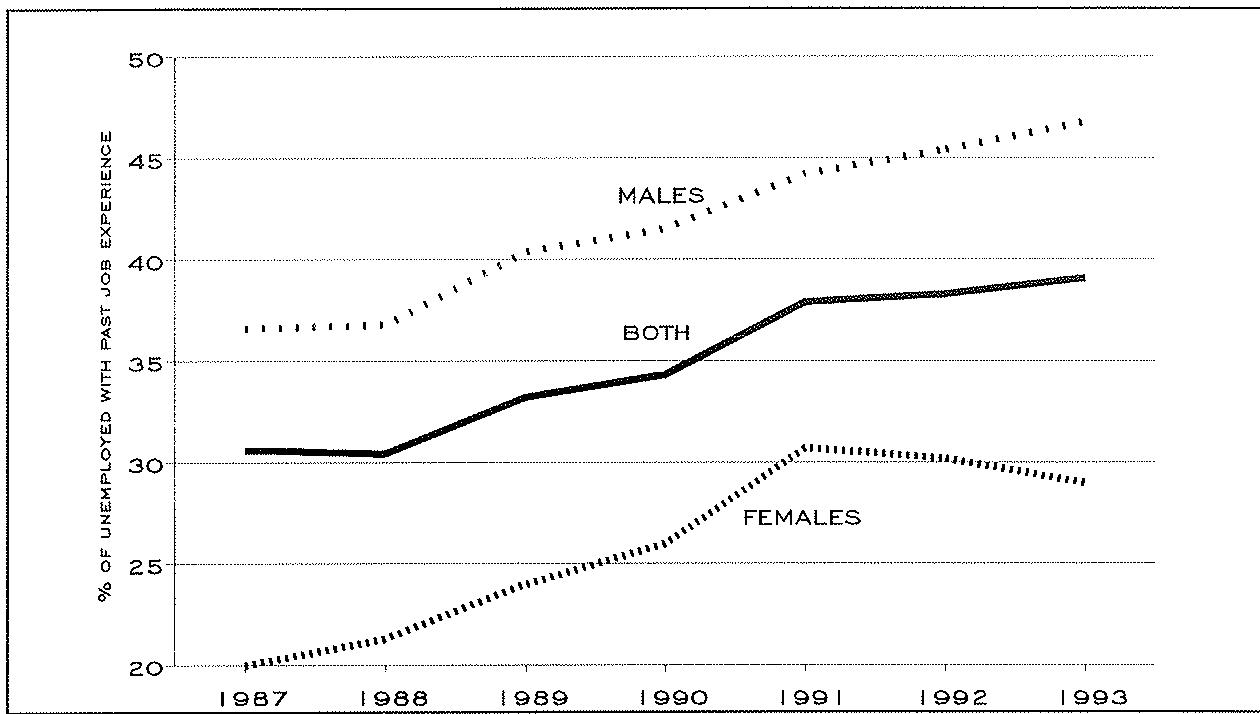
The rates are at present very high, although the problems mentioned above regarding registered unemployment imply that some skepticism is in order. If registered unemployment is being underestimated over the last few years, that would imply that the rates could be inflated. The figures from the Labour Force Survey, available since 1987, provide an alternative, perhaps more consistent series. According to these figures, presented in Figure 6, the evolution has also been one of increasing coverage, particularly in the case of males. However, the increase has not been in any way as dramatic as suggested by the data in Figure 5, coming from INEM. The reason behind these differences appear to be that many of the beneficiaries of unemployment compensation are not classified as "unemployed" by the Labour Force Survey (as many as 25-30% of benefit recipients). On the other hand, registered unemployment, as already mentioned, for unknown reasons, appears not to be capturing adequately the recent evolution of unemployment. In addition, however, the Labour Force Survey probably underestimates the number of unemployment compensation beneficiaries. On the whole, it may be safe to think that a middle figure between the two estimates provided is probably the closest guess to reality.
Figure 6. Unemployment compensation coverage according to the Labour Force Survey, 1987-1993 (second quarter).
C.- IMPACT AND EFFECTIVENESS OF THE ADOPTED TOOLS
C.1. Overall Evaluation
The regulation of redundancies and the unemployment protection system that we have reviewed in the previous two sections, together with other features of labour laws in Spain, plausibly are part of the explanation of the bad performance of the Spanish labour market observed in recent years. They are thought to affect negatively the competitiveness of Spanish firms and, therefore, job creation. In fact, as we have seen, Spanish employment increased at unknown high rates during the 1986-90 period (the unemployment rate was always over 16% during this period, though) and decreased also at very high rates once the current recession started in 1992. On the other hand, real wage growth have been positive after 1988 and the number of people who received unemployment benefits have increased substantially in recent years, so that currently it can be estimates that approximately 2 of every 3 unemployed receive some kind of unemployment benefits. Finally, the increasing use of fixed-term employment contract has affected job security very negatively, at least for approximately the 30% of employees (40% in the private sector), whose contract status is fixed-term. Those workers employed under the "typical" full-time employment contract of indefinite duration enjoy a great deal of job security with either continuous uninterrupted employment spells or, in any case, receiving high severance payments in case of dismissals.
Hence, if the goal of the labour laws on firings and unemployment benefits is to provide job security and income protection, any assessment on the effectiveness of the tools used has to be mixed. On one hand, job security and income protection is guaranteed to some extent for a certain group of workers (those with a permanent employment contract and who, having worked in the past, are entitled to receive unemployment benefits). On the other hand, fixed-term workers and unemployed without job experience are on a different footing. Besides this segmentation of the labour market, the unemployment rate is currently just below 23% and the average unemployment rate during the last decade is around 18%. It can be argued to what extent the labour law on firings and the unemployment protection system are "causes" of high and persistent unemployment, but it seems more productive to discuss whether the current levels of job security and income protection can be achieved by a different legislation without the perverse microeconomic and macroeconomic effects of the firing regulations and unemployment protection system now in effect. In the next two sections, we survey the evidence available on the microeconomic and macroeconomic effects of some Spanish labour regulations.
C.2. Microeconomic Effects
Job security regulations restrict not only dismissals but also the change of certain employment conditions (hours and location of work, occupations, tasks to be developed, etc.). Some regulations in effect (the Ordenanzas Laborales) are inherited from the Francoist system of labour legislation which supposedly protected workers, even though the most basic workers' rights were forbidden. Nowadays, after a decade of labour relations in a system of collective bargaining with almost no government intervention, neither these old regulations nor the structure of collective bargaining have substantially changed.
These restrictions on internal mobility have produced more dismissals and, given the cost of these dismissals, have increased the use of fixed-term employees who can be more easily substituted after firm reestructuring. Given the restrictions on the period durign which a worker can be fired under fixed-term contracts (normally three times), the recourse to this type of contracts has resulted in a very high turnover rate in the labour market, with workers being employed for a certain period of time to be unemployed at the end of the contract duration. Besides the financial strains that this turnover puts on the unemployment compensation system, it also creates negative incentives for both workers and employers to invest in firm-specific capital and undoubtedly has negative effects on firm productivity.
Hence, these restrictions to internal mobility, together with the already commented features of the firing regulations, are perceived as important deterrents to job creation and as negative contributions to the competitiveness of Spanish firms.
C.3. Macroeconomic Effects
The Spanish economy is currently in a very deep recession with GDP decreasing at a annual rate of about 1% during the last two quarters of 1993. The unemployment rate is close to 24% but inflation is not yet under control and real interest rates remain among the highest in the OECD countries. Nominal wages have continued increasing about two points over the rate of inflation, just as they did during the final years of the previous economic expansion (1988-90). This lack of response of wages to worsening economic conditions at the macroeconomic level is often perceived as a signal of the perverse macroeconomic effects of certain labour regulations.
More specifically, the legislation on firing costs is thought to substantially impede job creation. The liberalization of fixed-term employment that took place in late 1984 is mentioned as a very important cause of the very rapid increase of employment during the second half of the eighties. Some econometric studies (mainly Bentolila and Saint-Paul (1992)) have attempted to measure the importance of fixed-term employment reforms for job creation. They conclude that, in a sample of large manufacturing firms, these reforms contributed to increase employment by 1.5 percentage points during three years. Taking into account that fixed-term employment soared specially in small and newly created firms, it is plausible that the contribution of fixed-term employment could have been higher. In any case, the ultimate reasons of such a employment boom are difficult to identify since many things happened at the same time (liberalization of fixed-term employment in the late 1984, entry into the EC in 1986, an international demand expansion in the second half of the eighties, etc.).
What seems less controversial is that the coexistence of substantial restrictions to the dismissals of permanent employees and a very liberal regulation of fixed-term employment has resulted in a segmentation of the labour market by contract status which may have important macroeconomic implications. For instance, Jimeno and Toharia (1992 and 1993) argue that both the evolution of labour productivity and wages at the macroeconomic level could be related to this segmentation. For instance, productivity growth, which used to be above EC average, decreased substantially in the second half of the eighties (to about 1-1.5% annually), when fixed-term employment soared, to increase very sharply in the last year as a result of the very intense job destruction process that has been taking place . With regards to wages, real wage growth increased after 1988, being the increase of real wage rates the main reason. Contrary to what happened during the first half of the eighties, where real wage rates were more or less constant and the wage drift was of about 2%, during the second half of the eighties the wage drift was approximately nil (even negative in some years) and real wage rates increased substantially even during the current recession . Jimeno and Toharia (1993b) and Dolado and Bentolila (1993) claim that such evolution is the result of the regulation of fixed-term employment. As permanent workers enjoy even higher job security when fixed-term workers are hired, they enjoy a buffer (constituted by fixed-term employees) when employment needs to be adjusted as a result of excessive wage growth, so that wage pressure increases. On the other hand, less protected fixed-term employees may suffer wage discrimination (on the basis of contract status) and feel obliged to accept lower wages.
Another undesirable result of the legislation on dismissals, it is that provide very few incentives for employers and workers to arrange through collective bargaining agreements a more effective way of managing redundancies.
Jimeno and Toharia (1992) find a negative correlation between the proportion of fixed-term employees and productivity growth in a sample of industrial sectors for 1987-88.
Jimeno (1992) present some evidence on the determinants of wage rate growth during the 1983-90 period.
Finally, the current recession has proved that fixed-term employment is not the solution to managing redundancies. When these have occurred on a massive basis, the protective legislation has been ineffective to stop firings of permanent employees. The cost of these firings can be excessively high, specially in large firms, which may affect negatively job creation. The experience, hence, shows that the Spanish system of employment contracts does not solve the problems created by redundancies and may have generated new problems.
As for the unemployment protection system, the Spanish rules for entitlements and benefits are generous, even for European standards. Although the replacement ratio is not especially high, the duration of benefits extends for long periods and, as we have described in section B, most unemployed workers with previous job experience are entitled to receive unemployment benefits upon losing their job. This has four important implications:
- it has incentivated participation into the labour markert of the labour force marginally active (married women, youths, etc.),
- secondly, this may have affected the unemployment rate through perverse effects on job search and wage pressure,
- thirdly, intra-regional mobility has been drastically reduced, as unemployment benefits diminishes the "push" reasons to migrate ,
- finally, the cost of this system, financed to a non-negligible extent by the public budget, as seen in Section B, is part of the budget deficit, which will be around 7% of GDP in 1993 .
.Antolín and Bover (1993) find that to be registered as unemployed and receiving benefits reduces the likelihood to migrate. Gil and Jimeno (1993) also present some evidence on intra-regional migration in Spain and argue that fixed-term employment may be another reason of the low mobility observed.
. Unemployment benefits amount to about 4% of GDP, of which 1.5% is paid by the State through the budget.
C.4. Future Labour Market Reforms
The Spanish government has announced several reforms of the employment contract system whose final objectives are to ease some restrictions on firings and to favour the entry of youths with low levels of formal education into employment. It has also corrected some features of the unemployment protection system to lower the financial needs that such a system requires and to incentive job search by unemployed.
With regards to employment contracts, despite the negative implications of the current segmentation of the labour market, the government has apparently no intention of modifying the basic regulations of permanent and fixed-term contracts. On the contrary, the two most important proposals are the introduction of an "apprenticeship contract" for workers aged 16-25 years and without a school degree , which will allow hirings at wages lower than the minimum wage and without social security costs; and a regulation of "collective dismissals" which will allow small and medium sized firms to fire workers at some rate without having to present an ERE and, hence, without administrative control. The amount of severance payments established by law is not changed and the judiciary intervention in the firing process still remains. It is unclear, given the situation presented in Section A, that these measures imply any substantial change regarding the costs and easiness of dismissals.
As for unemployment benefits, the government plans to make unemployment benefits accountable for income tax (they are currently exempted) and subject to social security contributions. The main motivation is to reduce somewhat the deficit of the unemployment protection system, which could reach 800 billion pesetas (equivalent to 1.5% of GDP) at the end of the year. It is plausible that this measure may also have some positive effects on the intensity of unemployed workers at job search.
. Whether the contract is restricted to youngsters without degree is an important one, and is unclear. It is only for them, the measure may be useless, as there are only 100 thousand people in that situation, as compared to almost 6 million youngster of that age.
References
- Antolín, P. and O. Bover (1993): "Regional Migrations in Spain: the Effects of Personal Characteristics, and Unemployment, Wage and House Price Differentials Using Pooled Cross-Sections", Bank of Spain, working paper number 9318.
- Bentolila, S. and G. Saint-Paul (1992): "The Macroeconomic Impact of Flexible Employment Contracts: An Application to Spain", European Economic Review, 36.
- Dolado, J. J. and S. Bentolila (1994): "Labour Flexibility and Wages: Lesson from Spain", Economic Policy (forthcoming).
- Gil, L. A. and J. F. Jimeno (1993): The Determinants of Labour Mobility in Spain: Who are the migrants?". FEDEA, working paper 93-05.
- Jimeno, J. F. and L. Toharia (1993): "The effects of fixed-term employment on wages: Theory and evidence from Spain", Investigaciones Económicas, vol. XVII (3).
- Jimeno, J. F. (1992): "Las implicaciones macroeconómicas de la negociación colectiva: el caso español". Moneda y Crédito
- Jimeno, J. F. and L. Toharia (1992): "Productivity and wage effects of fixed-term contracts: Evidence from Spain". FEDEA, working paper 92-11.
DOCUMENTOS DE TRABAJO
93-01: "¿Son las Cajas y los Bancos estratégicamente equivalentes?, Juan Coello.
93-03: "Indiciación salarial y empleo: un análisis desagregado para el caso español", María Draper.
93-04: "The productivity effects of fixed term employment contracts: are temporary workers less productive than permanent workers?", Juan F. Jimeno and Luis Toharia
References
- 93-05: "The determinants of labour mobility in Spain: who are the migrants?", Luis Albériko Gil and Juan F. Jimeno
References
- 93-06: "A survey of recent applied macroeconomic and modelling research on the Spanish economy", José A. Herce y Simón Sosvilla-Rivero.
93-07: "Infraestructuras", Maria Draper y José A. Herce.
References
- 93-08: "Los Servicios de transporte aéreo, marítimo y terrestre: estructura económica y regulación", Ginés de Rus.
93-09: "Situación actual, resultados y perspectivas del sector de las telecomunicaciones en España", Francisco Caballero.
References
- 93-10: "Estructura y Regulación del sistema sanitario Español", Guillem López i Casasnovas.
94-01: "HERMINS3, A three-sector structural model of the Spanish Economy for the analysis of Community Support Frameworks", José A. Herce y Simón Sosvilla-Rivero.
References
- 94-02: "El mercado de depósitos a la vista en España: Banco Vs Cajas de Ahorro", Juan Coello.
94-03: "An Econometric Analysis of Foreign Direct investment in Spain, 1964-89", Oscar Bajo-Rubio y Simón Sosvilla-Rivero.
References
- 94-04: "The management of redundancies in Spain: Economic report", Juan F. Jimeno y Luis Toharia.
Este texto se ha extraído automáticamente del documento original. Para citarlo o leerlo con su maquetación, descargue el PDF.
Descargar en PDF