The organization of bargaining in Spanish firms*
by
Diego R. Palenzuela and Juan F. Jimeno DOCUMENTO DE TRABAJO 95-02
February 1995
** FEDEA.
* We thank participants of a workshop at CEMFI and of the 1994 ADRES conference at CREST (Paris), for helpful discussions, and Alejandro Inurrieta for comments and help in the elaboration of the data set of this study.
Universidad de Alcalá de Henares and FEDEA.
Abstract
A model of the determinants of formal firm-level firm is proposed, and some of their implications are tested. The model analyses bargaining within a firm, when replacing teams of workers is costly. Workers have the choice of bargaining ex ante and collectively for the value of the firm (formal firm-level bargaining), or to bargain ex post and independently for their marginal productivity (informal bargaining). Under the first of these choices, coordinated bargaining, workers cooperate with each other when negotiating with the firm. Under uncoordinated bargaining workers take as given the outcomes of other workers' negotiations. The model points to characteristics that should predict the likelihood of formal firm-level bargaining, and shows its implications regarding wages and total surplus. In particular, the model points to firms' size as a leading determinant factor of firm-level bargaining.
The main predictions of this model are tested empirically using Spanish firm-level data which combine information from collective bargaining statistics and from firms' balance sheets. Our main empirical findings are: i) surplus per employee is lower in firms with formal firm-level bargaining, ii) controlling for average surplus, number of employees and other variables, total payments to workers are higher and less correlated with the surplus variable in firms with formal bargaining, iii) larger firms are more likely to develop formal firm-level bargaining; and iv) controlling for endogeneity bias, firms' size appears to increase the ability of workers to increase wages.
JEL Codes: D23, D74, J31, J53.
1. Introduction
Mass and persistent unemployment is observed in some European countries since the early eighties. Most pundits have often pointed to departures from frictionless, competitive labor markets derived from institutional constraints as the main source of persistence of unemployment. Among these departures, the characteristics of the wage determination process have special relevance: In most European countries, collective bargaining has a very high incidence and, therefore, imposes a significant institutional constraint. Concretely, collective bargaining in continental Europe is mostly organized under an "open-shop" principle, that is, all workers, unionized or not, are covered by the agreement. Moreover, collective bargaining is often structured around multiple levels of negotiation (national, sectoral, firm, establishment). While the economic effects of these institutional constraints on the wage determination process have been profusely analysed from a macroeconomic point of view, there are fewer microeconometric studies of the determinants and implications of formal bargaining at each level of negotiation.
This paper is an attempt at identifying the determinants and implications of formal firm-level bargaining. We consider an environment under which, as happens in Spain, sectoral bargaining establishes minimum employment conditions, and formal firm-level bargaining is optional. (We will refer to formal bargaining -Negociación Colectiva- as C, and to informal bargaining as NC, henceforth). In this case, C is generally perceived as important, since: i) it provides workers with an instrument to extract firm-specific rents whic are out of scope in sectoral negotiations, ii) the degree of participation of the employees on the management and the distribution of surplus is most likely to affect firms' long term performance and industry evolution, and iii) formal bargaining may have positive effects at improving the firm's profitability if the focus of bargaining is not only on the distribution of surplus but also on issues that improve firms' productivity. Whereas there are numerous studies on the consequences of union bargaining under a closed-shop system, most of them regarding the US and the UK experience, few studies have adopted a microeconometric approach to estimate the economic effect of firm-level bargaining under different institutional constraints, from the European experience.
OECD (1994), chapter 5, provides data on the coverage of collective bargaining. In most continental European countries, collective bargaining coverage rates exceed 70%.
See Calmfors (1994) for a recent survey of this literature.
A recent study with similar goals as ours is Freeman and Kleiner (1994), who conclude that "(US) unions push wages to the pint where firm may expand less rapidly than nonunion firms, but not to the point where the firm, plant or business line closes down". We are not able to observe the survival rate of Spanish firms depending on the existence of firm-level bargaining,
From a purely theoretical perspective, there are several frameworks to analyze the determinants and the effects of formal firm-level bargaining. A particularly useful one is the incomplete contracts literature, since it gives a central role to bilateral relationships characterized by asset specificity (Hart and Moore [1990]). In this kind of setting, bargaining power is allocated in order to minimize the distortions in ex-ante investments imposed by ex post bargaining. And the higher workers' bargaining power is, the more likely that formal firm-level bargaining takes place. However, one difficulty in applying this theory to the existence of formal firm-level bargaining is that property rights over physical assets are not affected under coordinated or uncoordinated labor. Hence, it is necessary to model how the bargaining outcome is modified by the presence of firm-level negotiations. We take this approach and we argue that firm-level agreements modify the game agents play in the bargaining process, mainly by increasing the cost of renegotiation. This gives them commitment ability, both to collude against the firm and to bargain in anticipation to the realization of shocks.
Thus, in our model, C (collective bargaining at the firm level) will be described as one of two possible technologies that affect the distribution of surplus between workers (rather, a subset of "insider" workers) and owners. Under C workers delegate their ability to make and accept offers for wages in exchange for staying and producing in the firm. They perfectly coordinate offers to bargain as an individual that maximizes joint surplus of insider workers. As in Spanish firms with an explicit collective agreement, C is assumed to take place in anticipation to production. Without C each worker makes his own deal with the firm, taking the outcome of the deals between firm and each of the other workers as given. That is, workers compete with each other, in the sense that collusive offers to owners cannot be sustained in equilibrium.
This theoretical model is used to produce restrictions on empirical results. In particular, on the different behavior of workers' earnings as a function of total surplus, in firms with and without coordinated bargaining. Our model allows for two forms of organization of bargaining by workers. They represent (as a simplification) the two forms of bargaining we are able observe in our sample of Spanish firms: namely firms where workers coordinate when making offers, and firms where workers bargain simultaneously and independently, covered or uncovered by sectoral agreements. Coordination has a number of benefits for insider workers. It will imply that workers bargain for total surplus (net of owners' outside opportunity) rather than marginal surplus (as in NC). It implies that workers bargain in anticipation to firm-specific shocks, and therefore they get insurance against those shocks. Bargaining has a monetary cost (that we assume as a fixed cost) and it yields poor returns when replacing a team of workers is not very costly. Moreover, coordinated bargaining has an additional cost: the firm's outside opportunity deteriorates as it bargains at a time closer to production. This is because we assume that it is less costly to replace a leaving set of employees one year before than one day before a particular task has to be undertaken, which seems a sensible assumption.
but we obtain similar conclusions about the positive effect of C on wages, and estimate that surplus per employee is lower under C.
A different route is taken by Padilla, Dolado and Bentolila (1994). They emphasize the role of imperfect competition as a determinant of the outcome of firm-level bargaining. They argue that firms' market power, if any, provides an incentive for employees to become organized and extract some of the rents involved. There are no inefficiencies associated to either organizational form, beyond the ones induced by market externalities. We will not consider the role of strategic interactions in the product market, and we will assume that firms operate in competitive markets (and there are ex post rents derived from entry costs) or are monopolists and entry is not an issue.
Indeed, the ability of owners to replace a team of workers plays a crucial role in the analysis. The model describes a firm with a set of workers that have already been hired (insiders). The firm will sell in a market in a precise moment in the future . Insiders can pay a cost and bargain cooperatively at the initial stage or not pay that cost and then bargain non-cooperatively. If they choose the first, then bargaining takes place immediately (at t=0, when they also choose how to organize bargaining). At an intermediate stage between those periods, the firm can hire a set of "outsider" workers. Hiring has a non-monetary cost to the owner. The model has predictions as of what firm characteristics (like firm size) are correlated with worker coordination, the number of workers that will be hired, the correlation between payments to workers and total surplus for firms with and without C bargaining. Although the model is stylized, it captures some of the observed regularities and it provides a first cut before entering what would be a more satisfactory dynamic setting.
Regarding the empirical analysis, we use a data on Spanish firms to estimate the effects of C. Our main findings are that C increases average payments of workers, and that wages are positively correlated to total surplus, but that this correlation is higher in NC-firms than in C-firms. That is, it appears that coordination has positive returns as a strategy, yet increases in surplus have a higher effect in increasing wages in firms without collusive negotiation than in firms with it. In addition we show additional empirical findings that are not directly related to the model but that indicate the effects of formal firm-level bargaining on the efficiency of the firm. In this respect, the evidence shows quite strongly that the partial effect (controlling for possible selection bias) of labor coordination is to decrease firm's surplus per employee (productivity). This is certainly compatible with efficient bargaining (ex post). In an incomplete contracts framework (like the one we use in the model), ex post bargaining should discourage ex-ante investments and therefore stronger bargaining power by workers is naturally going to decrease investment by owners. To the extent that a potential increase in employees' incentives to exert effort does not translate (in our estimations) into higher productivity, our results point to potential inefficiencies associated with the effects of formal firm-level bargaining .
We report as well the results of a probit estimation where we describe which characteristics are more likely to be observed in a firm with C. It appears that firm size and profitability (controlling for size in terms of capital and employees) are positively correlated with the likelihood of that event.
The remaining of the paper is organized as follows: In section 2 we describe some institutional characteristics of collective bargaining in Spain that have inspired our model and that should be taken into account when interpreting the empirical results. Section 3 lays out the model and section 4 shows its implications. In section 5 we discuss the empirical evidence of the effects of formal firm-level bargaining on wages and firm's efficiency. Section 6 closes the paper with some concluding remarks.
2. Collective bargaining in Spain : some institutional aspects
Union density in Spain is rather low (somewhere between 10-15%) but the coverage of collective bargaining is much higher: approximately 70% of employees have their employment conditions established by either a sectoral or a firm-level agreement. There are multiple levels of bargaining: about 5000 collective agreements are struck each year. Most of these agreements are at the firm-level but, judging by the number of workers affected, formal firm-level bargaining is, however, less extended: only about 15% of employees are covered by firm-level collective bargaining (Jimeno (1992)). These facts arise from a regulation whose main elements are:
Collective bargaining is any worker's right recognized by the law (the Constitutional Law and the Workers' Charter, from 1980). In practice, this means that all workers, unionized or not, elect representatives, which may or may not belong to unions, in Work Councils. Elections take place every four years on a regional and sectoral basis in a process which is mostly organized and run by the major unions (UGT, socialist, and CC.OO, formerly communist). More than of the elected representatives belong to these two unions.
Although, we control for capital in the surplus regression, it is plausible that this effect still persist.
This section draws from Jimeno and Toharia (1994), chapter 3. See, also, Metcalf and Milner (1994).
- Collective agreements are legally enforceable and apply to all workers, regardless of their union status. Collective agreements are at multiple levels, and agreements at the national or sectoral levels are, de facto, binding at the firm level. Thus, there are minimum wages, besides the national statutory minimum wage, which apply on a regional and sectoral basis.
The structure of collective bargaining (levels of negotiation and number of agreements at each level) is mostly decide by the unions and the employers' associations. Since the two dominant unions enjoy some political and institutional recognition, they enjoy a higher bargaining power at the national and sectoral level than at the firm level, and they favour bargaining at these levels. According to most pundits (and, even, some union officials), firm-level bargaining is mostly devoted to large firms which supposedly have rents and capacity to pay higher wages.
- Bargaining at the sectoral level is mostly about wages and working hours. Firm-level bargaining is more deep and there are many clauses on absenteeism, productivity, and other issues, etc. However, explicit bargaining over employment is rarely observed (see Jimeno (1992)).
These institutional characteristics of Spanish collective bargaining suggest the existence of interesting hypothesis to be tested:
i) Formal firm-level collective bargaining should take place more often in firms with higher ability to pay and enjoying monopoly power that allow to generate rents,
ii) Formal firm-level bargaining is about the distribution of rents, so that wages will be higher in firms with formal firm-level bargaining.
iii) In principle, there should be no effects on firms' productivity, since the main motivation for bargaining is to distribute rents.
We now turn, first, to formalize these hypothesis by providing a theoretical model where they can be derived, and, then, we present some empirical evidence which is consistent with this theoretical model.
3. A model of firm-level bargaining
We consider a price-taking firm that produces and sells a good. Labor is required for production in addition to a skill that the owner/entrepreneur has. The owner has initially a set of employees, but it can hire an additional number, at a cost for himself. Decisions are taken along time, in three stages, t=0, 1 and 2.
At t=2: Production takes place. The firm's production (and sales) function is given by:
\[q = S (x) = \theta x ^ {\beta} \quad \beta \in (0, 1)\]
where x is the number of employees in the firm at the stage of production. x cannot increase at this stage, i.e. the cost of hiring a set of workers at t=2 is arbitrarily large, whether this set is measurable or not. is a random variable defined by: , where z is the positive mean of and is a positive random shock with expectation equal to one and standard deviation equal to . becomes known at the stage of production t=2 and z is common knowledge at t=0.
At t=1: The employer owner can hire an (additional) number of "outsider" workers. Hiring has a cost for the owner in the form of effort (this cost does not amount to any income for hired employees and should be interpreted as a cost of increasing the scale of the firm). The cost of hiring at t=1 depends on the number of workers hired. For a set of workers of measure , this cost , is:
\[C (N _ {1}) = \frac {1}{2} R _ {1} N _ {1} ^ {2}\]
The number of employees at t=2 is the sum of insider employees plus outsider employees . is the number of new (outsider) employees hired at t=1.
At t=0: In this stage insider workers (the number of which is given) choose whether or not to coordinate. Coordination affects their bargaining ability as described below.
As for preferences, employees are risk averse with mean-variance preferences. The marginal disutility for variance is normalized to one. The owners of the firm are risk neutral.
The split of surplus from production at t=2 between insider employees, outsider employees and owners is established through bargaining. We will consider only two possible bargaining games, that should be considered as the only two available bargaining technologies. At t=0 insider workers choose one of the two possible bargaining procedures, that are mutually exclusive:
NC: Ex post, uncoordinated bargaining. In this case, at t=2 workers negotiate with employers individually and simultaneously, without communicating with the rest of the workers in the firm.
C: Ex ante, coordinated bargaining. In this case, at t=0 workers bargain cooperatively. Each worker delegates his decision power, as of what offers to make and accept, to an agent that is perfectly monitored. Under coordinated bargaining workers are unable to deviate from the deal reached by the joint negotiation with the firm. That is, the delegation of decision power to the agent is irreversible. Coordination has a fixed sunk cost of K. Coordinated bargaining can only take place at t=0.
In either of these cases the firm has bargaining power given by and the workers have bargaining power of . Workers get expected utility of zero from leaving the firm (gross of coordination and opportunity costs) and owners get zero expected utility from not producing (gross of hiring costs). The timing structure of this model can be shown as follows:
| t=0 | t=1 | t=2 |
| Coordination by $N_0$ ? | $N_1$ chosen by owner | ε realizes Production Competitive Bargaining if NC. |
| Cooperative Bargaining if C. |
4. Theoretical results
We first obtain the socially optimal outcome. We then determine the distribution of surplus for a pair of firm's initial team size and productivity signal z, under coordinated and uncoordinated negotiation. Given the joint expected utility of workers under each of these regimes, it is shown which bargaining process will workers select. We find that the equilibrium does not replicate the socially optimal outcome. This is a consequence of workers' inability to commit to no renegotiation after the initial firm formation investment has taken place. It is shown that larger firms are the ones that develop collective negotiation, and that in turn the existence of collective negotiation in a firm implies higher surplus per worker and a lower correlation between contemporaneous wages and profits.
No result would change if the coordination cost depends on the size of insider team linearly. It is on the other hand important that there is a fixed cost component to the cost.
4.1. First Best
The efficient solution is that employees bear no risk and get a constant payment equal for all realizations of . The socially optimal investment is given by the following definition:
Observation 1:
The socially optimal outcome implies that:
- Given , solves the following first order condition:
\[\beta z \left(N _ {0} + N _ {1} ^ {*}\right) ^ {\beta - 1} = N _ {1} R _ {1}\]
- Number of employees at is : no hired employee leaves the firm.
- Employees bear no risk at any point in time.
Notice that the socially optimal investment is a function of and for any , is strictly positive. defines the socially optimal growth of the firm.
4.2. Bargaining without coordination
In this section we determine, under equilibrium formal bargaining, what is the firm growth that owners select and what is the split of ex post surplus, S. Given this, we have the equilibrium stream of payments to insider workers, outsiders and owners. Let these be respectively: , and .
Observation 2:
If insider workers do not invest in coordination at t=0, there is a unique pure strategies equilibrium such that:
- Under no coordination, the distribution of surplus at is:
\[w _ {\textbf {1}} ^ {N C} = w _ {0} ^ {N C} \alpha \theta \beta (N _ {0} + N _ {1} ^ {N C} (N _ {0})) \qquad \pi = \theta N _ {0} ^ {\beta} - w _ {0} ^ {N C} (N _ {0} + N _ {1} ^ {N C} (N _ {0}))\]
- Growth of the firm at , , is given by the following first order condition:
\[(1 - \alpha \beta) S ^ {\prime} (N _ {0} + N _ {1} ^ {N C} (N _ {0})) = C _ {1} ^ {\prime} (N _ {1})\]
Notice that workers' wages depend on (recall: ); so that for all realizations of it holds that:
\[S = \pi + w _ {0} ^ {N C} \left(N _ {0} + N _ {1} (N _ {0})\right)\]
PROOF:
Let x be the set (and total number) of employees in the firm at t=2. Let i be a member of x. With probability i makes a take-it-or-leave-it (tol) offer to the owner. Assume that in equilibrium only a fraction of the employees stay in the firm at t=2 and produce. Then the owner can obtain by rejecting any offer by i a surplus of . is what remains from the surplus when i leaves the firm, since the owner cannot replace i at t=2. So the offer by i is . When the owner makes the (tol) offer, this is equal to zero, i's outside opportunity.
But in both cases the offers are dominant strategies irrespectively of what outcomes and offers are taking place in the remaining bargaining games. Therefore is equal to one and the split of surplus at t=2 is as in observation 1.
At t=0 any insider worker individually is unable to extract any surplus since he can be replaced at t=1 without any cost. So all income is originated at t=2.
Given mean-variance preferences and giving equal weight to each worker, ex-ante joint worker surplus for workers under no coordination, is:
\[V _ {0} ^ {N C} (N _ {0}) = N _ {0} \left[ E (w _ {0} ^ {N C}) - \gamma v a r (w _ {0} ^ {N C}) \right] = N _ {0} (\alpha \beta z N ^ {\beta - 1} - \frac {1}{2} \gamma \sigma_ {\varepsilon} ^ {2} (\alpha \beta z) ^ {2} N ^ {2 \beta - 2})\]
where .
4.3 Bargaining under coordination
In the previous section we saw that bargaining took place at t=2 between the owner and workers independently. Now, with delegating to an agent that bargains at t=0, at t=2 there are outsider workers bargaining competitively at t=2. As opposed to no coordination, under cooperation each worker is not subject to bargaining on his marginal productivity but on his average productivity. This is the result of workers' collusion. Outside opportunity of owners is given by their surplus when firing insiders and hiring a replacement team ( ). We introduce now notation to describe bargaining at t=0.
Let be the owner's income when firing the initial team and forming a replacement team. is then the outside opportunity of the owner when negotiating with . Let be the surplus that owner and generate jointly. We define
\[\begin{array}{r c l} \mu & = & \underset {\{N _ {1} \}} {\max} E [ S (N _ {0} + N _ {1}) - \alpha N _ {1} S ^ {\prime} (N _ {0} + N _ {1}) - C (N _ {1}) ] \\ \xi & = & \underset {\{N _ {1} \}} {\max} E [ S (N _ {1}) - \alpha N _ {1} S ^ {\prime} (N _ {1}) - C (N _ {1}) ] \end{array}\]
Notice that since the replacement team is hired at t=1, it has no chance to coordinate an agreement and therefore will bargain without coordination at t=2. will extract a wage similar to the one obtained for all workers under NC above. This explains the second term in both expressions.
Observation 3:
Given , if insider workers invest in coordination at :
• Only outsiders bargain at t=2.
• The division of surplus among the three groups is:
\[w N _ {0} = \alpha (\mu - \xi) \quad \pi = \theta N ^ {\beta} - w _ {0} ^ {c} N _ {0} ^ {c} - w _ {1} ^ {c} N _ {1} \quad w _ {1} ^ {c} = \alpha s ^ {\prime} (N)\]
where and as defined above and
- Growth of the firm at , , is given by the following first order condition:
\[E \left[ (1 - \alpha) S ^ {\prime} \left(N _ {0} + N _ {1} ^ {c} \left(N _ {0}\right)\right) - \alpha N _ {1} S ^ {\prime} \left(N _ {0} + N _ {1} \left(N _ {0}\right)\right) \right] = C ^ {\prime} \left(N _ {1} ^ {c} \left(N _ {0}\right)\right)\]
Notice that bargaining takes place before the realization of and therefore workers bear no risk. Total payments to workers amount then to their expected utility at t=1, gross of the fixed cost of coordination. Expected aggregated utility of workers under coordination is:
\[V _ {L} ^ {C} (N _ {0}) = \alpha z N ^ {\beta} - \alpha \xi - K\]
4.4. Comparison of organizational forms
In this section we compare the outcomes under the two bargaining specifications in a number of respects. Comparing the net expected utility they yield to insider workers, we can determine how will workers organize bargaining. Larger firms are more likely to have coordinated offers. The threshold size of that determines coordination is shown to depend on , and . Hiring decision and payments to outsiders relative to insiders under the two forms are also compared. Finally we show that under coordination the correlation coefficient between contemporaneous wages and total surplus is larger in firms without coordination than in firms with coordination.
With and defined as functions of it is possible to determine under what conditions will workers coordinate. This is given in:
Observation 4:
Let be the set of pairs such that is nonnegative for any value of . Then for any strictly positive there is a value of , , such that for all values of smaller or equal to insider workers will not coordinate offers and for all values higher or equal to workers do coordinate offers.
This follows directly from the fact that as a function of has a higher slope than for all values of . is equal to zero at and for a positive K there is a neighborhood of where is greater than .
The critical value of will depend on parameter values according to:
Observation 5:
The comparative statics for are:
•
\[\frac {\partial \tilde {N} _ {0} (K)}{\partial R _ {1}} > 0\]
•
\[\frac {\partial \tilde {N} _ {0} (K)}{\partial \sigma^ {2}} < 0\]
•
\[\frac {\partial \tilde {N} _ {0} (K)}{\partial \Upsilon} < 0\]
●
\[\frac {\partial \tilde {N} _ {0} (K)}{\partial z} < 0\]
PROOF:
We will only consider the last expression, since it is less straightforward than the others. By the definition of it holds that:
\[V ^ {N C} (z) \equiv V _ {0} ^ {N C} (\tilde {N} _ {0} (K, z)) = V _ {0} ^ {C} (\tilde {N} _ {0} (K, z)) \equiv V ^ {N C} (z)\]
where the definitions at the extremes are introduced to simplify notation. Then:
\[\frac {d \tilde {N} _ {0}}{d z} = - \frac {\frac {\partial [ V ^ {C} - V ^ {N C} ]}{\partial z}}{\frac {\partial [ V ^ {C} - V ^ {N C} ]}{\partial N _ {0}}}\]
Since the denominator is positive, we only need to show that the numerator is also positive. It can be shown that:
\[\frac {\partial V ^ {C}}{\partial z} = \frac {V ^ {C}}{z} \quad \wedge \quad \frac {\partial V ^ {C}}{\partial z} = \frac {1}{z} (V ^ {N C} - \varrho) (1 - \varepsilon (1 - \beta))\]
where:
\[\varrho = \frac {1}{2} \Upsilon \sigma^ {2} (\alpha \beta z) ^ {2} N ^ {2 (\beta - 1)} > 0 \quad \Lambda \quad \tau = \frac {z}{N} \frac {d N}{d z} > 0\]
which proves the claim.
HIRING OF OUTSIDERS AT t=1:
Observation 6:
Given , under no coordination the number of workers hired at is larger than under coordination. That is .
Moreover, under no coordination insiders and outsiders obtain the same payment per worker. Under coordination payments to insiders have a lower correlation to contemporaneous surplus than payments to outsiders.
This is a consequence of the fact that there is positive externality for the employer in hiring outsiders, in that it decreases the cost of paying insiders. More formally, compare the definitions of and in observations 1 and 2 respectively. The only difference is the additional term in the condition for .
The second remark can be seen directly comparing the distribution of surplus in sections 4.2 and 4.3. It provides a testable implication.
5. Empirical evidence on the effects of formal firm-level bargaining
5.1. Empirical Implementation
In this section we introduce additional assumptions to relate the model to the data more tightly. Assume that are "small" and can be ignored (that is, the proportion of temporary workers is small). In addition we need assumptions on the shocks (z, ), since our sample provides a measure of surplus, but does not allow us to identify z and separately. Assume in particular that (i being an index of firms) are iid and constant through time. Assume are iid across firms and time periods. Workers total wages under C and NC are:
\[\mathrm{Nw} ^ {\mathrm{NC}} = \alpha \beta \theta \mathrm{N} ^ {\beta} = \alpha \beta z \varepsilon \mathrm{N} ^ {\beta}\]
\[\mathrm{w} ^ {\mathrm{C}} = \alpha (\mu - \xi) = \alpha \mathrm{zN} ^ {\beta} - \alpha \xi\]
For : , and . Taking logs in the expression of worker s' total proceedings:
\[\ln \mathrm{Nw} ^ {\mathrm{NC}} = \ln \alpha \beta + \ln \theta \mathrm{N} ^ {\beta}\]
\[\ln w ^ {c} = \ln \alpha + \ln z N ^ {\beta}\]
Since N is observed, randomness in surplus is in z and . Since by assumption z and are independent: and , it holds that
\[\begin{array}{l} \text {Cov} (\ln S, \ln N w ^ {N C}) = \text {var} (\ln z N ^ {\beta}) + \text {var} (\ln \epsilon N ^ {\beta}) \\ \text {Cov} (\ln S, \ln w ^ {C}) = \text {var} (\ln z N ^ {\beta}) \end{array}\tag{5.1}\]
Dividing both equations by the variance of surplus we get that the correlation coefficient between surplus and wages should be smaller in firms with formal bargaining. These coefficients can be estimated by OLS regression under no endogeneity bias and with an instrumental variables procedure if simultaneous determination between surplus and wages is an issue (as we assume below).
Therefore we obtain that in a linear regression of total payments on total surplus to workers, and after potential endogeneity bias is taken care of, it must be that:
I.1. The intercept term for firms without coordination should be smaller than in firms with coordination. (Alternatively, the coefficient on a dummy indicating C should be positive -and should be interpreted as an estimate of .)
I.2. The slope of the surplus term is smaller in firms with coordinated bargaining than in firms without it. (Alternatively, the coefficient on an interaction variable: C*SURPLUS should be negative).
Additional testable implications of the model are that in a (probit) regression with the decision to form a firm union as the endogenous variable, it should hold that:
Notice that the same holds for total payments and total surplus wages and surplus per employee.
1.3. Large firms (in terms of their total number of employees) are more likely to produce a firm union (observation 5, point 1, in section 4 above), that is, the coefficient of the observable variable measuring SIZE in that probit regression should be positive and significant.
I.4. Negative correlation between having a coordinated bargaining and the fraction of workers that are temporary employees in the firm (observation 6 in section 4 above); that is, the coefficient of the variable FRACTION OF TEMPORARY WORKERS in the (probit) regression describing variables correlated with firm union formation should be negative and significant.
Remaining restrictions from the model cannot be addressed with available data.
5.2. Data
The data set comes from the combination of the registry of collective agreements, held at the Spanish Ministry of Employment and Social Security (Estadística de Convenios Colectivos) and Bank of Spain's Balance Sheet Survey (Central de Balances). From the former data set we take only information relating to the existence of formal firm-level bargaining for each firm. We match this information by firm to the latter, from which we take balance sheet information (sales, profits, accounting value of capital...) plus information registered by the Central Bank when collecting firms' balance sheet data (number of employees, of temporary workers, industrial sector of the firm). In this matching process, a number of firms that do not appear in one or the other source are lost. We ignore here potential biases that this selection might introduce in the estimates. We drop firms for which the value of some variables (like zero sales, zero employees, zero capital) and changes in some variables (for instance, more than 200% change in employment) are not plausible.
The resulting data set consists of 676 companies observed during the 1982-1990 period. The panel is unbalanced: not all firms are observed over the same time period and some firms are not observed continuously along their time span in the panel. This fact, together with the static nature of our model and the stable nature of the phenomenon of coordinated bargaining lead us to consider averages of variables over the time dimension and reduce the panel to a cross section of firms.
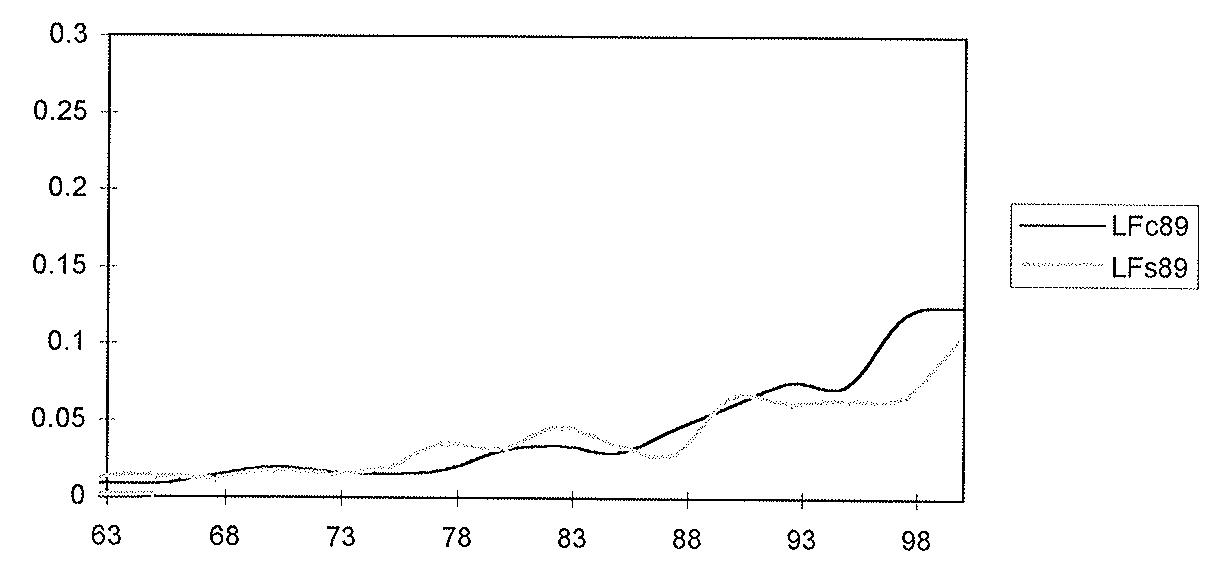
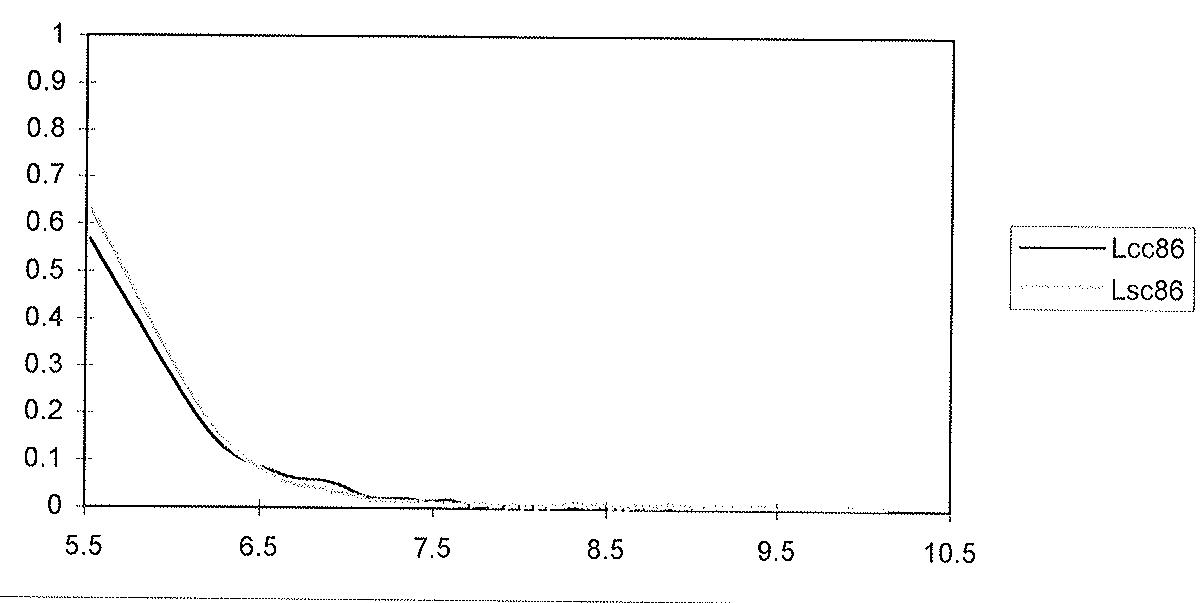
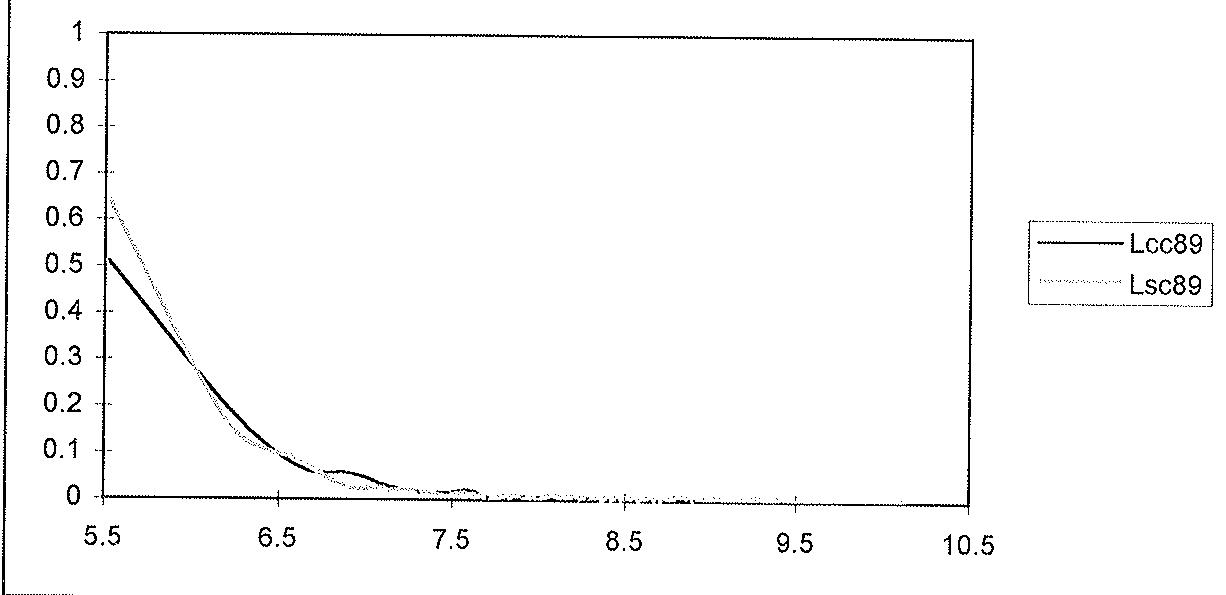
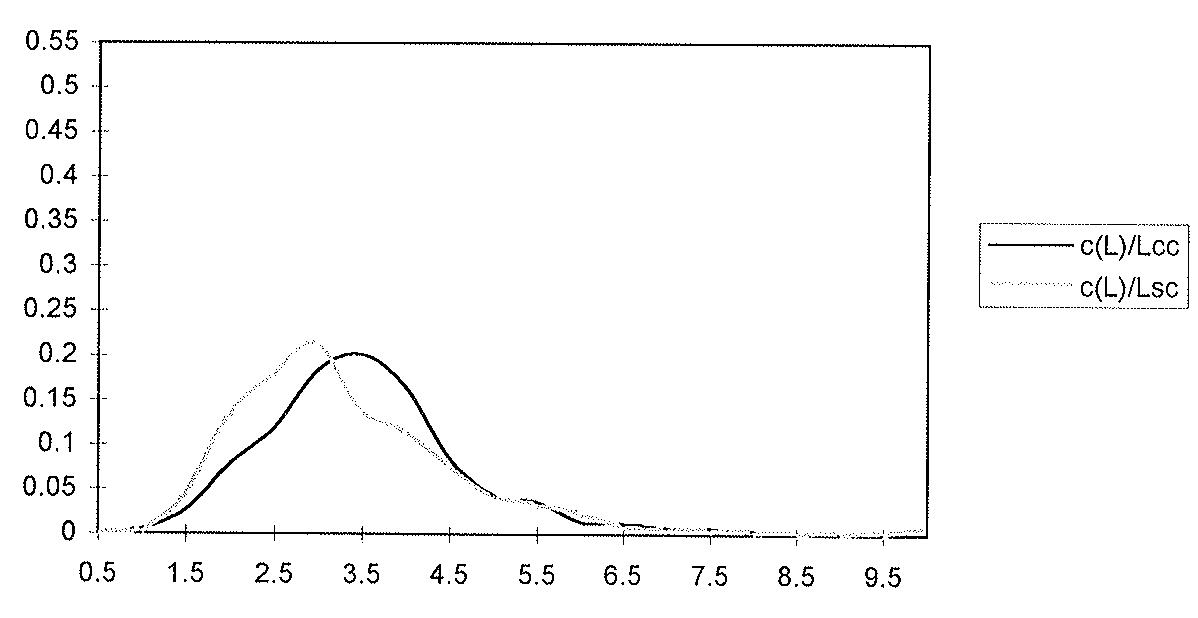
Figures 1 to 4 show the main trends of wages, surplus, number of employees and fraction of permanent (as opposed to temporary) workers in Spanish firms with and without firm-level formal bargaining during the sample period. Figure 1 represents the distributions of wages in those two sets of firms in 1982, 1986 and 1989. It is clearcut that there has been an increase in the dispersion of wages in both groups and a relatively greater increase in firms with labor coordination (black line). Figure 2 shows a very similar pattern for surplus (added value) per employee, except that the increase in the dispersion seems previous to the divergence of the two groups (both density functions almost coincide in 1982 and 1986). Mean surplus per employee in firms with coordination is higher only in 1989. Figure 3 shows that firms without coordination are consistently smaller. Figure 4 shows that firms with coordination are consistently less likely to hire a large fraction of temporary workers.
The remaining of this section describes the data transformations performed to reduce the panel to a cross section of firms. First, consider the following surplus equation:
\[\text {SURPLUS} _ {i t j} = (K _ {i t j}) ^ {\alpha_ {j}} (L _ {i t j}) ^ {\beta_ {j}} (M _ {i t j}) ^ {\gamma_ {j}} \eta_ {j} e _ {t} \vartheta_ {t}\tag{5.2.1}\]
where i is an index for firms , t for years and j for industrial sectors . That is, surplus follows a Cobb-Douglas form with industry specific parameters and industry, time and firm specific unobservable shocks. K is capital, L labor and M a set of additional observable factors (like characteristics of the owner of capital). We make the following transformations in the data:
1) First we take logs in (5.2.1).
2) We compute for each year t and for each sector k the average value of each variable. This gives JxT partial averages for each variable x, where J is the number of sectors and T the number of years.
3) For each time varying variable (like surplus) we take differences with respect to the partial average defined in 2). Thereafter (5.2.1.) become (5.2.2):
\[s _ {i} = k _ {i} ^ {\alpha} l _ {i} ^ {\beta} m _ {i} ^ {\gamma} e _ {i}\tag{5.2.2}\]
where:
\[s _ {i} = (1 / T) \sum [ \ln (s _ {i j t}) - \ln ((1 / J) \sum s _ {i j t}) ]\]
From (5.2.1) is clear that the time and sector shocks do not enter in (5.2.2) and what is lest is the firm specific shock .
Our transformation implies in particular that all variables are averages of ratios with respect to sectorial means.
5.3. Results
This section describes the results from estimation of equations with wages, surplus and the existence of firm-level negotiation as dependent variables. The implications of the model is compared to regression results of the wage equation. This comparison is shown in subsection 5.3.1. Additional evidence from the estimation but not related directly to the model in section 3 is summarized in subsection 5.3.2.
5.3.1. Testing implications of the model
Our main implication refers to the differential of correlation coefficient between surplus and wages in firms with and formal collective negotiation and the differential in the intercept term in these two groups of firms. The differential correlation coefficient and the mean effects could in principle be estimated with the coefficients on a constant, a dummy for formal firm-level bargaining and an interaction term between surplus and the bargaining dummy, plus additional controls for firm characteristics, estimated by ordinary least squares. This estimates would be subject to endogeneity bias since transformations described above did not cancel the firm specific effect and this may be correlated with the bargaining dummy.
To estimate the partial derivative of wages with respect to surplus we estimate a linear relationship using instruments for all firm characteristics. We use as instruments variables referring to sector aggregates corresponding to the sector where each in firm belongs. We expect these to have non-zero correlation with firm characteristics but not being correlated the unobservable firm specific effect. The list of instruments is described in the appendix. Nota that we use participation in workers' representative elections at the sectoral level as instrument. This is likely to be correlated with firm-level bargaining, as it is a proxy of bargaining power, while it has nothing to do with firm-specific effects on either wages or surplus.
In order to look into implications I.1 and I.2 at the end of section 5 we estimate through a two-stage least-squares procedure the following equation of wages as a function of surplus, a dummy of firm union existence and additional characteristics:
\[w _ {i} = \delta_ {0} (1 - C C V _ {i}) + \delta_ {1} C C V _ {i} + \lambda S U R P L U S _ {i} + \Delta S U R P L U S _ {i} * C C V _ {i} + \Gamma x _ {i}\]
where variables are defined as in (6.2) above. Instruments are the ones listed in the appendix and it is assumed that all firm covariates are potentially endogenous. The results of this estimation are in table 1.
TABLE 1 (a) Dependent variable: ln (wages) - ln (sectorial wages)
| OLS RESULTS | ROBUST STANDARD ERRORS | |
| VARIABLE | COEFF. | t-STAT. |
| Firm-level bargaining (ccv) | 0.0183 | 1.376 |
| No firm-level bargaining | 0.0143 | 1.216 |
| Surplus per employee (s.p.e.) | 0.0979 | 7.235 |
| S.p.e. * ccv | -0.0717 | -4.775 |
| Number of employees | 0.0506 | 9.249 |
| % of fixed-term employees | -0.0099 | -0.185 |
| Capital | 0.0759 | 8.597 |
| Co-owned by foreign firm | 0.0003 | 2.396 |
| Co-owned by priv. domest. firm | 0.0014 | 4.639 |
| Co-owned by public sector | 0.0016 | 4.256 |
TABLE 1 (b) Dependent variable: In (wages) - In (sectoral wages)
| 2SLS RESULTS | ROBUST STANDARD ERRORS | |
| VARIABLE | COEFF. | t-STAT. |
| Firm-level bargaining (ccv) | 0.0445 | 2.032 |
| No firm-level bargaining | 0.0124 | 0.753 |
| Surplus per employee (s.p.e.) | 0.1520 | 2.820 |
| S.p.e. * ccv | -0.0741 | -1.161 |
| Number of employees | 0.0524 | 6.071 |
| % of fixed-term employees | -0.0274 | -0.458 |
| Capital | 0.0531 | 2.940 |
| Co-owned by foreign firm | 0.0002 | 1.835 |
| Co-owned by priv. domest. firm | 0.0013 | 3.956 |
| Co-owned by public sector | 0.0022 | 4.478 |
The coefficient on formal firm-level barganing is positive and significant. The coefficient of the interaction surplus dummy is negative, although not significant at the 10% level. There is therefore evidence compatible with the restrictions implied by the model, although this evidence is not overwhelming. Interestingly, firms with more employees relatively to the sector pay higher wages. This appears compatible with our assumption that larger teams of workers are able to grab larger rents or that there are increasing returns to activities that affect distribution. It appears as well that firms participated by other firms and firms owned by the state give a wage premium. The former are firms where ownership is relatively less concentrated than firms with no participation. The public firm effect is probably related to a soft budget constraint effect, which damages firm's commitment ability.
In order to check implications I.3 and I.4 (larger firms are more likely to form a union, firms with more temporary are less likely to be in a firm with coordinated negotiation) we estimate the conditional probability of observing formal bargaining as a function of the total number of employees, the fraction of non-tenure workers and other characteristics. This conditional probability is estimated from a probit model. The results are shown in table 2.
TABLE 2: Probit estimates of firm-level bargaining
| VARIABLE | PROB. EST. | t-VALUE* |
| Constant | 3.32 | -2.22 |
| Sect 1 | -0.94732 | -3.54 |
| Sect 2 | -0.46793 | -1.88 |
| Sect 3 | -0.78568 | -3.04 |
| Sect 4 | -0.77078 | -2.42 |
| Sect 5 | -0.69622 | -2.38 |
| Sect 6 | -0.39791 | -1.07 |
| Number of employees (in ln) | 0.16365 | 3.56 |
| % fixed-term workers | -1.24781 | -1.81 |
| Bank Debt | -0.7929 | -2.04 |
| Cost of Debt | -0.1426 | -0.33 |
| Liquidity | -0.01324 | -0.48 |
| Quoted | 0.62264 | 2.7 |
| Bank Group | 0.02996 | 3.53 |
| Subsidiary | 0.00231 | 1.04 |
| Foreign | 0.00294 | 1.27 |
| Public | -0.15619 | -0.79 |
| Participation in union elections (by sector) | -0.03583 | -2.04 |
| Capital | -0.05353 | -0.68 |
| Subsidies to capital | -0.24983 | -0.43 |
| Subsidies to Sales | -0.10617 | -1.16 |
| Sales | -0.08509 | -0.79 |
| Surplus | -0.09719 | -1.72 |
*With robust standard errors
We see that indeed firms with a larger number of employees are more likely to develop coordinated bargaining (t-statistic of 3.56) and that a large fraction of temporary workers is negatively correlated with developing a firm union (the coefficient is negative and significant at the 10% level). Although the power of the test is not large, the evidence is not against our theoretical prior.
5.3.2. Additional evidence
Although our model does not have implications on the effect of existence of firm union on firm efficiency we can draw some results in this respect with a regression of surplus on firm characteristics and the existence of firm union that takes account of endogeneity bias. In particular we look at average firm surplus per employee relative to the average of the sector each year (definition 5.2 above) regressed on measures of productive factors of the firm (number of employees, capital per employee) and characteristics of capital ownership (whether it is private or public, domestic or foreign, dispersed or concentrated). This regression is estimated with instruments by two stage least squares and its results are shown in table 3:
TABLE 3 (a) Dependent variable: In (surplus per employee) - In (sectoral surplus per employee)
| OLS RESULTS | ROBUST STANDARD ERRORS | |
| VARIABLE | PROB. EST. | t-VALUE |
| Constant | -0.01 | -0.125 |
| Firm-level bargaining (ccv) | -0.328 | -2.542 |
| Number of Employees | 0.0576 | 1.395 |
| Number of Employees * ccv | -0.0678 | -1.001 |
| % Fixed-term employees | 0.2002 | 0.356 |
| % Fixed-term employees * ccv | 0.7187 | 0.599 |
| Bank Debt | -1.1243 | -2.862 |
| Bank Debt * ccv | 0.7501 | 1.217 |
| Co-owned by Priv. Domest. firm | -0.0007 | -0.322 |
| Co-owned by Priv. Domest. Firm * ccv | 0.0091 | 2.368 |
| Co-owned by foreign Firm | 0.0024 | 1.065 |
| Co-owned by foreign Firm * ccv | -0.0016 | -0.658 |
| Co-owned by public sector | -0.008 | -2.604 |
| Co-owned by public sector *ccv | -0.0099 | -2.177 |
| Capital | 0.2265 | 3.246 |
| Capital * ccv | -0.0142 | -0.131 |
TABLE 3 (b) Dependent variable: In (surplus per employee) - In (sectoral surplus per employee)
| 2SLS RESULTS | ROBUST STANDARD ERRORS | |
| VARIABLE | PROB. EST. | t-VALUE |
| Constant | 0.2425 | 0.890 |
| Firm-level bargaining | -0.9267 | -1.837 |
| Number of employees | -0.0779 | -0.654 |
| Number of employees * ccv | 0.1206 | 0.432 |
| % Fixed-term employees | -0.1353 | -0.06 |
| % Fixed-term employees * ccv | 4.0198 | 0.433 |
| Bank Debt | -2.3065 | -1.361 |
| Bank Debt * ccv | 2.1517 | 0.56 |
| Co-owned by Priv. Domest. firm | -0.0113 | -0.949 |
| Co-owned by Priv. Domest. Firm * ccv | 0.0345 | 1.051 |
| Co-owned by foreign Firm | -0.0034 | -0.521 |
| Co-owned by foreign Firm * ccv | 0.0051 | 0.706 |
| Co-owned by public sector | -0.0495 | -2.833 |
| Co-owned by public sector *ccv | 0.0782 | 2.089 |
| Capital | 0.2106 | 0.721 |
| Capital * ccv | 0.6226 | 0.875 |
The result from this regression that interests us most, is that surplus per employee is negatively and significantly affected by firm-level bargaining.
6. Concluding Remarks
Most of the research on union participation or firm level formal bargaining has focused on the benefits to workers of these rent seeking activities. It is thought that workers have more incentives to coordinate when there is a prospect of capturing a quasi-rent. In this paper we have emphasized the role of the cost to coordinate in formal firm-level bargaining as an additional motivation. We have as well pointed to the idea that it is likely to expect a life-cycle of the firm in respect to its growth and labor relations patterns. In sectors with decreasing marginal returns to labor, when firms are small workers obtain relatively high wages when bargaining independently (i.e. when bargaining for their marginal productivity). When the firm is large and the marginal productivity of labor relatively low, workers are worse off bargaining independently, and incentives to coordinate are greatest. Thus, conditioning on sectoral variables, firms' size is an explanatory variable for the existence of formal bargaining. The empirical evidence presented in the paper confirms this insight.
We have proposed an stylized model of firm-level bargaining with interesting implications regarding its economic effects and the likelihood of observing this type of bargaining. The main thrust of the model is to provide some guidelines for an empirical exercise of the effects of firm-level bargaining in Spanish firms, where firm-level bargaining takes place on an "open-shop" basis and after sectoral agreements establish minimum employment conditions. A nice sideline result of the model is an explanation for labor coordination to be a necessary and sufficient condition for employees to be able to bargain in anticipation to specific shocks and obtain insurance. The key point is that only under coordinated bargaining can workers commit not to renegotiate particular offers made to firm owners. The implication we draw from this is that under firm union wages should have higher intercept term and smaller correlation with surplus. This follows directly from the fact that with a firm union workers negotiate upon a variable less correlated with total surplus (expected surplus) than without it, where they negotiate ex post for a fraction of the realized surplus. The leverage provided by coordination manifests itself through a higher intercept term.
A number of extensions could enrich the analysis. One of them is to make firms' size endogenous. Firm's size will in general not be independent of efficiency parameters as our simplifying assumptions imply. Yet when firm size is introduced a number of issues complicate the model. Since the number of employees determines the existence of formal bargaining, the owner can affect labor coordination when deciding the scale of the firm. The employer would in this setting play an strategic game with his employees, namely an entry deterrence game where entry refers here to the existence of foremal bargaining in the firm.
A different issue with potentially interesting implications is labor heterogeneity inside the firm. With distinct types of workers, the decision to coordinate offers would be less straightforward. In particular it is likely that a number of political considerations appear, since each class of workers would obtain different net benefits from coordination. The question would then be what kind of coalitions are likely to be formed to induce coordination and how technology affects the incentives to form those coalitions.
We have also searched for an empirical regularity relating the split of surplus in firms and its relation to different agreements that workers do to affect distribution and the size of firms. We find that the data do not reject the main implication of the model. Finally, we have produced additional evidence relating formal firm-level bargaining and firm's efficiency, measured by its surplus per employee. After controlling for a likely selection effect, we find strong evidence of a negative effect of firm-level bargaining.
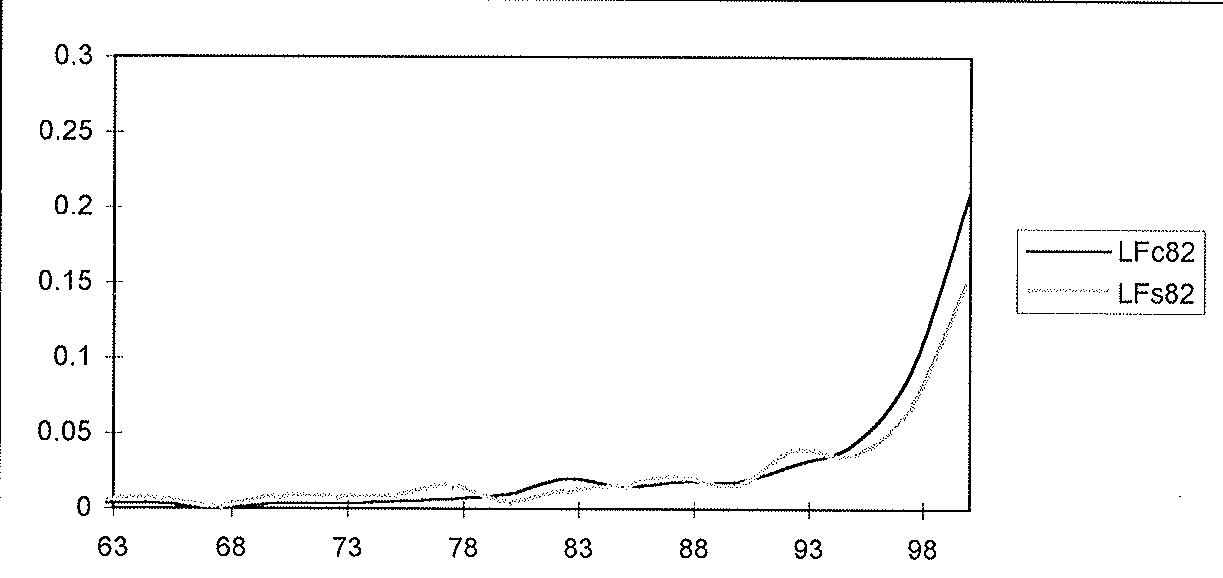
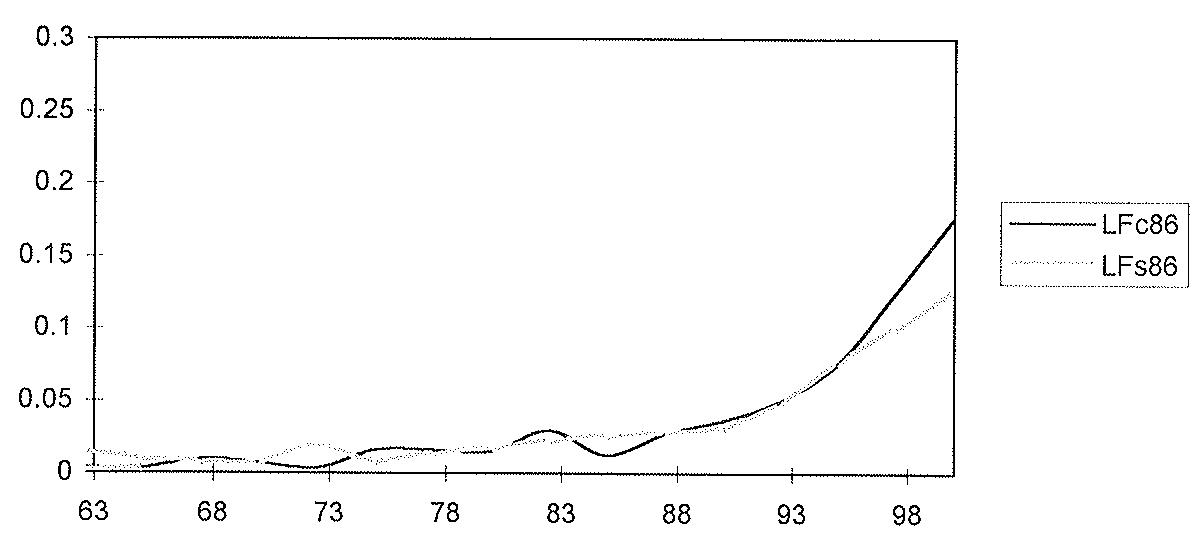
PROPORTION OF PERMANENT EMPLOYEES IN C (BLACK) AND NC (GREY) FIRMS IN 1982-86-89
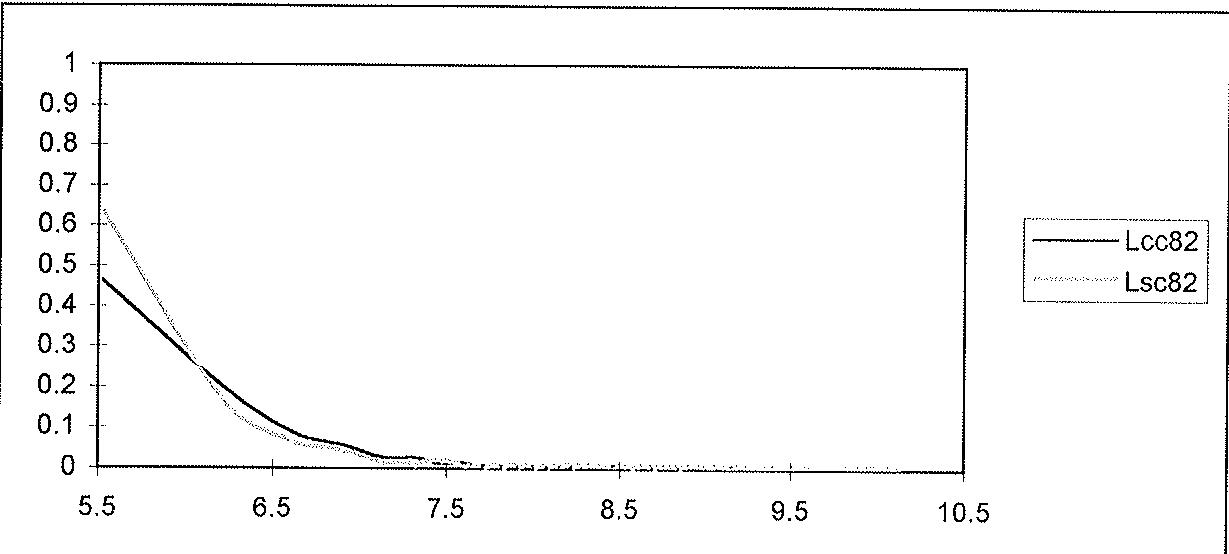
NUMBER OF EMPLOYEES IN C(BLACK) AND NC(GREY) FIRMS IN 1982-86-89
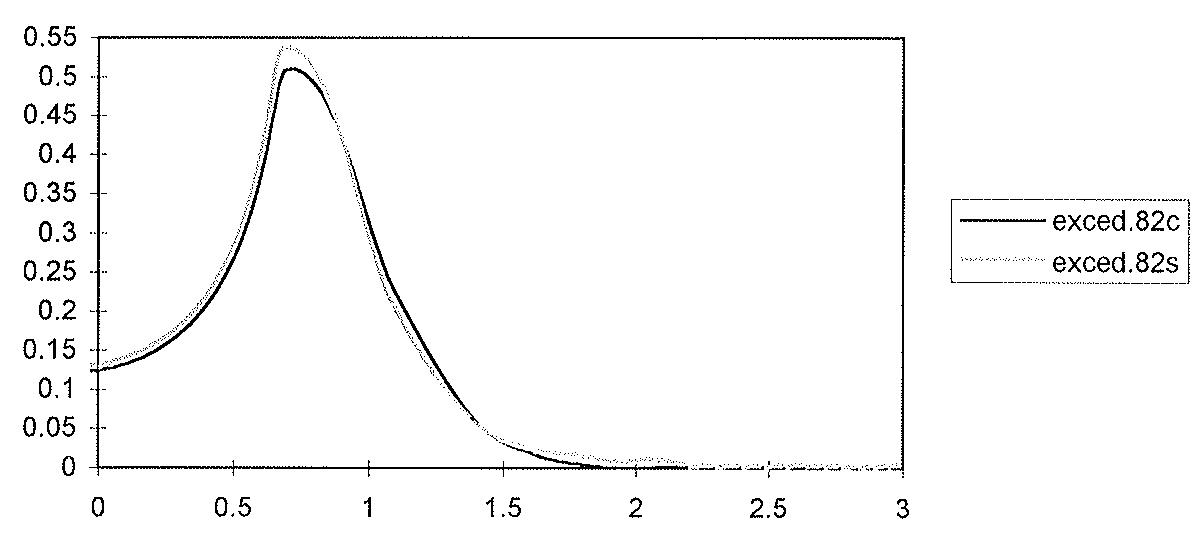
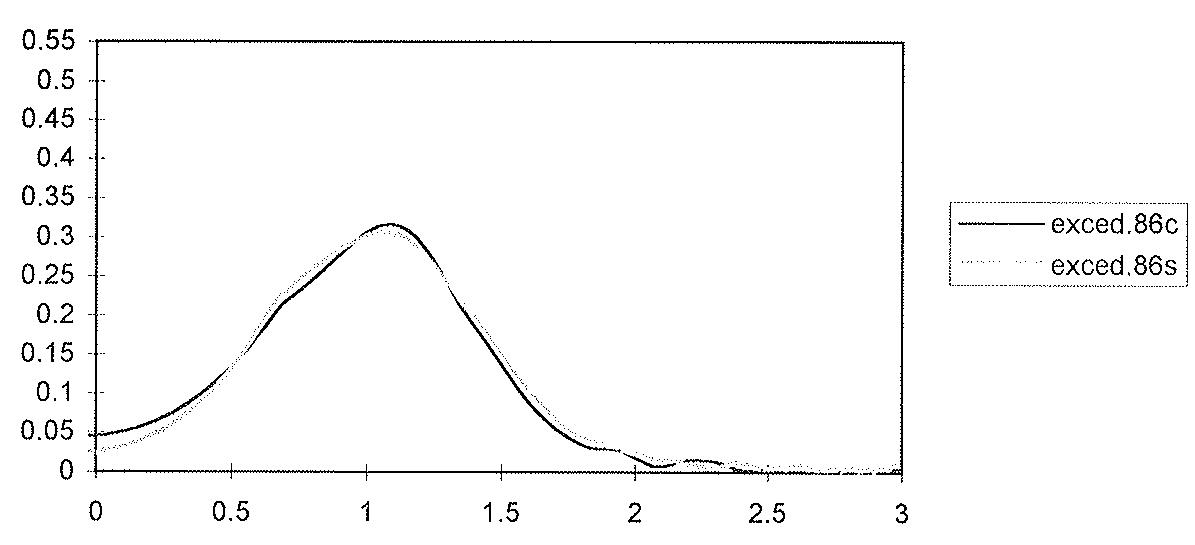
SURPLUS PER EMPLOYEE IN C (BLACK) AND NC (GREY) FIRMS IN 1982-86-89
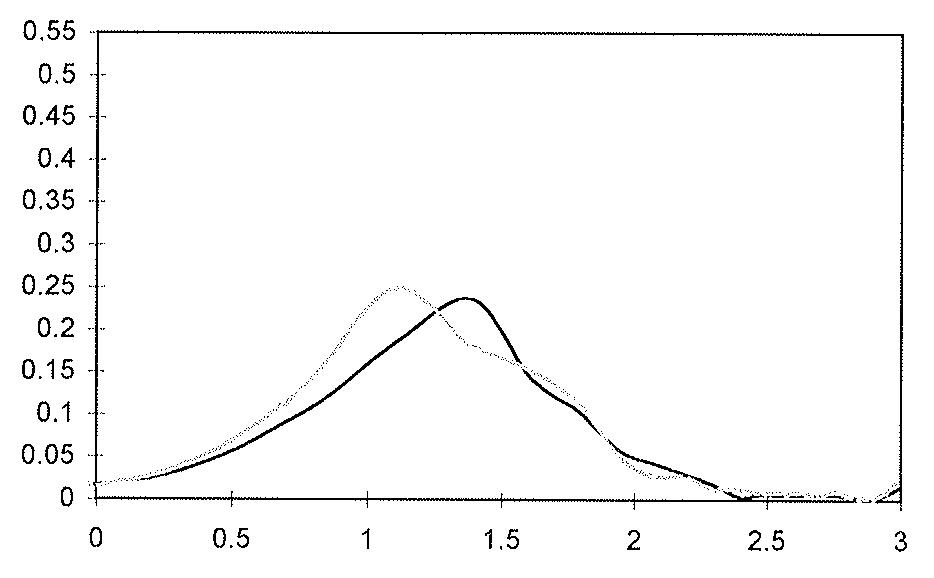
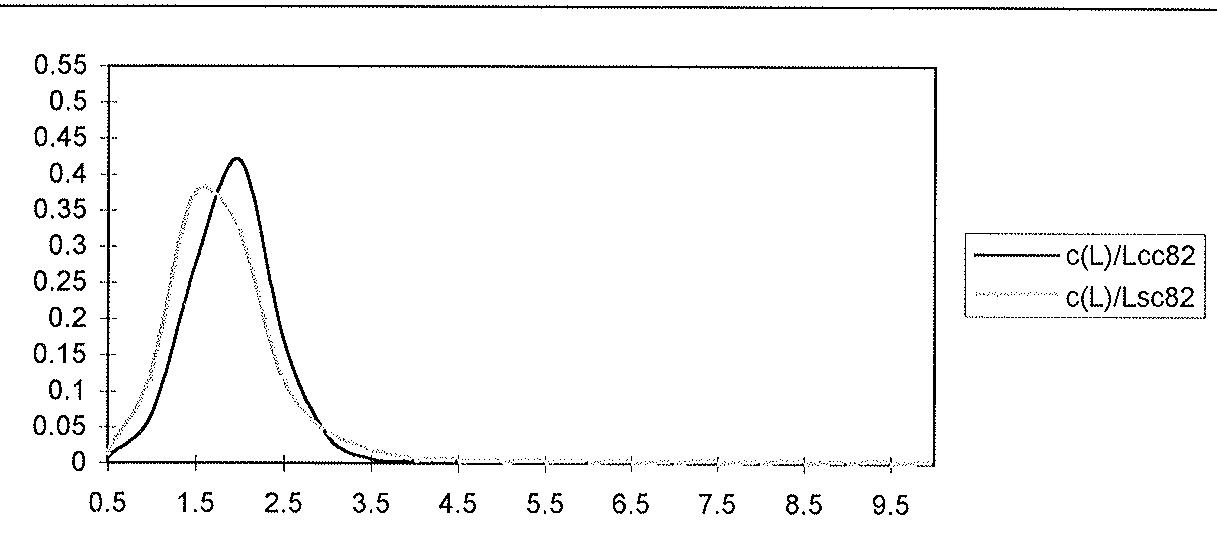
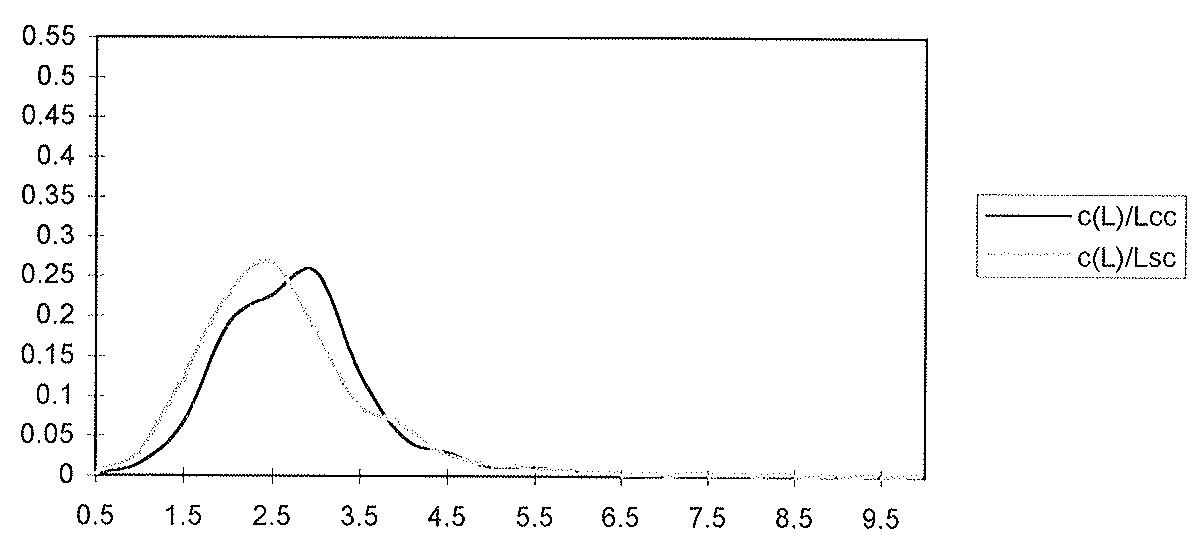
LOG OF WAGES IN C(BLACK) AND NC(GREY) FIRMS. 1982-86-89
References
Calmfors, Lars (1993). "Centralization of Wage Bargaining and Macroeconomic Performance -a Survey". OECD Economic Studies, #21, pp 159-190. Winter 1993. OCDE, Paris.
Freeman, C., and Richard Kleiner (1994) "Do Unions Make Enterprises Insolvent?". WP # 4797, National Bureau Of Economic Research.
Hart, O. and John Moore (1990) "Property Rights and the Nature of the Firm", Journal of Political Economy, 98, (December 1990), pp 1119-58.
- Jimeno, J.F. (1992) "Las implicaciones macroeconómicas de la negociación colectiva: el caso español", Moneda y Crédito, 195.
Jimeno, J.F. and Luis Toharia (1994) "Unemployment and Labour Market Flexibility: Spain". International Labour Office, Geneva.
- Mailath, G.J. and A.Postlewaite, (1990) "Workers Versus Firms: Bargaining Over a Firm's Value", Review of Economic Studies, vol. 57, (3), #151, pp 369-381, July 1990.
- Milner, S. and D. Metcalf, (1994) "Spanish Pay Setting Institutions and Performance Outcomes" Discussion Paper #198, Center for Economic Performance, June 1994.
OCDE (1994) "Employment Outlook", OCDE, Paris, July 1994.
Padilla, A.J., S. Bentolila and J.J. Dolado (1994), "Wage Bargaining in Industries with Market Power", mimeo, January, CEMFI.
Appendix
INSTRUMENTAL VARIABLES:
7 SECTORIAL DUMMIES
PARTICIPATION AT WORKERS' REPRESENTATIVE ELECTIONS (SECTOR)
AVERAGE WAGE IN SECTOR
UNEMPLOYMENT RATE IN SECTOR
AVERAGE WAGE IN 1 DIGIT SECTOR
OWNERSHIP CHARACTERISTICS
SUBSIDIES TO CAPITAL
SUBSIDIES TO EXPENDITURE
ENTIDAD:
Departamento:
Persona de contacto:
Código Postal: Población: Capital:
Teléfono: Fax:
Deseo recibir regularmente:
[ ] Documentos de trabajo
[ ] Boletín
Deseo recibir el Documento de Trabajo N°......
Deseo recibir en diskette el D. T. N ....
Remitir esta solitud a:
FEDEA - Documentación
Jorge Juan, 46
28001 MADRID
Fax: (91) 577 95 75
Telf. (91) 435 90 20
* Indicar el documento de trabajo deseado (a partir del n° 94-05). Se enviará un diskette que contenga el texto de dicho documento en formato WPD (Word Perfect versión 6.0), para su reproducción en tamaño DIN A4.
References
- 94-01: "HERMINS3, A three-sector structural model of the Spanish economy for the analysis of Community Support Frameworks", José A. Herce y Simón Sosvilla-Rivero.
References
- 94-02: "El mercado de depósitos a la vista en España: Bancos vs cajas de ahorro", Juan Coello.
References
- 94-03: "An econometric Analysis of Foreign Direct investment in Spain, 1964-89", Oscar Bajo-Rubio y Simón Sosvilla-Rivero.
References
- 94-04: "The management of redundancies in Spain: An Economic report", Juan F. Jimeno y Luis Toharia.
References
- 94-05: "Modelling international capital movements in the Spanish economy: A portfolio-balance approach". Oscar Bajo-Rubio y Simón Sosvilla-Rivero.
References
- 94-06: "Demanda de tráfico telefónico nacional en España 1985-1989: Un estudio econométrico con datos de panel provinciales", Teresa Garín.
References
- 94-07: "Demanda de tráfico telefónico internacional en España 1985-1989: Un estudio econométrico con datos de panel provinciales", Teresa Garín.
References
- 94-08: "HERMIN-S4, a four-sector structural model of the Spanish economy for the analysis of Community Support Frameworks", Simón Sosvilla-Rivero y José A. Herce.
References
- 94-09: "European railway comparisons and the future of RENFE", John Preston y Chris Nash.
References
- 94-10: "The Effects of the Community Support Framework 1994-99 on the Spanish Economy: An analysis based on the HERMIN Model", José A. Herce y Simón Sosvilla-Rivero.
References
- 94-11: "A cost-benefit analysis framework for Spanish railway services", John Dodgson y Marta González Savignat.
References
- 94-12: "El mercado de trabajo en Andalucía: Los factores determinantes del paro masivo y persistente", Sonsoles Castillo, Rosa Duce y Juan F. Jimeno.
References
- 94-13: "Efectos del Marco de Apoyo Comunitario 1989-93 sobre el crecimiento y la distribución de la renta regional", Indalecio Corugedo, Lorenzo Dávila, Ricardo Martín y Pablo Moliner (no disponible).
References
- 94-14: "Desregulación y privatización del transporte público urbano en España", Ginés de Rus y Gustavo Nombela.
References
- 94-15: "Profitability of the different services of RENFE", John Dodgson y Pablo Rodríguez.
References
- 94-16: "Exchange rate volatility in the EMS before and after the fall", Simón Sosvilla-Rivero, Fernando Fernández-Rodríguez, Oscar Bajo-Rubio y Juan Martín-González.
References
- 94-17: "Consecuencias socio-económicas de las tendencias demográficas españolas", José A. Herce.
References
- 94-18: "Efectos de la desregulación del transporte aérero en España", Ofelia Betancor y J. D. Jorge Calderón.
References
- 94-19: "Regulación de las oficinas de Farmacia: Precios y libertad de entrada", Walter García-Fontes y Massimo Motta.
References
- 94-20: "Irreversibility, uncertainty and underemployment equilibria", David de la Croix y Omar Licandro.
References
- 95-01: "Workforce adjustment in Spain: Are working hours a choice variable?*, Carlos García-Serrano, Juan F. Jimeno and Luis Toharia.
References
- 95-02: "The organization of bargaining in spanish firms", Diego R. Palenzuela y Juan F. Jimeno.
References
- 94-01: "HERMINS3, A three-sector structural model of the Spanish economy for the analysis of Community Support Frameworks", José A. Herce y Simón Sosvilla-Rivero.
References
- 94-02: "El mercado de depósitos a la vista en España: Bancos vs cajas de ahorro", Juan Coello.
References
- 94-03: "An econometric Analysis of Foreign Direct investment in Spain, 1964-89", Oscar Bajo-Rubio y Simón Sosvilla-Rivero.
References
- 94-04: "The management of redundancies in Spain: An Economic report", Juan F. Jimeno y Luis Toharia.
References
- 94-05: "Modelling international capital movements in the Spanish economy: A portfolio-balance approach". Oscar Bajo-Rubio y Simón Sosvilla-Rivero.
References
- 94-06: "Demanda de tráfico telefónico nacional en España 1985-1989: Un estudio econométrico con datos de panel provinciales", Teresa Garín.
References
- 94-07: "Demanda de tráfico telefónico internacional en España 1985-1989: Un estudio econométrico con datos de panel provinciales", Teresa Garín.
References
- 94-08: "HERMIN-S4, a four-sector structural model of the Spanish economy for the analysis of Community Support Frameworks", Simón Sosvilla-Rivero y José A. Herce.
References
- 94-09: "European railway comparisons and the future of RENFE", John Preston y Chris Nash.
References
- 94-10: "The Effects of the Community Support Framework 1994-99 on the Spanish Economy: An analysis based on the HERMIN Model", José A. Herce y Simón Sosvilla-Rivero.
References
- 94-11: "A cost-benefit analysis framework for Spanish railway services", John Dodgson y Marta González Savignat.
References
- 94-12: "El mercado de trabajo en Andalucía: Los factores determinantes del paro masivo y persistente", Sonsoles Castillo, Rosa Duce y Juan F. Jimeno.
References
- 94-13: "Efectos del Marco de Apoyo Comunitario 1989-93 sobre el crecimiento y la distribución de la renta regional", Indalecio Corugedo, Lorenzo Dávila, Ricardo Martín y Pablo Moliner (no disponible).
References
- 94-14: "Desregulación y privatización del transporte público urbano en España", Ginés de Rus y Gustavo Nombela.
References
- 94-15: "Profitability of the different services of RENFE", John Dodgson y Pablo Rodríguez.
References
- 94-16: "Exchange rate volatility in the EMS before and after the fall", Simón Sosvilla-Rivero, Fernando Fernández-Rodríguez, Oscar Bajo-Rubio y Juan Martín-González.
References
- 94-17: "Consecuencias socio-económicas de las tendencias demográficas españolas", José A. Herce.
References
- 94-18: "Efectos de la desregulación del transporte aérero en España", Ofelia Betancor y J. D. Jorge Calderón.
References
- 94-19: "Regulación de las oficinas de Farmacia: Precios y libertad de entrada", Walter García-Fontes y Massimo Motta.
References
- 94-20: "Irreversibility, uncertainty and underemployment equilibria", David de la Croix y Omar Licandro.
References
- 95-01: "Workforce adjustment in Spain: Are working hours a choice variable?*, Carlos García-Serrano, Juan F. Jimeno and Luis Toharia.
References
- 95-02: "The organization of bargaining in Spanish firms", Diego R. Palenzuela y Juan F. Jimeno.
Este texto se ha extraído automáticamente del documento original. Para citarlo o leerlo con su maquetación, descargue el PDF.
Descargar en PDF