The effects of minimum bargained wages on Earnings: Evidence from Spain* by Juan J. Dolado** Florentino Felgueroso*** Juan F. Jimeno**** DOCUMENTO DE TRABAJO 97-04
Febrero, 1997

We thank V. Bhaskar and O. Bover for helpful comments. The third autor acknowledges financial support from the Spanish Ministry of Education under contract DGICYTSEC 95-0131.
** Universidad Carlos III de Madrid, CEPR.
*** Universidad de Oviedo
**** FEDEA, Universidad de Alcalá de Henares, CEPR.
THE EFFECTS OF MINIMUM BARGAINED WAGES ON EARNINGS: EVIDENCE FROM SPAIN
by
Juan J. Dolado , Florentino Felgueroso , Juan F. Jimeno
(a) Bank of Spain, Research Department, Alealá 50, 28014 Madrid, Spain.
(b) Universidad de Oviedo, Spain.
(c) FEDEA and Universidad de Alcalá de Henares, Spain.
(d) CEPR, London, UK.
ABSTRACT
This paper provides an empirical evaluation of the effects of Spanish sectoral collective bargaining on wages. For this purpose, we use a sample of workers for whom bargained wage rates and earnings are available. Using a variant of the Meyer and Wise approach, we are able to estimate wage gains due to minimum bargained wages and their employment effects. The most relevant conclusion is that there is evidence of a 'sword of justice' effect by unions, but this is limited by non-compliance among unskilled workers and the non-binding nature of bargained wages for skilled workers.
Keywords: Minimum wages, collective bargaining, wage dispersion.
JEL classification: J31, J51
1. INTRODUCTION
Although the role of the minimum wage as a redistributive tool is a policy mainstay, as demonstrated by the current revival of the literature on these issues, little is known about the role played by other minima often set through collective bargaining machinery and which are often superimposed on the statutory ones.
(*) Corresponding author. We thank V. Bhaskar and O. Bover for helpful comments. The third author acknowledges financial support from the Spanish Ministry of Education under contract DGICYTSEC 95-0131.
Indeed, research on the effects of trade unionism and collective bargaining has mostly focused on countries with decentralised wage-setting systems and a large non-covered sector (see, e.g., Lewis, 1986). Nevertheless, much less attention has been paid to studying the extent to which trade unionism can alter wage distribution in countries with more centralised collective bargaining systems where the terms of agreements are extended to almost all workers, regardless of their union status .
Such is the case of the Spanish collective bargaining system where bargained wages often play the role of minimum wages, being in general well above the statutory ones (see below). Wage bargaining in Spain has three layers: nationwide, industrywide and firm-level agreements . In the event of conflict, the most beneficial agreement for the workers prevails. The main layer of bargaining is the sectoral (provincial-industrywide) one which establishes minimum bargained wages for all working categories (except for high management and certain specialists). Under the so-called "principle of general effectiveness", these bargained wages are extended to all workers within the corresponding scope of bargaining, covering nowadays about 85% of wage earners in Spain. Thus, the combination of these rules has provided the Spanish unions, whose membership is still below 15 percent, with a strong instrument of income redistribution which is potentially much more forceful than the statutory minima.
However, two problems arise when analysing the effectiveness of bargained wages in affecting earnings distribution in Spain. First, these wages may not be binding, given their minimum wage nature. Thus, they could be possibly improved by other formal or informal agreements at the firm-level (formal agreements, however, only affect 11% of wage earners). And, secondly, some doubts remain regarding compliance in small firms (70% of Spanish firms have fewer than 6 workers). This is so since small firms fail to recognise legal workers' representation and, therefore, control of the sectoral collective agreement may be difficult to enforce. In this case, the statutory minimum wage is likely to represent the relevant wage floor.
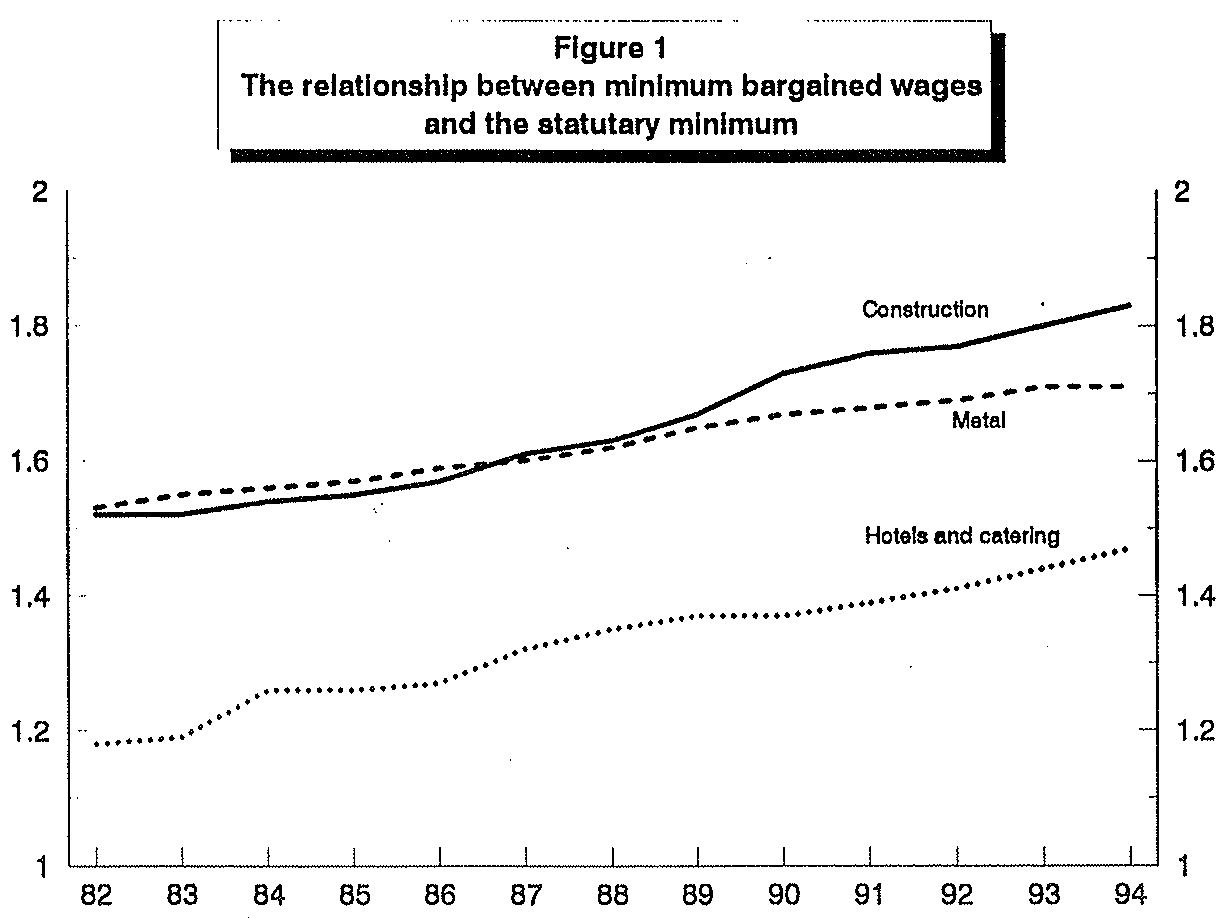
At this stage, a few words about the statutory minimum are in order. The so-called Salario Mínimo Interprofesional (henceforth SMI) dates from the sixties and is set by the government in consultation with trade unions and employers' associations. As a proportion of the average wage, the adult minimum wage for workers 18 or above is nowadays about 35% and has been trending downwards since the beginning of the seventies. Thus, it is difficult to argue that statutory minima are responsible for the extremely poor performance of the Spanish labour market over the last two decades (see, e.g., Dolado et al., 1996). We have argued, however, that bargained wage rates at the sectoral level are more relevant. In this respect, Figure 1 presents the ratio of the average bargained wage to the SMI for the lowest skill category (labourer/waiter) between 1982 and 1994 in three sectors (metal, construction and hotels & catering). It ranges from 1.50 in hotels & catering to 1.8 in construction. Hence, the evidence is clear-cut: between the two layers of minimum wages in Spain, bargained wages at the sectoral level are much higher. [FIG. 1 ABOUT HERE]
When studying the effects of bargained wages on earnings, a natural hypothesis to test is whether unions try to compress the wage distribution according to the preferences of the median voter (see Freeman and Medoff, 1984). In most industries, this policy would imply a "sword of justice" effect by which unions aim to raise the relative wages of unskilled and semi-skilled workers. However, as indicated above, both the fact that bargained wages are just wage floors and the suspicion of non-compliance could severely limit the unions' efforts to compress earnings distribution. Therefore, the relevant questions posed in this paper are the following: How effective are Spanish unions in influencing wage distribution through collective bargaining? Can we infer anything about unions' goals from the estimated effects of bargained wages on earnings? and, finally, Are there adverse employment effects from having such a bargaining system?
To deal with these questions, this paper analyses the differences between hourly bargained wages and actual wages for a cross-section of individuals in 1990. In this respect, it is important to stress that this is the only data base available in Spain which offers information at the individual level on both sets of wages. In section 2, we describe the data and discuss the effectiveness of collective bargaining agreements at reducing wage dispersion. In section 3, given that a single cross-section is available, we use a variant of the method proposed by Meyer and Wise (1983a,b) to estimate the wage gains derived from wage bargaining for different types of workers. Finally, some conclusions and extensions are suggested in Section 4.
2. THE DATA
In order to examine the consequences of minimum bargained wages on wage dispersion, we use a subsample of the Structure, Biography and Class-Consciousness Survey, which provides information about work conditions for 6632 individuals between December 1990 and March 1991. We have been able to obtain a final subsample including 491 wage earners who reported both their labour earnings and detailed information about their personal and professional status, and for whom we could determine their minimum bargained wages which were in force in November 1990. The chosen subsample corresponds to six major industrial sectors plus construction. These are industries where more than 90% of workers are covered by sectoral collective agreements.
Hence, for each of these individuals, we have information on two types of wages. On the one hand, there is the "guaranteed hourly wage" (henceforth GHW)
which is defined as the minimum bargained wage in the corresponding sectoral agreement, and which applies to all workers with an identical skill/professional status. It includes seniority premia and overtime work rewards. On the other hand, the quoted survey gives information on the individuals' hourly earnings, denoted as "reported hourly wage" (henceforth RWH). [TABLE 1 ABOUT HERE]
Table 1 records means and coefficients of variation of GHW and RWH, both by skill level and professional status, together with the relative wage gap and the proportion of non-compliance. The most important conclusion to be drawn is that the GHWs are not binding for the more skilled/white collar workers but are so for the less skilled/blue collar workers. Furthermore, GHW dispersion grows commensurately with the category level. Thus, we can conclude that if the unions' goal is to reduce wage dispersion, this is only achieved within the low skill categories. For these workers, the RHWs represent merely a small interval around the GHWs which, in turn, are on average about 60% above the SMI. Finally, there is evidence of non-compliance for the low skill categories, where the proportion of workers reporting wages below the GHWs is between 30 and 40 percent, but is negligible among the high skill workers. In turn, the proportion of workers receiving the SMI is 2%, below the nationwide "spike" of 6%, probably because minimum wage incidence in the service sector (not considered here) is likely to be larger. Thus, there is evidence that a "black labour market" segment exists among the low skill workers, the most likely explanation for which is the extension of the working day without reward.
3. ESTIMATION OF WAGE GAINS
3.1. Methodology
In the previous section we have presented evidence pointing out that the unions' attempt to affect wage dispersion only applies at the lower tail of the distribution. In this section we try to evaluate the size of these effects. For this purpose, we estimate "wage gains" due to bargaining, namely, the average mark-ups between the actual expected wage and the one the worker would receive in the absence of sectoral bargaining, after controlling for a large set of observable characteristics.
Given the strong limitation imposed by the availability of a single cross-section and the absence of a non-covered sector, the most natural method to use is that developed by Meyer and Wise (1983a,b) who study the US federal minimum wage effects on wage and employment distributions by parameterising them in the absence of the minimum . A straightforward interpretation in our framework of their procedure will enable us to compare expected wages of workers under sectoral agreements with their expected wages in the absence of such a type of bargaining.
The method works as follows . Suppose that, in the absence of sectoral minimum wages, the hourly wage that the i-th individual would receive is . This underlying market wage is not observable and is assumed to be determined by
\[\ln W _ {n i} = \alpha_ {0} + X _ {i} \alpha_ {1} + u _ {i}\tag{1}\]
where is a vector of individual and labour market characteristics. As regards the error term, which assumed to be normal, we use a heteroskedastic version of the Meyer and Wise' model to allow for unobserved heterogeneity, whereby
\[\text { Var } (u _ {i}) = \sigma_ {i} ^ {2} = (\delta_ {0} + Z _ {i} \delta_ {1}) ^ {2}\tag{2}\]
where is a set of variables (e.g. schooling) determining the variance of . Now suppose that a minimum wage is set for the i-th individual in industrywide bargaining at level and that firms take it as exogenous. Some workers, who in the absence of the minimum wage would be paid a wage below it, are presumed to receive with probability . Others, with probability , shall continue to be paid below .
because of non-compliance. The remaining subminimum workers are presumed to lose their jobs with probability .
Further assumptions are that labour supply is constant (no monopsony) and there are no spillovers on wages perceived by workers with an underlying market wage above . Moreover, in practice, to avoid measurement errors, we consider that the minimum wage corresponding to each worker belongs to a small interval where the length of the interval in of . Then, we can classify each individual in the sample in one of the following four groups: [1] individuals for whom the observed wage ( ) is larger than , i.e., ; [2] equal to minimum, i.e., ; [3] lesser that the minimum, i.e., ; and [4] individual is unemployed, i.e., . Their respective probabilities will be denoted as [·].
Next, define the normalised variates
\[\omega_ {i} = \left(l n W _ {i} - \alpha_ {0} - X _ {i} \alpha_ {1}\right) / \left(\delta_ {0} + Z _ {i} \delta_ {1}\right)\]
and
\[\omega_ {m j i} = \left(l n W _ {m j i} - \alpha_ {0} - X _ {i} \alpha_ {1}\right) / \left(\delta_ {0} + Z _ {i} \delta_ {1}\right), j = (1, 2)\]
where and represent the standardised normal density and distribution functions. Then, the observed wages of employed individuals can be classified in three segments, in terms of the underlying distribution, with the following associated probabilities:
\[h _ {1} \left(W _ {i}\right) = \frac {P _ {r} [ 1 ]}{1 - P _ {r} [ 4 ]} = \frac {1}{\sigma_ {i}} \frac {\phi (\omega_ {i})}{D} \quad i f W _ {i} > W _ {m 2 i}\]
\[h _ {2} \left(W _ {i}\right) = \frac {P _ {r} [ 2 ]}{1 - P _ {r} [ 4 ]} = \frac {\Phi [ \omega_ {m 2 i} ] - \Phi [ \omega_ {m 1 i} ] (1 - P _ {2})}{D} \quad i f W _ {m 1 i} \leq W _ {i} \leq W _ {m 2 i}\]
\[h _ {3} \left(W _ {i}\right) = \frac {P _ {r} [ 3 ]}{1 - P _ {r} [ 4 ]} = \frac {1}{\sigma_ {i}} \frac {\phi \left(\omega_ {i}\right) P _ {1}}{D} \quad i f W _ {m 1 i} < W _ {i}\]
where is a common denominator which can be interpreted as the probability that an individual employed in the underlying market remains employed after the introduction of minimum wages. The numerators, in turn, represent the probabilities of worker initially employed having an observed wage above, equal or below the minimum wage, respectively.
Using a maximum likelihood procedure, ML estimates for the 's, 's, and can be obtained by maximising the following log-likelihood function:
\[L = \sum_ {i = 1} ^ {n _ {1}} \ln h _ {1} (W _ {i}) + \sum_ {i = n _ {1} + 1} ^ {n _ {2}} \ln h _ {2} (W _ {i}) + \sum_ {i = n _ {2} + 1} ^ {N} \ln h _ {3} (W _ {i})\tag{2}\]
From these estimates the "wage gain" due to sectoral minimum wage for the i-th employed worker is defined as:
\[G _ {i} = \left[ e x p (\hat {\omega} _ {i}) / e x p (\hat {\omega} _ {n i}) \right] - 1\tag{3}\]
where and which is obtained through weighting the predicted wage in each segment by their corresponding probabilities 's.
3.2 Results
Estimates of the parameters in the previous model are presented on the left hand side of Table 2, using job tenure (and its square) and dummies for skill levels, gender, sector and professional status as the elements of , and schooling as the only element of . They correspond to the heteroskedastic version of the model since homoskedasticity was rejected at very low significance levels. All the variables have the expected sign in an earnings equation and, apart from the level of schooling, no other arguments are found to explain the unobserved heterogeneity in equation (1). As regards the estimates of the 's, they point out that the probabilities of losing the job and non-compliance for workers whose underlying wages were below the bargained minima are about 10% and 39%, respectively. [TABLE 2 ABOUT HERE].
The estimated industrywide "wage gains" are reported on the right hand side of Table 2. They tend to be higher for low skill, blue-collar and low tenure workers. Nonetheless, the higher categories also get sizeable gains. On the basis of these gains, semi-skilled workers seem to benefit most and, hence, they could be identified as the median voter.
In sum, bargained wages at the sectoral level reduce wage dispersion. However, this 'sword of justice' effect is weakened by a non-negligible employment loss, by the existence of a 'black labour market' for the low skill workers and finally, by the presence of other types of informal agreements through which high skill workers are rewarded above the bargained terms at the sectoral level.
4. CONCLUDING REMARKS AND EXTENSIONS
So far, we have presented evidence showing that unions succeed in reducing wage dispersion but to a limited extent. How can these results be interpreted? Three possible explanation come to mind:
(i) Unions care for skilled and unskilled workers and bargain binding rates for both. However, they care less for the former and aim at achieving larger wage gains for the latter.
(ii) Unions do not care at all for skilled workers whose wages are determined in a competitive way. However, by setting minimum wages for the unskilled, they give rise to spillover effects which ultimately raise the wages of skilled workers.
Models of monopsonistic competition in Bhaskar and To (1996) and Dolado, Felgueroso and Jimeno (1996) produce this sort of result as a consequence of firms' interaction in the product market.
(iii) Even without spillover effects, unskilled workers' wages may possibly be found to affect skilled workers' wages if the elasticity of substitution between both types of worker is sufficiently high. The mechanism would be as follows: as the unskilled workers' wages increase the demand for skilled workers increases and, thus, their wages also rise.
The analysis presented here is too simple to distinguish among the above three possibilities. Thus, a call for further research along those lines is in order.
NOTES
1. For a comparison of earnings distribution in US and several european countries with collective bargaining above the firm-level, see Blau and Kahn (1994).
2. For a detailed account of the Spanish collective bargaining system, see Jimeno and Toharia (1994) and Lorences et al. (1995).
3. The Meyer and Wise approach, however, has been criticized by Dickens et al. (1994) who claim that the employment effects estimated through this method are very sensitive to the functional form assumed for the underlying distribution.
4. A more detailed discussion of the method can be found in the detailed version of this paper; cf. Dolado, Felgueroso and Jimeno (1996).
5. The sectoral classification is a follows: Food and drink (1); Construction (2); Paper and paper products (3); Timber and wooden furniture (4); Chemicals (5); Textile, footwear and clothing (6); Metal industry (7).
6. Given that the 's are conditional probabilities, we have estimated how many workers would lose their jobs due to the imposition of the bargained minima. They turned out to be 9 out of a sample of 491 workers. If we extend the results on this sample to the whole economy, about 100 thousand jobs could have been jeopardised, out of 6 million workers affected by sectoral bargainings in 1990.
References
- Bhaskar, V. and T. To, 1996, Minimum wages for Ronald McDonald monopsonies: A theory of monopsonistic competition, University of St. Andrews, Discussion Paper no. 9605.
References
- Blau, F. and L. Kahn, 1994, International differences in male wage inequality: Institutions versus market forces, NBER Working Paper no. 4678.
References
- Dickens, R., S. Machin and A. Manning, 1994, Estimating the effect of minimum wages on employment from the distribution of wages: A critical review, LSE/CEP Discussion Paper no. 203.
References
- Dolado, J., F. Felgueroso and J. Jimeno, 1996, Minimum wages, collective bargaining and wage dispersion: The Spanish case. Mimeo. (Bank of Spain).
References
- Dolado, J., F. Kramarz, S. Machin, A. Manning, D. Margolis and C. Teulings, 1996, The economic impact of minimum wages in Europe, Economic Policy 23, forthcoming.
References
- Freeman, R. and J. Medoff, 1984, What do unions do? New York: Basic Books.
References
- Jimeno, J. and L. Toharia, 1994, Unemployment and labour market flexibility: Spain, Geneva (International Labour Office).
References
- Lewis, H., 1986, Union relative wage effects, in O. Ashenfelter and R. Layard (eds.) Handbook of Labour Economics, Amsterdam: North-Holland.
References
- Lorences, J., V. Fernández and C. Rodríguez, 1995, Diferencias interterritoriales de salarios y negociación, Investigaciones Económicas 19, 309-324.
References
- Meyer, R. and D. Wise, 1983a, Discontinuous distributions and missing persons: The minimum wage and unemployed youth, Econometrica 61, 1677-1698.
References
- Meyer, R. and D. Wise, 1983b, The effects of the minimum wage on the employment and earnings of youth, Journal of Labour Economics 1, 66-100.
TABLE 1 Guaranteed and Reported Hourly Wages
| GHW | RHW | (RHW/GHW) - 1 | RHW | |||
| avg. (pts.) | c.v. (%) | avg. (pts.) | c.v. (%) | avg. (%) | (% workers) | |
| All workers | 583.0 | 24.8 | 733.2 | 57.7 | 25.7 | 18.0 |
| High skilled | 791.4 | 20.7 | 1245.3 | 51.2 | 57.3 | 0.0 |
| Skilled | 573.3 | 14.2 | 717.9 | 35.6 | 25.2 | 1.6 |
| Semi-skilled | 497.7 | 14.0 | 499.7 | 28.9 | 0.4 | 29.2 |
| Unskilled | 482.8 | 13.5 | 483.7 | 26.5 | 0.2 | 41.4 |
| White-collar | 690.2 | 25.5 | 1021.4 | 58.2 | 48.0 | 2.4 |
| Blue-collar | 537.0 | 17.0 | 606.1 | 35.3 | 12.0 | 32.1 |
Note: avg. = mean; c.v. = coefficient of variation.
Underlying Wage Function and Wage Gains
| Underlying Wage Function | Wage Gains | ||
| Variables | Coefficients (MLE) | Worker | Estimated Wage Gain |
| Constant | 6.40(0.07) | All workers | 6.21 |
| High-skilled | 0.57(0.07) | ||
| Skilled | 0.27(0.05) | High-skilled | 2.55 |
| Semi-skilled | 0.09(0.06) | Skilled | 8.01 |
| Tenure | 0.08(0.02) | Semi-skilled | 12.32 |
| Tenure (**2)/100 | -0.23(0.16) | Unskilled | 11.67 |
| Gender (female) | -0.20(0.05) | ||
| Sector 1 | -0.21(0.08) | White-collar | 3.65 |
| Sector 2 | -0.15(0.04) | Blue-collar | 7.55 |
| Sector 3 | -0.16(0.07) | ||
| Sector 4 | -0.33(0.06) | High tenure | 4.13 |
| Sector 5 | -0.02(0.06) | Low tenure | 9.76 |
| Sector 6 | -0.26(0.10) | ||
| Blue-collar | -0.36(0.05) | ||
| P1 | 0.51(0.07) | ||
| P2 | 0.39(0.05) | ||
| Variance Equation Constant | 0.19(0.03) | ||
| School | 0.02(0.003) | ||
| Log-lik. | -355.0 | ||
| No. obs. | 491 | ||
Note: MLE = maximum likelihood estimation. Standard errors (in parenthesis) are computed from covariance of analytic first derivatives. The estimated wage gains have been computed as in formula (3) in the text.
COLECCION RESUMENES
96-02: “Evidencia empírica de sustituibilidad entre los componentes sectoriales del ahorro nacional en algunos países de la Unión Europea”, Isabel Argimón.
96-01: “El mercado de depósitos español (1985-1994): Bancos versus Cajas de Ahorro”, Juan Coello.
TEXTOS EXPRESS
97-01: “La cuestión de las pensiones”, José A. Herce.
96-02: “La Unión Económica y Monetaria en Europa”, encuesta coordinada por: Miguel Sebastián y Simón Sosvilla.
96-01: “La Seguridad Social del siglo XXI y la reforma de las pensiones de 1996”, José A. Herce.
DOCUMENTOS DE TRABAJO
97-04: “The effects of minimum bargained wages on earnings: Evidence from Spain”, Juan J. Dolado, Florentino Felgueroso y Juan F. Jimeno.
97-03: “Convergence in social protection benefits across EU countries”, Javier Alonso, Miguel Angel Galindo y Simón Sosvilla.
97-02: “Public-good productivity differentials and non-cooperative public-good provision”, Eduardo Ley.
97-01: “Paridad del poder adquisitivo: Una reconsideración”, F. J. Ledesma, M. Navarro, J. V. Pérez y S. Sosvilla.
96-28: “Urbanization and growth”, Juan J. de Lucio.
96-27: “Efectos macroeconómicos del mercado único europeo: Un análisis basado en el modelo HERMIN”, Simón Sosvilla-Rivero y José Antonio Herce.
96-26: “Capacity and access pricing strategies: An argument for the liberalization of telecommunication infrastructure”, A. Urbano, G. Olcina y Y. Tauman.
96-25: “La reforma de las pensiones en España: Aspectos analíticos y aplicados”, José A. Herce.
96-24: “Transitional effects of a pension system change in Spain”, José M. Bailén y Joan Gil.
96-23: “Convergencia real en la Unión Europea: Un análisis de series temporales”, Vicente Esteve y Vicente J. Pallardó.
96-22: “Monetary Union and european unemployment”, José Viñals y Juan F. Jimeno.
96-21: “El equilibrio financiero de un sistema de reparto de pensiones de jubilación: Una aplicación al caso español”, Juan F. Jimeno y Omar Licandro.
96-20: “The effects of migration on the relative demand of skilled versus unskilled labour: Evidence from Spain”, Juan J. Dolado, Juan F. Jimeno y Rosa Duce.
96-19: “The causes of Spanish unemployment: A structural VAR approach”, Juan J. Dolado y Juan F. Jimeno.
96-18: “La Unión Económica y Monetaria en Europa: Una encuesta entre expertos académicos y de mercados”, Miguel Sebastián y Simón Sosvilla.
96-17: “Externalities and growth in the Spanish industries”, Berta Moreno.
96-16: “Replacement echoes in the vintage capital growth model”, Raouf Boucekkine, Marc Germain y Omar Licandro.
96-15: "La industria en las Comunidades Autónomas: 1978-1992", José A. Herce, Juan J. de Lucio y Ana Goicolea.
96-14: "Externalities and industrial growth: Spain 1978-1992", Juan J. de Lucio, José A. Herce y Ana Goicolea.
96-13: “Bases para profesionalizar la sanidad pública”, Benito Arruñada.
Este texto se ha extraído automáticamente del documento original. Para citarlo o leerlo con su maquetación, descargue el PDF.
Descargar en PDF