Life expectancy and endogenous growth* por David de la Croix** y Omar Licandro*** DOCUMENTO DE TRABAJO 97-23
Noviembre, 1997
We are grateful to Raouf Boucekkine, Fabrice Collard and Harris Dellas for their helpful comments..
National Fund for Scientific Research and IRES, Université catholique de Louvain.
FEDEA and Universidad Carlos III de Madrid.
David de la Croix
Omar Licandro
November 97
Abstract
We consider an overlapping generations model with uncertain lifetime and endogenous growth. Individuals have to choose the length of time devoted to schooling before starting to work. We show that it depends positively on life expectancy but that the positive effect of a longer life on growth could be offset by a decrease in the participation rate. Dynamics are characterized by a delay differential equation and human capital converges with oscillations to a balanced growth path.
JEL classification numbers: O41, J10
Keywords: Endogenous growth, human capital, life expectancy, Lambert W function, delay differential equation.
*We are grateful to Raouf Boucekkin, Fabrice Collard and Harris Dellas for their helpful comments. †National Fund for Scientific Research and IRES, Université catholique de Louvain, Place Montesquieu 3, B-13-48 Louvain-la-Neuve, Belgium. E-mail:delacroix@ires.ucl.ac.be. The financial support of the PAC programme 93/98-162 of the Ministry of Scientific Research (French Speaking Community, Belgium) is gratefully acknowledged.
FEDEA and Universidad Carlos III de Madrid. Address: FEDEA, c/ Jorge Juan 46, E-28001 Madrid, Spain. E-mail:licandro@fedea.es.
1 Introduction
In their empirical study of the determinant of growth, Barro and Sala-I-Martin (1995) find that life expectancy is an important factor for growth: a 13 year increase in life-expectancy is estimated to raise the annual growth rate by 1.4 percentage points. The authors think that it is likely that life expectancy has such a strong, positive relation with growth as it proxies for features other than good health that reflect desirable performance of a society. There is however several channels through which life expectancy affects growth directly: for instance, when the probability of dying young is high, the discount rate is also high making it optimal for people to start working early in their life and not to stay at school too long (part of this effect should be captured in Barro and Sala-I-Martin (1995) by the variables “male/female secondary and higher education”). Moreover, when life expectancy is short, the depreciation rate of human capital is high, making its accumulation more difficult. If the human capital accumulated at school is an important engine of growth, we should thus expect that the growth rate depends upon life expectancy. We thus want to investigate this question in an overlapping generations model à la Blanchard (1985), in which we assume that agents decide the length of time devoted to schooling before starting to work. The resulting dynamics will be described by a delay differential equation (DDE).
2 The model
Time is continuous and the equilibrium is evaluated from time 0 onward. At each date there is a continuum of generations indexed by the date at which they are born, t. Each member of a given generation dies with a constant probability per unit of time, . The effective horizon of an agent is thus .³ The number of persons born at time t is normalized to 1. Thus a cohort born at time t has a size, as of time z, of which is also the expectancy at time t to live until time z. Thus, although each agent is uncertain about the time of his death, the size of a cohort declines deterministically through time. There is a unique material good, the price of which is normalized to 1, that can be used for consumption. This good is produced from a technology using labour as the only input.
An individual born at time , derives from his consumption stream the following expected utility:
\[\int_ {t} ^ {\infty} e (z, t) e ^ {- (3 + \theta) (z - t)} \mathrm{d} z,\tag{1}\]
in which is the subjective discount rate. To simplify the resolution of the model, the utility function is assumed linear. is consumption of generation t member at time z. We assume the existence of perfect insurance markets. All lending and borrowing contracts between generations are insured by competitive life insurance companies. The intertemporal budget constraint of the agent born in t is:
This contrasts with Lucas (1988) which has the unrealistic implication that people invest a share of their time in education over all their life. Another extension of Blanchard (1985) model to allow for endogenous growth is in Saint-Paul (1992) who assumes an AK technology.
A recent and comprehensive theoretical analysis of DDEs arising from growth models is due to Benhabib and Rustichini (1991).
The assumption of a constant probability of death, independent of age, is the key of the tractability of the model.
This is a usual assumption in general equilibrium models generating a DDE system, because it allows for an analytical characterization of the equilibrium delays. See for example Boucekkin, Germain and Licandro (1997).
\[\int_ {t} ^ {\infty} c (z, t) R (z, t) \mathrm{d} z = \int_ {t + T (t)} ^ {\infty} \omega (z, t) R (z, t) \mathrm{d} z \quad \mathrm{with} \quad R (z, t) \equiv e ^ {- \int_ {t} ^ {z} (r (s) + \beta) \mathrm{d} s},\tag{2}\]
in which is the interest rate and is the discount factor. The left-hand side is the expected discounted flow of spending on consumption goods. The right-hand-side is the expected discounted flow of earnings. The agent is assumed to go to school until time . After this education period, he earns a wage per unit of time. Notice that the young agent thus has to borrow from the older agents to finance his consumption. The life insurance company would pay his debt in case of death.
Wages depend on individual human capital, :
\[\omega (z, t) = h (t) w (z),\]
where is the wage per unit of human capital. The individual's human capital is a function of the time spend at school and of the aggregate human capital at birth:
\[h (t) = H (t) T (t).\tag{3}\]
The presence of introduces an externality as in Lucas (1988) and Azariadis and Drazen (1990): the cultural ambiance of the society at the time of the birth influences positively the future quality of the agent (through for instance the quality of the school). The aggregate human capital stock is computed from the capital stock of all generations which are currently at work:
\[H (t) = \int_ {- \infty} ^ {t - J (t)} e ^ {- \beta (t - z)} h (z) \mathrm{d} z,\tag{4}\]
where is the last generation that entered the job market. Function evaluated at birth gives the interval of time spent at school for any generation. Then, . To evaluate we need to know an entire span of initial conditions from to zero: we assume and , .
The problem of the agent is to select a consumption flow and the duration of his education in order to maximize his expected utility given his intertemporal budget constraint. The first order condition for consumption is
\[r (z) = \theta\]
reflecting the fact that, with a linear utility function, the equilibrium interest rate should be equal to the subjective discount rate. Using this, we may rewrite the discount factor as
\[R (z, t) = e ^ {- (\theta + \beta) (z - t)}.\]
The first order condition for is
\[\int_ {t + T (t)} ^ {\infty} e ^ {- (\theta + \beta) (z - t)} w (z) \mathrm{d} z = T (t) e ^ {- T (t) (\theta + \beta)} w (t + T (t)).\tag{5}\]
We do not explicitly introduce obsolescence of , although this would not change the results as long as the individual's human capital never becomes fully depreciated.
The left hand side is the marginal gain of increasing the time spent at school by one unit. The right hand side is the marginal cost, i.e. the loss in wage income if the entry on the job market is delayed.
Notice that some generations born at t < 0 are still at school at time -dt. At t = 0, individuals from these generations should face the same problem that new born generations: Since they have cumulated at t = 0 a debt equal to the discounted flow of past consumption, they must maximize (1) under (2). Equation (5) holds also for all these generations
The production function allows one unit of efficient labour to be transformed into one unit of the good:
\[Y (t) = H (t).\tag{6}\]
The equilibrium in the labour market thus implies that the wage per unit of human capital is constant through time and is equal to one: . At each time output is entirely consumed, that is
\[Y (t) = \int_ {- \infty} ^ {t} e ^ {- \beta (t - z)} c (t, z) \mathrm{d} z.\]
Since wages are constant over time, equation (5) becomes
\[T (t) = T \equiv \frac {1}{\theta + \beta},\tag{7}\]
. The optimal time spent on education is thus negatively affected by the instantaneous probability of death. Notice that , .
Using equations (4), (3) and (7) we rewrite the aggregate stock of human capital as:
\[H (t) = T \int_ {- \infty} ^ {t - T} e ^ {- \beta (t - z)} H (z) \mathrm{d} z,\tag{8}\]
where , (the past sequence of comes from the initial conditions). Differentiating (8) with respect to time, we find the following DDE:
\[H ^ {\prime} (t) = T e ^ {- \beta T} H (t - T) - \beta H (t).\tag{9}\]
Aggregate human capital decreases at a rate as time passes and people die. This is compensated by the entry of new generations in the job market. At time t, individuals of generation t - T enter the job market with human capital .
The steady state growth rate of human capital is the solution to
\[\gamma + \beta = T e ^ {- (\beta + \gamma) T}.\]
Solving for leads to
\[\gamma = - \beta + \frac {W (T ^ {2})}{T}\tag{10}\]
where is the Lambert W function that satisfies , see Corless, Gonnet, Hare, Jeffrey and Knuth (1996). Since T is positive, gives a real solution, amongst other complex solutions, which is unique and positive. As we show in the next section, dynamics depend crucially on the complex solutions. Using the fact that
, the effect of the instantaneous probability of death on the growth rate is given by
\[\frac {\mathrm{d} \gamma}{\mathrm{d} \beta} = - 3 + W (T ^ {2}) + \frac {2}{1 + W (T ^ {2})},\]
and the sign is indeterminate.
Intuitively, the total effect of an increase in life expectancy results from combining three factors: (a) agents die later on average, thus the depreciation rate of aggregate human capital decreases; (b) agents tend to study more because the expected flow of future wages has risen, and the human capital per capita increases; (c) agents enter the job market later in their life, thus the activity rate decreases. The two first effects have a positive influence on the growth rate but the third effect has a negative influence.
Notice that the two last effects would still be effective even if we had introduced a fixed retirement age (which does not change with life expectancy) or assumed that human capital becomes fully depreciated after a given age. This is due to the fact that a rise in life expectancy reduces the probability of dying during the activity period.
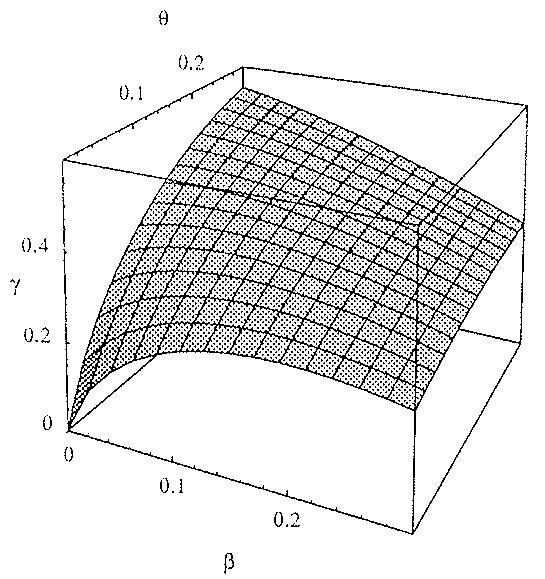
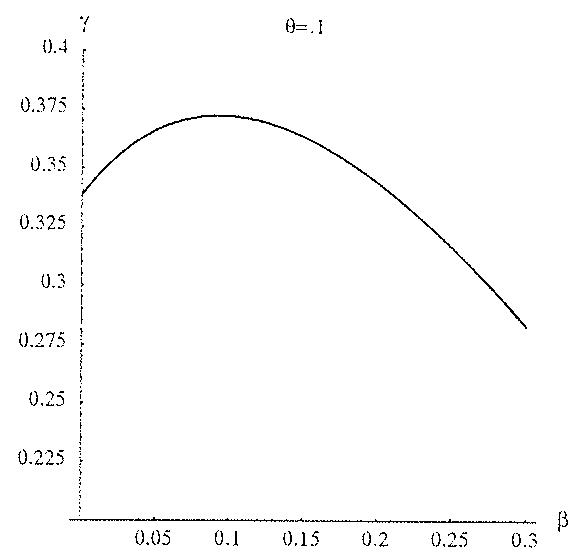
Numerical simulations show that, when life expectancy is below a certain threshold, or when the discount rate is above a certain threshold, the two first effects dominate. From figure 1, we observe that if the discount factor is low enough the effect of on is hump shaped. Starting from a situation in which agents have an infinite horizon ( ), a rise in first leads to an increase in the growth rate. After some point, the sign of the effect changes and a rise in leads to a drop in . If the discount factor is high, the effect of on is always negative. From an empirical point of view, we should thus observe that the effect of life expectancy on growth is positive for countries with a relatively low life expectancy, but could be negative in more advanced countries.
To study the dynamics of this economy, we define detrended human capital as
\[z (t) = I I (t) e ^ {- \gamma t}.\]
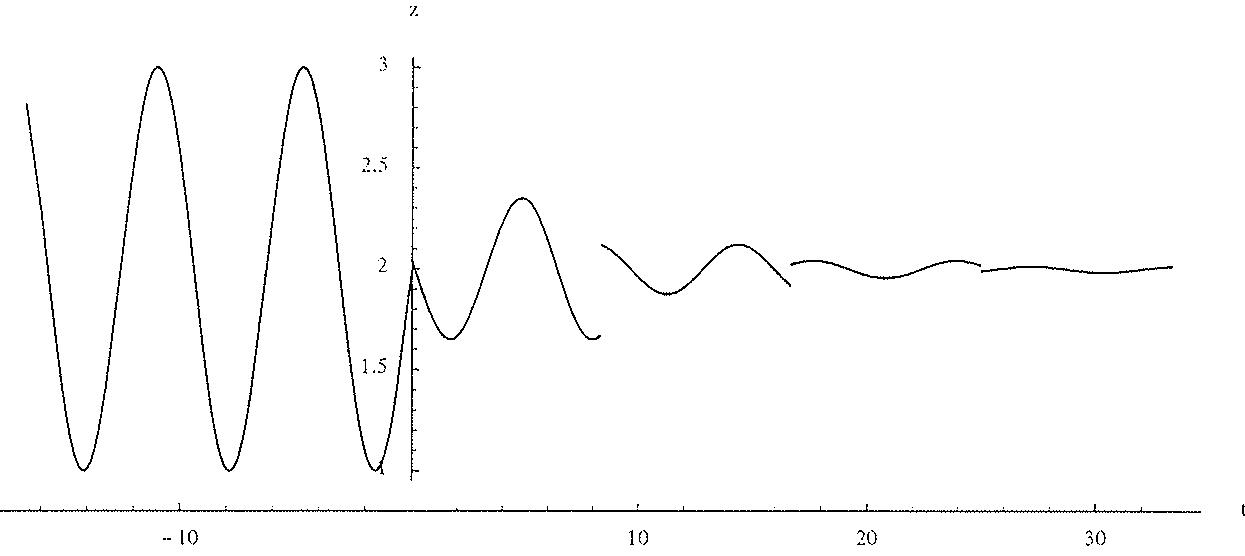
Figure 2: Dynamics The DDE (9) becomes
\[z ^ {\prime} (t) = (\beta + \gamma) (z (t - T) - z (t)).\tag{11}\]
To solve it, we follow Bellman and Cooke (1963). We guess that is a solution. Then,
\[s = (\beta + \gamma) (e ^ {- s T} - 1).\tag{12}\]
If is a solution of equation (1.2), by linearity
\[z (t) = \sum p _ {k} e ^ {s _ {k} t}.\]
Equation (11) is identical to the one handled by Boucekkine, del Rio and Licandro (1997). Using the results of the later authors, we know that any root of the equation (12) has non-positive real part. The only root with zero real part is . Then, (11) is asymptotically stable. Moreover, the solution path is oscillatory because except the origin, the system only admits complex non-real roots.
An example of this oscillatory dynamics is provided in figure 2. We have assumed that , , and . The optimal time spent on education is 8.33. The average level of the initial conditions gives the stationary level of the solution, i.e. . We observe that converges to its stationary level. There are two types of oscillations: first, there are discontinuities at with a reduction in the amplitude of the fluctuations from each interval to the next. Second, echoes coming from the initial conditions could be observed at the interior of each interval.
3 Concluding comments
When households have to decide the moment at which they will leave school to work, life expectancy is a central factor that affects positively the optimal length of education, and hence, the growth rate of the economy. However, the positive effect of a longer life on growth could be offset by a decrease in the participation rate.
To derive this result in a simple way, we have made the assumption of a linear utility function and of the absence of physical capital. A further investigation of the role of life expectancy on the dynamics of growth should include a more general utility function and introduce physical capital. This enrichment of the model makes the problem significantly more difficult to solve, because the optimal length of education would be no longer constant over time. The dynamics will then be described by a mixed-delay differential system with endogenous leads and lags (Boucekkine, Germain, Licandro and Magnus (1997) propose a shortcut to deal with this type of model). The solution to this problem is on our research agenda.
References
- Azariadis, C. and A. Drazen (1990) "Threshold externalities in economic development". Quarterly Journal of Economics, 101:501-526.
- Barro, R. and X. Sala-I-Martin (1995) Economic growth. McGraw-Hill.
- Bellman, R. and L. Cooke (1963) Differential-difference equations. Academic Press.
- Benhabib, J. and A. Rustichini (1991) “Vintage capital, investment, and growth”. Journal of Economic Theory, 55:323–339.
- Blanchard, O. (1985) “Debts, deficits and finite horizon”. Journal of Political Economy, 93:223–247.
- Boucekkine, R., F. del Rio and O. Licandro (1997) “Replacement investment, endogenous fluctuations and the dynamics of job creation and job destruction”. Working Paper 9713, FEDEA, Madrid.
- Boucekkine, R., M. Germain and O. Licandro (1997) "Replacement echoes in the vintage capital growth model". Journal of Economic Theory, 74:333–348.
- Boucekkine, R., M. Germain, O. Licandro and A. Magnus (1997) “Creative destruction, investment volatility and the average age of capital”. Working Paper 9708, FEDEA, Madrid.
- Corless, R., G. Gonnet, D. Hare, D. Jeffrey and D. Knuth (1996) "On the Lambert W function". Advances in Computational Mathematics, 5:329-359.
- Lucas, R. (1988) “On the mechanics of economic development”. Journal of Monetary Economics, 22:3–42.
- Saint-Paul, G. (1992) "Fiscal policy in an endogenous growth model". Quarterly Journal of Economics, 107:1243–1259.
COLECCION RESUMENES
97-01: “Geografía económica y crecimiento”, Juan J. de Lucio.
TEXTOS EXPRESS
97-02: "Il Encuesta sobre la UEM InterMoney-FEDEA: Resultados". C. Arenillas, J. A. Herce, J. A. Ketterer, S. Sosvilla y D. Vegara.
97-01: “La cuestión de las pensiones”, José A. Herce.
DOCUMENTOS DE TRABAJO
97-23: “Life expectancy and endogenous growth”, David de la Croix y Omar Licandro.
97-22: "Los efectos de los planes Renove y Prever sobre el reemplazo de turismos", Omar Licandro y Antonio R. Sampayo.
97-21: “Geografía económica: Aglomeración, localización y externalidades”, Juan J. de Lucio.
97-20: “Divide et impera: Bargaining and incentives within a hierarchy”, Diego R. Palenzuela y Justo Jorge Moreno.
97-19: “Union effects and the reform of labor relations, with consensus”, Diego R. Palenzuela.
97-18: "Pay determination in the Spanish public sector", Cecilia Albert, Juan F. Jimeno y Gloria Moreno.
97-17: "Provision of private health insurance under public insurance captivity". Diego R. Palenzuela.
97-16: "Inversión directa extranjera y especialización comercial en los países periféricos. Salvador Barrios.
97-15: “Replacement echoes in durable goods purchases”, Raouf Boucekkine y Omar Licandro.
97-14: "Credibility in the EMS: New evidence using nonlinear forecastability tests", F. Fernández-Rodríguez, S. Sosvilla-Rivero, J. Martín-González.
97-13: "Replacement investment, endogenous fluctuations and the dynamics of job creation and job destruction". Raouf Boucekkine, Fernando del Rio y Omar Licandro.
97-12: “La demanda de automóviles en España: Un análisis de la evolución y variabilidad de las tasas de reemplazo”, Omar Licandro, Antonio R. Sampayo.
97-11: "Respuesta de los tipos de interés nominales españoles a shocks de inflación esperada y de tipos de interés real ex-ante: Una aplicación VAR estructural", Vicente Esteve.
97-10: “Convergence in fiscal pressure across EU countries”, Vicente Esteve, Simón Sosvilla y Cecilio Tamarit.
97-09: “Evaluación de los efectos macroeconómicos del fondo de cohesión en España”, Juan Carlos Císcar.
97-08: "Creative destruction, investment volatility, and the average age of capital". R. Boucekkine, M. Germain, O. Licandro y A. Magnus.
97-07: "Spatially and intertemporally efficient waste management: The costs of interstate flow control", Eduardo Ley, Molly K. Macauley y Stephen W. Salant.
97-06: “Are there any special features in the Spanish business cycle? Luis Puch y Omar Licandro.
97-05: “Los factores específicos del paro en Andalucía” Juan F. Jimeno.
97-04: “The effects of minimum bargained wages on earnings: Evidence from Spain”. Juan J. Dolado, Florentino Felgueroso y Juan F. Jimeno.
97-03: "Convergence in social protection benefits across EU countries", Javier Alonso, Miguel Angel Galindo y Simón Sosvilla.
97-02: "Public-good productivity differentials and non-cooperative public-good provision", Eduardo Ley.
97-01: "Paridad del poder adquisitivo: Una reconsideración", F. J. Ledesma, M. Navarro, J. V. Pérez y S. Sosvilla.
Este texto se ha extraído automáticamente del documento original. Para citarlo o leerlo con su maquetación, descargue el PDF.
Descargar en PDF