Healthier Starts: The intergenerational Effects of Maternal General Skills
CRISTINA BORRA
PILAR CUEVAS-RUIZ
ALMUDENA SEVILLA
Documento de Trabajo 2026/10 Octubre 2026
fedea
Las opiniones recogidas en este documento son las de sus autores y no coinciden necesariamente con las de Fedea.
Cristina Borra† Pilar Cuevas-Ruiz‡ Almudena Sevilla§
September 17, 2026
Abstract
We examine the long-term effects of maternal general education on infant health, leveraging a nationwide secondary school reform in Spain that expanded academic instruction without increasing years of schooling. Using newly digitized enrollment data linked to administrative birth records, we find that the reform significantly reduced very preterm birth and overall prematurity, with gains concentrated at the lower tail of the gestational age distribution. Mechanism evidence from high-quality adult survey data is consistent with reform-induced improvements in women’s information-processing skills, reductions in risky prenatal behaviors, higher labor force participation, and more effective family planning.
Keywords: Health at Birth; Health Behaviors; Information Processing Skills; Intergenerational Transmission
JEL Codes: I12; I14; J13
Publication Funding. This publication is part of the project PID2022-141375OB-I00, funded by MICIU/AEI/ 10.13039/501100011033 and by ERDF/EU.
Acknowledgments. We thank Gabriella Conti, Libertad González, Bahadir Dursun, Cecilia Garcia-Peñalosa, Lind say Macmillan, Cristina Bellés Obrero, Isabel Ruiz, Ana Rute Cardoso, Juan Vargas, and participants at the CUNY Graduate Center (Queens College), Boston University Department of Economics, University College London (UCL) Institute of Education (IoE), the 2023 EEA ESEM Congress (Barcelona School of Economics), the 2023 Risky Behaviour Conference at the London School of Economics, the 2024 Annual Conference of the European Society for Population Economics, Universitat Aut`onoma de Barcelona, and Fundación Ramón Areces. Cristina Borra acknowledges funding from the Spanish National Research Plan 2017–2020 (RTI2018-098217-B-I00) and 2021–2023 (PID2022-141375OB I00). Pilar Cuevas-Ruiz acknowledges funding from Fundación Ramón Areces. Almudena Sevilla acknowledges funding from the ERC Consolidator Grant PARENTIME (ERC-2017-COG, SH3).
† Universidad de Sevilla and IZA. Email: cborra@us.es
‡ Universidad de Sevilla. Corresponding author. Email: pcuevas1@us.es
§ London School of Economics and IZA. Email: a.sevilla@lse.ac.uk
1 Introduction
Health at birth deficits, such as low birth weight and preterm birth, have persistent negative effects on individual well-being and impose substantial burdens on both health systems and families (Cunha et al., 2010; Currie, 2011; Almond et al., 2018). For individuals, being born preterm is the leading cause of infant mortality before the age of five, and the labor market penalties of being born low weight are large. A 10% decrease in birth weight reduces full-time earnings by approximately 1%, comparable to losing a quarter year of education (Black et al., 2007; Currie and Moretti, 2007). For the economy as a whole, the financial burden is further reflected in high medical costs. Saving a newborn life at a birth weight near 1,500 grams is estimated to cost approximately $550,000 (in 2006 dollars) (Almond et al., 2010). Despite significant advancements in medical care over the past decade, the challenge remains, as the global incidence of preterm birth has remained largely unchanged (WHO-UNICEF, 2023). This persistent trend has led to growing calls for interventions beyond medical care, emphasizing the need to address socioeconomic factors such as poverty and access to education to effectively tackle these deficits (Almond and Currie, 2011; Aizer and Currie, 2014; Aizer et al., 2022). While prior research shows that maternal education improves infant health, the role of general education remains unclear because large-scale reforms jointly alter education content and years of schooling. Yet answering this question is central for policy, as governments routinely make curriculum design choices with potential intergenerational consequences. Leveraging a nationwide high-school reform in Spain that expanded general education content without extending years of schooling, we present the first causal evidence at scale on the effect of general education on a wide range of infant health outcomes.
Standard economic models of human capital identify multiple channels through which maternal general education, acquired during adolescence, shapes infant health outcomes (Cunha and Heckman, 2007, Heckman, 2007). Compared with vocational instruction, which aims to develop occupation-specific skills, general education builds cognitive flexibility and analytical skills that are broadly applicable across contexts, improving mothers’ ability to acquire, process, evaluate, and act on information relevant to health and fertility decisions (Grossman, 1972; Thomas et al., 1991). Higher-skilled mothers are more likely to adopt healthier behaviors, including reduced smoking, greater use of prenatal care, and more effective contraception (Rosenzweig and Schultz, 1989; Currie and Moretti, 2003), as these decisions require understanding risks, interpreting medical advice, and responding to new information. For example, this includes higher ability to learn about the risks of alcohol consumption during pregnancy, using contraceptives effectively, and correctly following medical instructions, such as reading a drug prescription or interpreting health advice. General education also raises mothers’ earning potential, directly through skills that are transferable across occupations and sectors and indirectly through positive assortative mating with more educated partners (Goldin, 2001, Hanushek et al., 2017). Higher household resources, in turn, enable greater investment in health inputs such as nutrition, prenatal care, and housing, improving infant health outcomes (Behrman and Rosenzweig, 2004; Currie, 2009).
Spain’s 1990 LOGSE reform offers a particularly clean setting to study the causal effect of general education on infant health, because it substantially expanded students’ exposure to general education without raising total years of schooling. Introduced to align Spain’s education system with European Communities standards following Spain’s accession in 1986, the reform replaced a system in which students sorted into general or vocational programs at age 14 with a common general program for all students until age 16. Under the pre-reform system, vocational students received occupation-specific training and apprenticeships with minimal academic instruction, so the shift to a common general program represented a large change in education content for this group, without any corresponding change in years of schooling. The reform was implemented against a background of near-universal school attendance among 14- to 16-year-olds, largely due to a 1980 national labour law setting the minimum legal working age at 16, so that the expansion in general education content was not accompanied by an increase in enrollment.1 Implementation was staggered across provinces between 1989 and 2000, with timing driven by administrative and logistical constraints, such as teacher availability and infrastructure capacity, rather than by local socioeconomic or health conditions. Because vocational and general programs were typically offered within the same schools, the reform entailed minimal changes in peer composition, allowing us to isolate the role of general education from the effect of other schooling inputs.
Our analysis combines newly digitized administrative records with population-wide health data, allowing us to measure both exposure to the LOGSE reform and infant health outcomes with unusual precision. We construct a continuous, province–cohort index of reform exposure using enrollment records from the 1989–2000 school years, which captures the phased rollout of LOGSE and closely mirrors its implementation. We link this exposure index to administrative birth records containing detailed information on infant health and maternal characteristics. To investigate underlying mechanisms, we further link these data to multiple nationally representative surveys collected when the treated cohorts reached childbearing age, providing a rare combination of outcomes on education, information processing skills, labor market participation, and maternal health behaviors.
We use a generalized difference-in-differences (DiD) design that exploits quasi-experimental variation from the staggered rollout of the LOGSE reform across provinces and birth cohorts. The specification allows outcomes to evolve flexibly across cohorts and provinces, accounting for smooth differences in underlying trends and isolating variation associated with reform exposure rather than fixed provincial differences or common time shocks. We complement our baseline design with a dynamic event-study approach that is robust to heterogeneous treatment effects, as is standard in settings with variation in treatment timing and intensity (De Chaisemartin and D’Haultfœuille,
1Servicio de Estudios Estadísticos (1994).
2024). We further assess robustness to time-varying provincial characteristics and mobility.
We find that exposure to general education improves infant health across a wide range of outcomes. An additional year of general schooling reduces very preterm birth by 0.13 percentage points, a 16% decline relative to baseline, corresponding to approximately 388 fewer very preterm births per cohort of 150,000 births. Since very preterm births account for roughly 52% of deaths before age five in high-income countries (Barfield, 2018), this implies a reduction in infant mortality of approximately 8% per additional year of general schooling. We also find a 4.2% reduction in preterm birth, and positive point estimates on low birth weight and gestational age, although these are less precisely estimated. The pattern of effects across gestational weeks, with improvements throughout the lower tail of the distribution, is consistent with a nationwide reform operating across the full population, where education-driven gains are concentrated among births at higher baseline risk.
Additional evidence indicates that increased exposure to general education content is the key channel through which the reform improved infant health. In the pre-reform setting labour market regulations in Spain meant that the majority of teenagers remained in school until age 16. Consistent with this, the LOGSE reform did not change average years of schooling, high school completion, or college attendance. The absence of changes in these educational outcomes aligns with our finding that the health gains are concentrated among girls who would have entered vocational programs in any case. For this group, the reform delayed entry into vocational education by two years, resulting in two additional years of general academic instruction, while leaving the educational trajectories of girls in the general education program unchanged. We also rule out that our results are driven by changes in peer composition or fertility behavior.2
We investigate the mechanisms linking increased exposure to general education to improvements in infant health at birth by examining adult information processing skills, health behaviors, and la bor and marriage market outcomes. Mothers exposed to more general education score significantly higher in numeracy in the 2011 PIAAC assessments, consistent with lasting gains in informationprocessing skills. These skill improvements are accompanied by lower alcohol consumption during pregnancy and a higher likelihood of marriage prior to birth, patterns indicative of healthier behaviors and greater capacity to plan fertility. The reform also increases maternal labor force participation by 3.2%, with no corresponding changes in occupational status, partnership rates, or partner characteristics, pointing to effects concentrated on the extensive margin of labor supply. These patterns align with the observed reductions in very preterm birth and very low birth weight and are consistent with improved information-processing skills, related health behaviors, and stronger maternal attachment to the labor market as plausible mechanisms.
2In a standard quantity–quality framework, higher education may affect fertility timing or completed fertility (Becker, 1973; Goldin, 2006).
Our analysis makes two main contributions to the literature. First, we identify a previously unmeasured margin through which education affects the next generation: the type of human capital schools produce. Previous studies using nationwide school interventions that increased years of schooling without altering curriculum content generally find limited effects on infant health outcomes (Lindeboom et al., 2009; McCrary and Royer, 2011). In contrast, studies of comprehensive school reforms and college expansions that simultaneously increased schooling duration and exposure to general academic instruction find improvements in infant health (Currie and Moretti, 2003; Grytten et al., 2014). More recently, Dursun et al. (2024) show that increasing academic course requirements within the U.S. general high school track also improves infant health outcomes for Black mothers. These findings suggest that general education content may play an important role in shaping intergenerational health. Yet existing interventions do not cleanly isolate the effect of broad general education either because they also extend years of schooling or because they capture piecemeal changes in course requirements within an already general secondary curriculum. We address this question using Spain’s 1990 LOGSE reform, which replaced early vocational specialization with two additional years of broad general education while holding total years of schooling constant, generating a large shift from specialized to broad-based human capital acquisition during adolescence for students who would otherwise have entered vocational pathways. Combining the nationwide implementation of the reform with continuous province-cohort variation in exposure and population-wide administrative birth records covering the universe of births in Spain, we estimate the causal effect of general education across the full distribution of birth outcomes, including rare but economically costly outcomes such as very low birth weight and extreme prematurity. We find that greater exposure to general education substantially improves infant health outcomes, with the largest effects concentrated at the lower tail of the birth outcome distribution. That these effects emerge in Spain, a country with universal prenatal care and a generous welfare state, suggests that the effects of general education may be even larger in settings with weaker social insurance systems and more limited access to healthcare.
We also contribute new evidence on the mechanisms linking maternal general education to infant health. Prior evidence documents improvements in maternal behaviors and socioeconomic outcomes, including reductions in smoking and increases in prenatal care utilization (Currie and Moretti, 2003; McCrary and Royer, 2011; Dursun et al., 2024), as well as gains in household resources operating partly through partner characteristics (Currie and Moretti, 2003; Lindeboom et al., 2009; McCrary and Royer, 2011). Far less is understood about how these mechanisms operate in response to increases in maternal general education in isolation. We address this gap by linking exposure to a secondary school reform to adult information processing skills, and to related outcomes in health behavior, marriage, and labor supply. The evidence is consistent with improvements in informationprocessing skills, healthier prenatal behaviors, and greater maternal labor force participation as potential channels through which general education may affect infant health, and with adolescence being a crucial window for educational investments with lasting intergenerational effects (Almond et al., 2018; Guryan et al., 2023; Currie and Aizer, 2024).
The remainder of the paper is organized as follows. Section 2 describes the institutional background of the Spanish secondary education system before and after the LOGSE reform. Section 3 presents the data, sample construction, and the reform exposure index underlying the identification strategy. Section 4 outlines the empirical framework. Section 5 reports the main results on maternal education and infant health outcomes, together with a set of robustness and validation exercises. Section 6 examines the mechanisms through which increased exposure to general education affects infant health at birth. Section 7 concludes.
2 Institutional Background: the LOGSE Reform
The 1990 LOGSE reform was introduced by the national government with the aim of improving workforce competitiveness and supporting Spain’s integration into the European Union. Before LOGSE, the Spanish education system was governed by the 1970 LGE reform, which allowed students to access either upper secondary general education or vocational studies at age 14. Following the LOGSE reform, all students were required to follow a common core of general education subjects until age 16. This change delayed early specialization and ensured that all students acquired core academic skills before entering the labor market.3
Figure 1 compares the pre- and post-reform lower secondary education curricula. Panel A shows that, before LOGSE, vocational students at age 14 received limited general instruction, focusing instead on occupation-specific training and apprenticeships. In contrast, students in the general education program followed a broader set of academic subjects, referred to as the general education curriculum. As illustrated in Panel B, the reform eliminated vocational instruction from lower secondary education, requiring all students to complete a common core in general education subjects through age 16. While the academic content of the general education program remained largely unchanged, the reform substantially altered the curricula for vocational students by extending to them the same general education curriculum previously followed only by their general education program peers.
3For the legal foundations of the reforms, see Organic Law 1/1990, which implemented the LOGSE reform (Ley Orgánica de Ordenación General del Sistema Educativo), and Law 14/1970, which introduced the earlier LGE reform (Ley General de Educación).
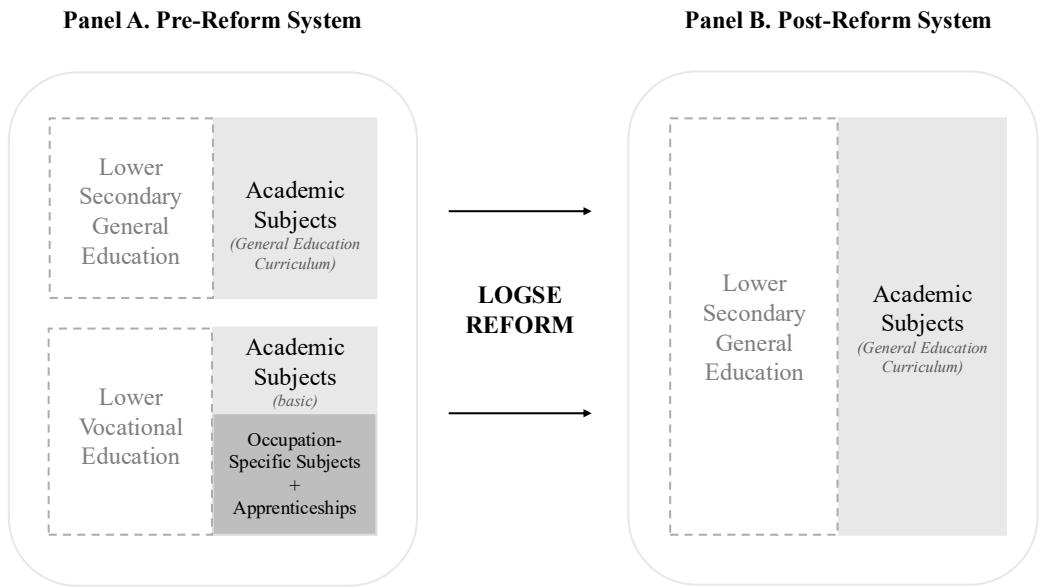
Notes: The general education curriculum under the pre-reform system (Panel A) included core academic subjects such as mathematics, sciences, Latin, social sciences, languages (native and foreign), and physical education. Vocational students under the pre-reform system (Panel A) received basic academic instruction limited to social sciences, languages, and physical education, alongside five occupation-specific subjects and apprenticeships. In the post-reform system (Panel B), the common general education curriculum included the same core academic subjects in the prereform system (mathematics, academic stream-specific subjects such as sciences and Latin, social sciences, languages (native and foreign), and physical education) plus ethics, and technology and digitalization.
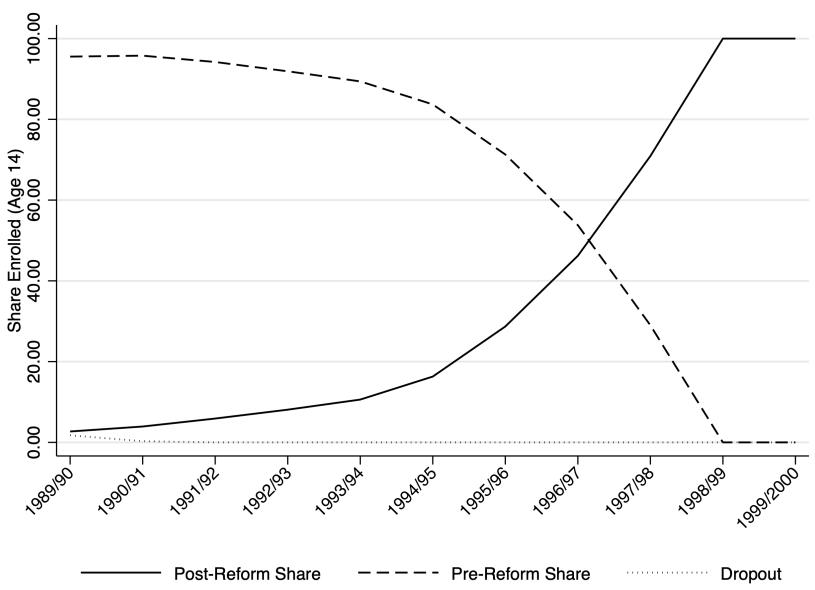
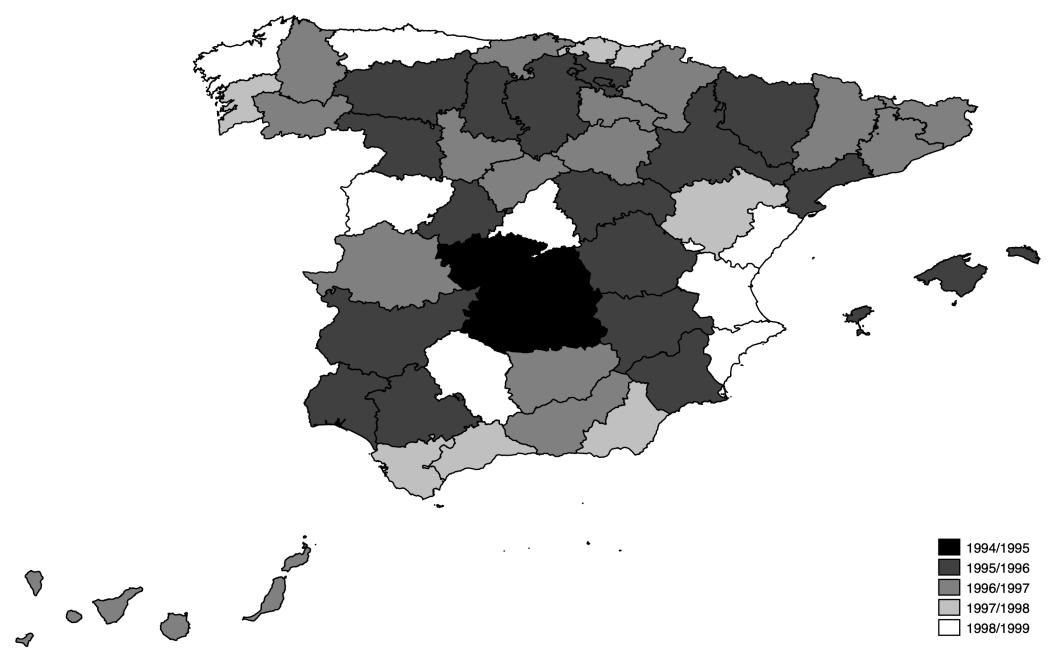
The Spanish central government allowed education centers up to ten school years, from 1989-1990 to 1999-2000, to fully implement the LOGSE reform. This resulted in a staggered roll-out across provinces with students’ exposure to the reform varying substantially both across space and time. Panel A in Figure 2 uses enrollment data from national education registries to show how, over the transition period, the share of 14-year-olds enrolled in the post-reform system steadily increased, while enrollment in the pre-reform system declined at a similar rate. Importantly, dropout rates remained close to zero throughout this period. At the start of the rollout in 1989–1990 school year, 5% of 14-year-olds were in the post-reform secondary education system. Enrollment shifted gradually, reaching a 50–50 split by 1996–1997 school year, and 99% in the post-reform system by 1998–1999 school year. Panel B in Figure 2 highlights that the pace of implementation differed markedly across provinces, contributing to significant spatial variation in students’ exposure to the reform. This variation is visually represented through shading, with darker provinces adopting earlier. Some provinces reached over 50% enrollment of 14-year-olds in the post-reform system as early as the 1994–1995 school year, while others did not cross this threshold until 1998–1999 school year.
The timing of implementation varied due to administrative decisions made across multiple levels of government including local, regional, and national. These differences arose from the complex and often lengthy processes involved in navigating the regulatory framework. Regional and local education authorities were responsible for adapting school infrastructure and the supply of subjectspecific teachers to meet the new curricular requirements, while the national government set the legislative framework and administered the funding. As noted by Marchesi (2020), the implementation process faced a range of administrative challenges that varied considerably across provinces. First, local systems faced acute teacher shortages driven by the expanded academic requirements for vocational students. Second, infrastructure-related delays arose from the need to reconfigure facilities in order to integrate these students into the enhanced general education framework. Third, unexpected changes in cohort sizes also disrupted planning and implementation. These shocks are arguably orthogonal to potential changes in the health of the next generation, and provide a source of exogenous variation that we exploit for identification. Previous studies have similarly exploited variation in the staggered implementation of LOGSE, using alternative measures of reform exposure, to study educational, cognitive, and labor market outcomes (Felgueroso et al., 2014; Felfe et al., 2015; Robles-Zurita, 2017; Bellés-Obrero and Duchini, 2019).
Due to key institutional features, the LOGSE reform increased general education content while keeping other critical factors largely unchanged. First, the reform did not affect total years of schooling. According to official figures, secondary school enrollment among 14- to 16-year-olds was already nearly universal, around 95%, before the reform.4 As documented by Bellés-Obrero and Duchini (2021), this was largely due to a 1980 national labor law setting the minimum working age at 16, which effectively limited the outside options available to teenagers and kept them in school.5 Our first-stage results confirm this in section 5.1. Second, the LOGSE reform led to limited changes in peer composition, as students were already learning in integrated environments prior to its implementation given that vocational and general education programs were frequently housed within the same school buildings, a pattern supported by the evidence in section 5.3.
3 Data
To measure the causal impact of mothers’ increased general education on children’s health at birth, we use a rich set of high-quality administrative registers that offer both fine-grained educational exposure measures and complete population coverage of birth outcomes. Table A1 in the Appendix provides an overview of the data sources, including the register name, unit of observation, a brief description, main outcome variables, and other available information.
Exposure to the LOGSE reform is captured by a province-level intensity index constructed using administrative enrollment records from 1989–1990 to 1999–2000, which we manually digitized. The exposure index captures the granular variation in implementation intensity at age 14 across birth cohorts and provinces (see Panel A in Table A1 in the Appendix). Specifically, the LOGSE exposure index reflects the number of 14-year-old students enrolled in the old and new systems during the transition period, based on high-resolution province-by-school-year data. Focusing on 14-year-old allows for a sharp definition of treatment that aligns with the institutional design of the reform. This approach minimizes contamination from partially treated or untreated individuals, ensures that we capture true variation in general education exposure (rather than downstream educational choices), and reduces measurement error in treatment assignment. The index of reform exposure is calculated as shown in equation (1):
4See Servicio de Estudios Estadísticos (1994) for enrollment rates.
5Law 8/1980 of the Workers’ Statute.
Panel A. Share of 14-Year-Old Students Enrolled in Pre- and Post-Reform Systems, by School Year Panel B. School Year When Each Province First Reached 50 Percent of 14 Year Old Students Enrolled in the Post Reform System
\[R e f o r m E x p o s u r e _ {t k} = \frac {L O G S E _ {t k}}{L O G S E _ {t k} + L G E _ {t k}}\tag{1}\]
Where ReformExposuretk is a continuous treatment variable that captures the intensity and timing of LOGSE implementation, measured as the proportion of 14-year-old students in cohort t and province k enrolled under the new system. The numerator reflects the number of students enrolled in the post-reform (LOGSE) general education program, while the denominator includes all 14-year-olds enrolled in either the post-reform (LOGSE) system or the pre-reform (LGE) general or vocational programs. To precisely identify first-time exposure, we include in the numerator repeaters from earlier cohorts who, due to grade repetition, were 14-year-old and enrolled when the new system was introduced. We exclude repeaters from the current cohort who had not progressed to the appropriate grade and thus were not yet exposed. The index ranges from 0 (no student enrolled under LOGSE) to 1 (full coverage within a province-cohort). Figure A1 in the pendix presents three province-level maps illustrating the evolution of the LOGSE exposure index (ReformExposuretk) across representative school years during the transition period. By combining fine-grained administrative data with a cohort- and grade-specific construction strategy, the index captures detailed variation in exposure intensity across provinces and birth cohorts.
Birth outcomes for the children of mothers exposed to the reform are constructed using populationwide microdata from birth certificates provided by the Spanish National Statistical Institute (INE) (see Panel A in Table A1 in the Appendix). The dataset covers the universe of births in Spain from 2000 to 2018, drawn from the official civil registry, where registration is mandatory and completed shortly after delivery. In addition to detailed child-level outcomes, such as gestational age, birth weight, and birth order, the data include rich information on maternal characteristics, including, province of residence, and cohort of birth. This level of detail is crucial for accurately linking mothers to their exposure to the LOGSE reform, which we define based on the mother’s cohort and province of residence at the time of childbirth.6 The combination of comprehensive population coverage and unusually rich maternal detail makes these data well suited for linking to education records and for studying how changes in maternal education affect children’s health at birth.
Our sample consists of 1,521,770 first births occurring between 2000 and 2018 to mothers born between 1975 and 1985 and aged 25–33 at first birth. We focus on first-time mothers for three reasons. First, infant health at first birth may causally shape subsequent fertility and parental investment choices, making first births the most informative margin for studying the influence of maternal education (Wolpin, 1997). Second, higher-order births reflect parents’ fertility preferences, including desired family size, timing, and spacing, which are systematically related to maternal education through the Becker quantity–quality framework; analyzing first births therefore provides a sample that is conceptually aligned with this theoretical structure. Third, restricting attention to first births follows standard practice in the literature and facilitates direct comparability with prior literature (eg. McCrary and Royer, 2011). We select mothers born between 1975 and 1985 because these cohorts turned age 14 during the 1990s and were differentially exposed to the staggered rollout of the LOGSE reform across provinces. We further restrict the sample to mothers aged 25–33 at first birth. The lower age bound ensures that women have completed their education by the time they give birth, allowing us to capture the full LOGSE-induced increase in maternal general education. Skills acquired during compulsory schooling enhance the productivity of later learning and capabilities, making completed schooling, rather than education in progress, the relevant causal margin (Heckman, 2007). The upper age bound corresponds to the oldest age at which the youngest treated cohort is observed by the end of our sample period, ensuring common support across cohorts.
6We use the mother’s province of residence at the time of delivery as a proxy for the province where she attended high school. This is a reasonable assumption in the Spanish context, where internal migration is relatively low. Using microdata from the 2021 Spanish Census, we estimate that over 90% of women give birth in the same province where they lived at age 14. In section 5.3, we also show that the staggered rollout of the reform was not associated with changes in cross-province migration patterns among women in our sample.
To alleviate concerns about selection into this sample, as we sample only women who become mothers, we confirm that LOGSE did not affect either the likelihood of becoming a mother or the timing of first births, as shown in Section 5.3. We also document that our main results on infant health at birth are robust to extending the sample to mothers aged up to 43, corresponding to the end of the fertile age range. As shown in Table A3 in the Appendix, the resulting estimates are very similar to our baseline results (Table 2), indicating that our age restriction does not exclude a margin along which the reform affects infant health outcomes.
Following standard practice in the literature, we proxy health at birth using birth weight and gestational age. In particular, we focus on the incidence of low birth weight (less than 2,500 grams), very low birth weight (less than 1,500 grams), preterm birth (less than 37 weeks), and very preterm birth (less than 32 weeks). These clinically meaningful and widely accepted measures are widely used to document the strong association between maternal education and infant health, and to capture the impact of early health on later-life outcomes.7
The incidence of adverse birth outcomes in our birth records is similar to rates in other highincome countries with universal healthcare systems providing broad access to prenatal, delivery, and postnatal care, as in Spain. For example, the share of very preterm births in our sample (about 1%) is similar to estimates reported in other high-income settings (Larroque, 2004; Barfield, 2018; Ohuma et al., 2023). Detailed summary statistics and definitions of the health outcomes used in the analysis are provided in Appendix Table A4.
7See, for example, Currie and Moretti (2003); Behrman and Rosenzweig (2004); Almond et al. (2005); Oreopoulos et al. (2006); Chou et al. (2010); McCrary and Royer (2011), among others.
To further support the validity of our identification strategy and examine potential mechanisms linking maternal education to infant health, we draw on several complementary administrative and survey data sources. These additional datasets, summarized in Panel B of Table A1 in the Appendix, allow us to assess changes in maternal educational trajectories, labor market outcomes, cognitive skills, and health behaviors, thereby enabling a richer understanding of how the reform may have improved early-life health.
We study the educational choices of potential mothers using the 1991–2018 Spanish Labor Force Survey (LFS), a nationally representative, continuous quarterly survey conducted by the national statistical office. The LFS collects demographic, labor market, and educational attainment information for all household members aged 16 and older across roughly 65,000 households (about 160,000 individuals) per quarter. In line with prior studies and to avoid seasonality concerns, we use data from the second quarter of each year.8 Our analytic sample includes 194,687 Spanish women born between 1975 and 1985, the cohorts directly affected by the reform, aged 17 to 33 at the time of interview, closely mirroring the women in our main birth register sample.
The richness of the LFS allows us to examine both enrollment patterns during schooling years and completed educational attainment. To capture enrollment patterns before education is complete, we analyze the share of women enrolled in different programs between ages 17 and 24. To measure completed education, we use data on the highest qualification earned and the age of completion between ages 25 and 33, when most women have exited the education system. These analyses provide a detailed picture of how the reform influenced exposure to general education and offer strong support for the first stage of our identification strategy. Summary statistics and definitions are reported in Table A5 in the Appendix.
8See for instance Amuedo-Dorantes et al. (2023).
We use data from the 2011 Spanish wave of the Program for the International Assessment of Adult Competencies (PIAAC) to examine whether improvements in information-processing skills represent a potential mechanism linking increased general education to infant health. Developed by the OECD, PIAAC measures adults’ proficiency in key information-processing skills across multiple domains, including literacy and numeracy, which capture the cognitive abilities required to understand, evaluate, and use written and numerical information in everyday contexts. We focus on the literacy and numeracy domains. PIAAC reports ten plausible values per domain, each representing a draw from the posterior distribution of latent ability conditional on item responses and background characteristics, to account for measurement error in individual skill assessments. We standardize each plausible value (which range from 0 to 500) to mean zero and unit standard deviation within our sample and combine estimates across plausible values following Rubin (1987) rules, so that standard errors reflect both sampling variability and measurement uncertainty. The survey also collects basic demographic information, including gender, year of birth, and region of residence, which we use to link respondents to our reform exposure index.
We focus on a sample of 410 interviewed women aged 25 to 33 born between 1979 and 1985, who turned 14 during the years when the LOGSE reform was being implemented. This sample overlaps closely with the cohorts analyzed in our main specification and allows us to assess skill acquisition for mothers exposed to the reform. The timing of the survey provides a unique opportunity to observe cognitive outcomes in a nationally representative sample of adults affected by the reform, offering rare insight into a mechanism that is typically unobserved in similar studies. Summary statistics and variable definitions are provided in Table A6, Panel A, in the Appendix.
We complement this analysis by examining risky health behaviors using data from the Spanish Alcohol, Tobacco, and Illegal Drugs Surveys. Conducted by the Spanish Observatory on Drugs and Addictions, these surveys provide nationally representative data on psychoactive substance use and basic demographics, including year of birth and province of residence, for residents aged 15 to 64. Interviews are conducted in person at respondents’ homes, with an interviewer present throughout the completion of the questionnaire to ensure data quality.
To capture health behaviors during pregnancy, we use the 2017 wave, the only one reporting alcohol consumption during pregnancy, and restrict the sample to mothers born between 1975 and 1985, yielding 2,314 observations.9 To examine lifetime substance use, we draw on the 2007 wave, which includes questions on alcohol, tobacco, and drugs such as cannabis, cocaine, ecstasy, amphetamines, and tranquilizers. For this analysis, we restrict the sample to women aged 25 to 33 born between 1975 and 1983 who report at least one co-residing child, resulting in 1,003 observations.10 Table A6, Panel B, in the Appendix presents the definitions and summary statistics of the relevant variables. Together, these data offer rare insight into behaviors that are typically unobserved in administrative sources and allow us to assess whether exposure to general education reduces risky maternal behavior, a key mechanism emphasized in the literature. Summary statistics and variable definitions are provided in Table A6, Panel B, in the Appendix.
Finally, we examine increased maternal earning potential as a second channel through which general education may affect infant health, drawing on detailed information from the birth register data. Specifically, we analyze mothers’ marital status, labor force participation, occupation, partner characteristics, and age at first birth. These outcomes capture broader socioeconomic returns to general education and provide insight into whether improved economic conditions for mothers contribute to better birth outcomes for their children. Table A7 in the Appendix presents variable
9We do not restrict this sample by current household composition or age, as pregnancy can occur throughout the reproductive years, and the survey includes retrospective questions on behaviors during past pregnancies.
10We exclude women born after 1983, as they had not yet reached age 25 by 2007.
definitions and summary statistics.11
4 Empirical Model
To identify the causal impact of increased maternal general education on infant health at birth, we exploit the staggered implementation of a major education reform in Spain. We draw on quasiexperimental variation in exposure to general education generated by the differential rollout of the LOGSE reform across provinces and over time. We estimate a generalized DiD model using maternal exposure to the reform as a continuous treatment variable in a two-way fixed effects (TWFE) regression. Our baseline model is specified as
\[\mathrm{Y} _ {i t k} = \alpha + \beta \mathrm{ReformExposure} _ {\mathrm{tk}} + \eta_ {\mathrm{t}} + \theta_ {\mathrm{k}} + \epsilon_ {i t k}\tag{2}\]
where is a child’s outcome of interest for mother i from cohort t and province k. represents weight at birth, number of gestational weeks, and indicators for low birth weight (under 2,500 grams), very low birth weight (under 1,500 grams), premature birth (less than weeks), and very premature birth (less than 32 weeks). ReformExposuretk is our key regressor, which captures the intensity of LOGSE exposure for mothers born in year t in province k. Cohort year fixed effects are included to monitor the socio-economic situation of each cohort, while province fixed effects account for any province-level factors correlated with education systems.12
Our coefficient of interest is which shows the relationship between our LOGSE exposure index and health outcomes at birth. A positive coefficient indicates that an increase in mothers’ general education is associated with higher birth weight, longer gestation, and higher incidence of adverse outcomes such as preterm birth or low birth weight.
11Because the coding of labor market participation and occupation changed after 2016, we limit the analysis of mothers’ and fathers’ employment and occupational outcomes to births occurring between 2000 and 2016.
(Eitk)
12We estimate equation (2) using ordinary least squares (OLS) and cluster standard errors (ωitk) at the province level. We then adjust the standard error for multiple hypothesis testing.
For to identify the average treatment effect on the treated (ATT) of increased maternal general education on infant health outcomes, our identification strategy relies on three assumptions. First, in the absence of the reform, infant health trends would have evolved similarly across provinces. This parallel trends assumption could be violated if provinces that implemented the reform earlier were already on diverging health trajectories. Second, treatment timing must be unrelated to prior changes in infant health or anticipatory behaviors. In our setting, this rules out the possibility that provinces with worsening birth outcomes implemented the reform earlier, or that families or schools adjusted behavior in anticipation of LOGSE. Third, identification under a two-way fixed effects model assumes homogeneous treatment effects across units and over time. This assumption may be problematic if, for example, the reform had stronger effects in provinces where a larger share of students were previously enrolled in vocational tracks, or if the benefits of general education accumulated differently depending on when or how intensely the reform was implemented.
We present several pieces of evidence on the plausibility of the identifying assumptions. First, we implement the DiD event study estimator developed by De Chaisemartin and D’Haultfœuille (2024) (hereafter CH estimator), which is well suited to our setting, where treatment intensity, measured as exposure to the LOGSE reform, varies continuously across provinces and increases gradually over time until full implementation. The CH estimator accommodates staggered continuous treatments and is robust to heterogeneous treatment effects, allowing the effects of LOGSE to evolve with the timing and intensity of exposure. By relaxing the assumption of homogeneous treatment effects across cohorts and provinces, this approach helps assess the validity of the baseline TWFE estimates and, by flexibly examining pre-reform dynamics, allows for formal tests of parallel trends and no anticipation.
Second, we further explore pretrends and anticipatory effects by estimating placebo regression using a lead version of the LOGSE exposure index to assess whether differences in prior school enrollment patterns or health at birth outcomes predict the subsequent rollout of the reform. Third, we test whether the timing of LOGSE implementation is correlated with province-level time-varying factors that could confound our estimates, including GDP per capita, female labor force participation and employment, population size, and neonatal and post-neonatal mortality. Lastly, we examine cross-province migration patterns to address concerns about selective mobility, which could bias our estimates if women relocated in response to the reform or if movers differed systematically from stayers in characteristics related to both educational attainment and infant health. These analyses, explored in detail in section 5, help assess the plausibility of the identifying assumptions and address potential limitations of the TWFE model in our setting.
5 Results
The reform substantially increased exposure to general education without raising educational attainment, and significantly improved infant health at birth, with effects concentrated at the lower tail of the gestational age distribution.
5.1 First Stage: Effects of the Reform on Maternal Education
Consistent with its intended design, the reform substantially increased women’s exposure to general education, while it did not change overall educational attainment or total years of schooling. Panel A of Table 1 shows the impact of the reform on school enrollment among women aged 17 to 24, capturing enrollment decisions while individuals may still be in the education system. The results indicate that the reform triggered precisely the mechanical shift in education content we exploit for identification. Students who would have previously entered vocational or upper secondary general education programs at age 14 were instead retained in the extended lower secondary general education, thereby increasing exposure to general academic content among students at the margin between vocational and general education. Column 2 in Table 1 shows an increase in the share of female students enrolled in lower secondary general education by 10.38 percentage points, a 33.16% increase relative to the pre-reform mean (column 2), while reducing enrollment in upper secondary general education and vocational education by 13.90% and 25.51% respectively (columns 3 and 4). As expected, the share of female students leaving school without any credentials was unaffected (column 1), consistent with our identification strategy, which captures changes within secondary education.13 Panel B of Table 1 examines the impact of the reform on degree completion among LFS respondents aged 25 to 33, an age range at which individuals have typically completed their schooling, so observed qualifications capture final degree completion rather than current enrollment choices. The reform left unchanged total years of schooling (column 1) as well as the type of qualifications earned (columns 2 to 5).14 Overall, the results from Table 1 confirm that the reform increased exposure to general education without raising educational attainment, thereby generating the variation in education content we exploit in what follows.
5.2 Effects on Health at Birth
Table 2 presents our baseline DiD estimates from equation (2). The results show clear improvements in gestational age, particularly at the lower tail of the distribution, and less precisely estimated reductions in adverse birth weight outcomes.
Panel A of Table 2 shows that the reform significantly reduced the incidence of preterm and very preterm births, with no corresponding change in mean gestational weeks, a pattern consistent with effects concentrated at the lower tail the gestational age distribution. The confidence interval reported in column 1 for mean gestational weeks allows us to reject increases exceeding 0.22%.15 The null effect on mean gestational weeks is therefore informative, suggesting that the reform did not shift the centre of the gestational age distribution. Column 2 reports a statistically significant decrease in the incidence of preterm births of approximately 0.58 percentage points, corresponding to an 8.32% reduction relative to the baseline incidence. Because the reform increased general schooling by two years, this implies a 4.2% reduction per additional year of general schooling. Column 3 shows a significant decline of 0.26 percentage points in the incidence of very preterm births. Relative to the baseline incidence, this corresponds to a 33% reduction, or approximately 16% per additional year of general schooling. Estimates for both preterm and very preterm births are robust to wild bootstrap procedures that account for clustering, with p-values very similar to our baseline estimates. After correcting for multiple hypothesis testing across outcomes using Romano–Wolf adjusted p-values, the estimate for very preterm births remains statistically significant. Thus, the effects become larger toward the extreme lower tail of the gestational age distribution, consistent with the reform generating the largest gains among births at higher baseline risk.
13We measure enrollment using the Spanish LFS, capturing the highest level of education currently being pursued among respondents aged 17 to 24 who have not yet completed their education. See panel A of Table A5.
14See Panel B of Table A5 in the Appendix for the exact definition of degree completion outcomes.
Table 1: Effects of the Reform on Enrollment and Degree Completion
| (1) | (2) | (3) | (4) | (5) | |
| Panel A: Secondary Education Enrollment | |||||
| No Degree | Lower Secondary General Education | Upper Secondary General Education | Vocational Education | ||
| Reform exposure | 0.002(0.004) | 0.104***(0.020) | -0.061**(0.026) | -0.047***(0.015) | |
| Pre-Reform Mean (1975 Cohort) | 0.011 | 0.313 | 0.438 | 0.183 | |
| Observations | 109,339 | 109,339 | 109,339 | 109,339 | |
| Panel B: Degree Completion | |||||
| Age at Highest Qualification | No Degree | High School Degree | Vocational Degree | College Degree | |
| Reform exposure | 0.220(0.184) | -0.001(0.005) | 0.005(0.018) | 0.033(0.028) | -0.033(0.028) |
| Pre-Reform Mean (1975 Cohort) | 19.641 | 0.013 | 0.360 | 0.246 | 0.343 |
| Observations | 85,004 | 85,348 | 85,348 | 85,348 | 85,348 |
Notes. The table shows the estimates of the coefficient on reform exposure from equation (2). Reform exposure is a 0–1 index equal to the province–cohort share of 14-year-old students enrolled in the post-reform (LOGSE) general education system; a one-unit change corresponds to full exposure to the reform. The dependent variable is indicated in each column heading in each panel. Panel A includes all female Spanish nationals aged 17–24, born between 1975 and 1985. Panel B includes all female Spanish nationals aged 25–33, born between 1975 and 1985. All specifications control for birth year and province of residence fixed effects. Standard errors are shown in parentheses. Data come from the 1991–2018 waves of the Spanish Labor Force Survey (LFS). *** Significant at the 1% level, ** at the 5% level, * at the 10% level.
15The upper bound of the coefficient interval was calculated as the sum of the point estimate of the coefficient (0.0217) and 1.96 times the standard error (0.0319). This result was then divided by the population average (39.1448), as follows: 0.0217 1.96 0.0319 39.1448 .
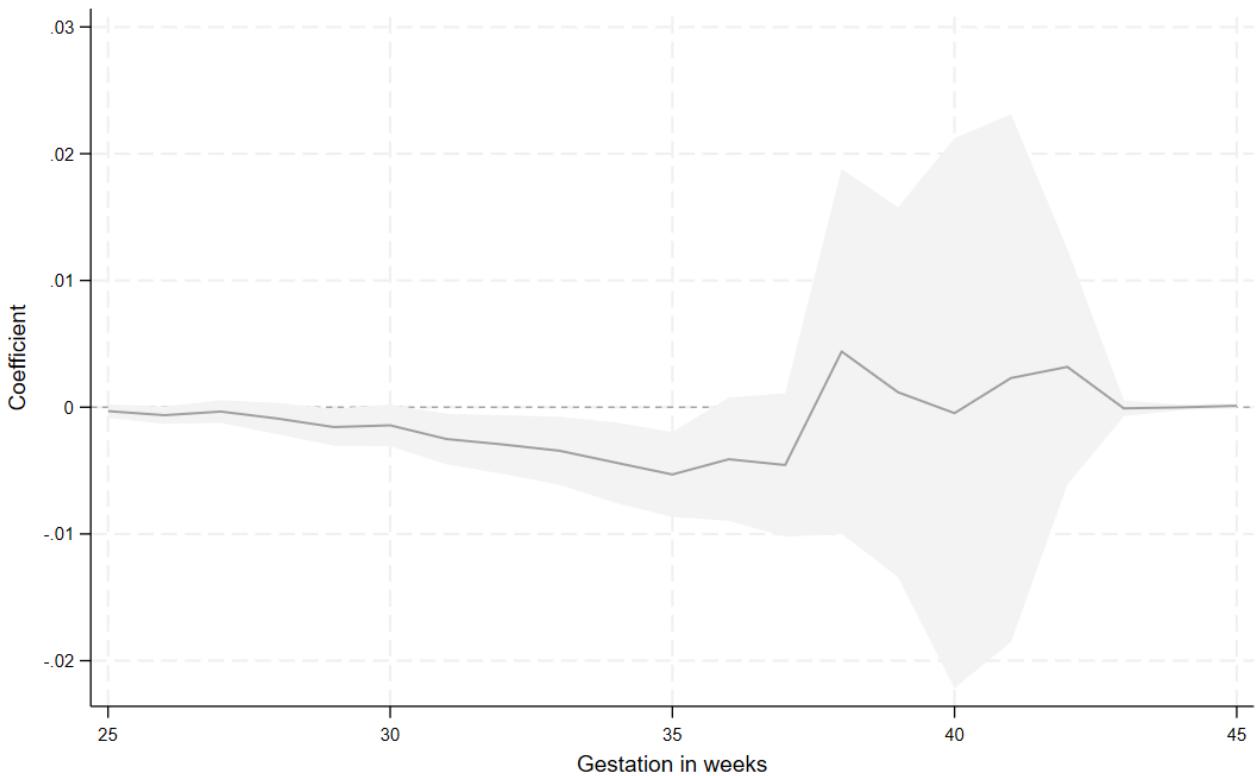
Figure 3 confirms the distributional pattern underlying the the results for preterm and very preterm birth in Panel A of Table 2. The graphical evidence indicates a reduction in the probability of births between 30 and 36 weeks, with no detectable effects at full term. Because early births represent a small share of all births, these reductions at the lower tail are not large enough to produce a statistically significant change in mean gestational weeks, which is consistent with the zero reported in column 1 of Panel A.
Panel B of Table 2 provides more limited evidence of reform-induced improvements in birth weight outcomes. Column 1 shows no effects of the reform on birth weight. The corresponding 95% confidence intervals allow us to reject positive impacts of the LOGSE reform on birth weight larger than 0.75%. Column 2 shows negative, non-significant effects on low birth weight, and we can rule out reductions in the incidence of low birth weight larger than 10%. There is a marginally significant drop of 0.18 percentage points in the incidence of very low birth weight at the 10% level (column 3). Given the baseline incidence of very low birth weight, this corresponds to a 24.32% reduction overall, equivalent to roughly 12% per additional year of general schooling. However, this result does not hold after a multiple hypothesis testing correction (Romano-Wolf p-value = 0.2857), and its statistical significance is weaker under wild cluster bootstrap inference (Wild bootstrap p-value=0.0981).16
16Figure A2 of the Appendix visually represents the impact of the reform across the birth weight distribution. The confidence intervals largely overlap the zero line, indicating the lack of significant reform effects on most of the birth weight spectrum. The intervals slightly dip below the zero line for weights under 2,500 grams, suggesting a small decrease at the lower end of the birth weight distribution. This graphical evidence aligns with the statistical findings in Panel B of Table 2, indicating that any positive influence of the reform on birth weight is limited, with a slightly more noticeable effect at the very low birth weight threshold.
We contrast our baseline health-at-birth estimates with effect sizes reported in relevant papers investigating the causal relationship between maternal education and children’s health at birth in developed countries. Figure 4 plots our estimates for premature birth and low birth weight, re-scaled to reflect a one-year increase in education, and compares them to similarly re-scaled estimates from studies that induce changes in maternal education, presented in chronological order. We focus on these two outcomes because they are the most consistently reported across studies, allowing for direct comparability. Appendix Table A8 provides detailed information for the papers included in Figure 4 and summarizes the exogenous sources of education variation, institutional features, and health-at-birth outcomes examined. This comparison helps situate our results within the broader literature and highlights how differences in the type of education intervention relate to differences in health effects.
Evidence from education interventions in high-income countries points to a consistent pattern: changes that expand general education content are associated with improvements in infant health, whereas reforms that increase years of schooling without altering curriculum content generally are not. Our estimates are comparable in magnitude to those from other interventions that increased exposure to general education. The 1959 Norwegian reform studied by Grytten et al. (2014), which expanded both general education content and compulsory schooling, reduced low birth weight by approximately 10%. Currie and Moretti (2003) find that U.S. college openings reduced low birth weight by approximately 10% and preterm birth by 6%, while Dursun et al. (2024) find that U.S. high-school subject requirement reforms reduced preterm birth by 3.4% and low birth weight by 3.5% among Black mothers. In our setting, an additional year of general schooling reduces preterm birth by 4.2% and very preterm birth by 16%, with a less precisely estimated 12% reduction in very low birth weight. By contrast, Lindeboom et al. (2009) find null effects on birth weight, low birth weight, and illness at birth following the 1947 UK school-leaving-age reform, and McCrary and
Royer (2011) report null effects on low birth weight, preterm birth, and infant mortality following U.S. school-entry policies. Consistent with this comparison, our re-scaled estimate for prematurity of –0.0029 (s.e. = 0.0015) allows us to reject effects larger than 0.0020, the point estimate in McCrary and Royer (2011). This pattern suggests that expanding general education, rather than extending schooling duration alone, is an important margin for improving infant health.
Table 2: Effects on Health at Birth
| (1) | (2) | (3) | |
| Panel A: Gestational Age | |||
| Weeks | Preterm | Very Preterm | |
| Reform exposure | 0.0217(0.0319) | -0.0058**(0.0028) | -0.0026***(0.0010) |
| Wild bootstrap p-value | 0.4985 | 0.0440 | 0.0150 |
| Romano-Wolf p-value | 0.7413 | 0.2048 | 0.0899 |
| Pre-Reform Mean (1975 Cohort) | 39.1448 | 0.0697 | 0.0079 |
| Observations | 1,296,160 | 1,296,160 | 1,296,160 |
| Panel B: Weight at Birth Measures | |||
| Weight | Low Weight | Very Low Weight | |
| Reform exposure | 10.5373(6.9480) | -0.0011(0.0029) | -0.0018*(0.0010) |
| Wild bootstrap p-value | 0.1752 | 0.7077 | 0.0981 |
| Romano-Wolf p-value | 0.3377 | 0.7413 | 0.2857 |
| Pre-Reform Mean (1975 Cohort) | 3199.5799 | 0.0699 | 0.0074 |
| Observations | 1,446,005 | 1,446,005 | 1,446,005 |
Notes. The table shows the estimates of the coefficient on reform exposure from equation (2). Reform exposure is a 0–1 index equal to the province–cohort share of 14-year-old students enrolled in the post-reform (LOGSE) general education system; a one-unit change corresponds to full exposure to the reform. The dependent variable is indicated in each column heading in each panel. The sample includes all mothers aged 25–33 and born between 1975 and 1985. All specifications control for birth year and province of residence fixed effects. Wild bootstrap p-values are based on 1,000 wild cluster bootstrap replications clustered at the province level. Romano-Wolf p-values are based on 1,000 studentized bootstrap replications. Standard errors are in parentheses. Data are from the 2000–2018 Childbirth Microdata of Vital Statistics (INE). *** Significant at the 1% level, ** Significant at the 5% level, * Significant at the 10% level.
Event Study Figures
To assess parallel trends, rule out anticipation effects, and trace the dynamics of treatment in a setting with staggered continuous exposure and potentially heterogeneous treatment effects, we estimate the event-study version of De Chaisemartin and D’Haultfœuille (2024):
Figure 3: Effects along the Distribution of Gestational Weeks Notes. The figure plots DiD estimates of the effect of the LOGSE reform on the probability that gestational age is less than or equal to each week shown on the x-axis. Each point corresponds to a separate regression based on eq. (2) for mothers aged 25–33, born 1975–1985. Shaded areas denote 95% confidence intervals. Data are from the 2000–2018 Childbirth microdata of Vital Statistics (INE).
\[Y _ {i t k} = \alpha + \sum_ {\substack {g = - 4 \\ g \neq -1}} ^ {5} \beta_ {g} R e f o r m E x p I n t e n s i t y _ {k t} \mathbf {1} \{G _ {k t} = g \} + \gamma_ {t} + \theta_ {k} + \varepsilon_ {i t k}\tag{3}\]
where ReformExpIntensi is a discretized version of the reform exposure index capturing treatment intensity in quartile steps, denotes event time, the number of cohorts before or after the LOGSE reform reached province and (the last untreated cohort) is the omitted reference period.17 We restrict the sample to mothers born 1972–1983, yielding four clean pre-reform periods and preserving at least one untreated group throughout under a non-pathological
17ReformExpIntensitykt is an ordered variable reflecting the share of the cohort educated under the reform. It takes value 0 if exposure is below 25%, 1 if between 25–50%, 2 if between 50–75%, and 3 if above 75%. All other variables are as defined in equation (2).
Figure 4: Comparison to Previous Effect Sizes in the Literature Panel A: Premature Birth
| Paper | Effect (95% CI) | |
| Currie & Moretti (2003) | -0.002 (-0.004, -0.000) | |
| McCrary & Royer (2011) | 0.002 (-0.004, 0.008) | |
| Dursun et al (2024) | -0.004 (-0.007, -0.002) | |
| Our paper | -0.003 (-0.006, 0.000) |
Panel B: Low Birth Weight
| Paper | Effect (95% CI) | |
| Currie & Moretti (2003) | -0.002 (-0.004, -0.001) | |
| Lindenbom et al (2008) | 0.002 (-0.088, 0.092) | |
| McCrary & Royer (2011) | 0.003 (-0.003, 0.008) | |
| Grytten et al (2014) | -0.010 (-0.018, -0.001) | |
| Dursun et al (2024) | -0.003 (-0.005, -0.001) | |
| Our paper | -0.001 (-0.004, 0.002) |
Notes. This figure compares our re-scaled estimates of the causal impact of maternal education on health at birth outcomes with corresponding estimates from Currie and Moretti (2003), Lindeboom et al. (2009), McCrary and Royer (2011), Grytten et al. (2014), and Dursun et al. (2024). All coefficients are normalized to reflect a one-year increase in schooling. Estimates are reported in comparable units across studies, and bars denote 95% confidence intervals. Details on the construction of comparable estimates are provided in Appendix B.
design.18
The pre-reform coefficients satisfy the parallel trends assumption and are uniformly close to zero across all outcomes, providing no evidence of anticipation effects. Post-reform, the CH estimators show significant reductions in the likelihood of low birth weight and very preterm birth, consistent with the baseline estimates in Table 2. The monotonically increasing effects over time reflect rising treatment intensity, as later cohorts contain a larger share of mothers fully exposed to the reform, mechanically amplifying the estimated impact on birth outcomes (Panel A, Figure 2).
Placebo tests using five pre-reform cohorts born 1970–1975 confirm these findings formally, showing no spurious correlation between future reform exposure and pre-existing enrollment patterns or health outcomes (Appendix Tables A10 and A11). The reform rollout is also unrelated to provincelevel time-varying determinants of infant health, including GDP per capita, female labor force participation, female employment, population size, and neonatal and post-neonatal mortality rates (Appendix Table A12), and our main results are robust to the inclusion of these controls (Appendix Table A13).
18We exclude Alava, where a pilot rollout in 1989 exposed roughly 35% of the 1975 birth cohort before the national reform, violating this condition. Estimates excluding Alava are reported in Appendix Table A9.
Figure 5: Dynamic Effects on Health at Birth Notes. This figure presents dynamic event-time dummy coefficients from estimating eq. (3) on a sample of mothers aged 25–33, born between 1972 and 1983. The bars represent 95% confidence intervals. Standard errors are clustered at the province level. Data are from the 2000-2018 Childbirth microdata of Vital Statistics (INE).

5.3 Validity of the Research Design
This section assesses the validity of our research design. We provide evidence that the results reflect increased exposure to general education rather than other features of the reform, do not arise from changes in fertility behavior or selection into motherhood, and are not confounded by peer effects or migration.
Table 3 shows that the reform’s effects on infant health are concentrated among students who switched from vocational to general education, consistent with general education being the key driver of the results. We decompose our main index into separate measures of pre-reform vocational and general education enrollment shares.19 Estimates for gestational age show that switching from vocational to general education reduces the likelihood of very preterm birth by 0.78 percentage points (Panel A, column 8), equivalent to a 33.5% reduction (0.34 × 0.0078), or approximately 17% per additional year of general schooling. This estimate closely matches our baseline estimate for very preterm birth, reproduced in Panel A, column 7, providing further evidence that the reform’s effects are driven by students who switched from vocational to general education.20
We perform a complementary instrumental-variables exercise, following Bertrand et al. (2018) and Bellés-Obrero and Duchini (2021), providing further evidence that the positive impact of the reform is driven by students who would have taken the vocational program. The strategy instruments the share of students in either the pre- or post-reform general education program with its 1975 cross-province variation interacted with cohort fixed effects, exploiting the fact that provinces with more such students require fewer adjustments to implement the reform compared to those with more vocational training students. Appendix Table A15 shows that provinces in which the reform induced larger shifts from vocational to general education experienced greater improvements in infant health.21
We also rule out that the reform improved infant health by changing fertility behavior or se-
LGEGeneralEducationtk LOGSEtk LGET otaltk
19Pre-reform Voc Sharetk LGEVocationalEducationtk LOGSEtk LGETotaltk captures the share of 14-year-olds enrolled in the pre-reform vocational program. Pre-reform GenEd Sharetk captures the share enrolled in the pre-reform general education program. Both indices decrease over the transition period and are zero by construction at full implementation; their coefficients are therefore expected to have the opposite sign to the main LOGSE exposure index. Figure A3 plots both indices alongside the main exposure index by birth cohort. Notice that the Pre-reform Voc Share reflects an average cross-province decline of 34 percentage points (from approximately 34% to 0%) in the share of students enrolled in the pre-reform vocational training, while the Pre-reform GenEd Share represents a corresponding decline of 66 percentage points (from around 66% to 0%).
20We also show in Appendix Table A14 that children benefit equally from the reform regardless of their mother’s socioeconomic background. This alleviates concerns that the estimated effects are driven by disproportionately larger gains among lower socioeconomic status mothers, rather than by the substitution of vocational with general education.
21Appendix Table A16 reports the corresponding first stage estimates, documenting a strong relationship between the instrument and exposure to general education. Because the instrument ranges from approximately 0.5 at the start of the transition period to 1 at full implementation, its coefficient is expected to have the same sign as the main reform exposure coefficient in Table 2. The larger IV estimate is consistent with the instrument placing greater weight on provinces that experienced larger reform induced shifts from vocational to general education.
Table 3: Decomposition of Effects on Health at Birth by Pre-Reform Programs
| (1) | (2) | (3) | (4) | (5) | (6) | (7) | (8) | (9) | |
| Panel A: Gestational Age | |||||||||
| Weeks | Preterm | Very Preterm | |||||||
| Reform exposure | 0.0217(0.0319) | -0.0058**(0.0028) | -0.0026***(0.0010) | ||||||
| Pre-reform Voc Share | -0.0783(0.0604) | 0.0097*(0.0053) | 0.0078***(0.0022) | ||||||
| Pre-reform GenEd Share | 0.0014(0.0446) | 0.0060*(0.0035) | 0.0006(0.0016) | ||||||
| Wild bootstrap P-Value | 0.4985 | 0.2182 | 0.9840 | 0.0440 | 0.0631 | 0.1101 | 0.0150 | 0.0040 | 0.7447 |
| Romano-Wolf P-Value | 0.7413 | 0.5305 | 0.9760 | 0.2048 | 0.3207 | 0.3876 | 0.0899 | 0.0280 | 0.9291 |
| Observations | 1,296,160 | 1,295,433 | 1,295,839 | 1,296,160 | 1,295,433 | 1,295,839 | 1,296,160 | 1,295,433 | 1,295,839 |
| Panel B: Weight at Birth | |||||||||
| Weight | Low Weight | Very Low Weight | |||||||
| Reform exposure | 10.5373(6.9480) | -0.0011(0.0029) | -0.0018*(0.0010) | ||||||
| Pre-reform Voc Share | -4.9956(14.6813) | -0.0005(0.0061) | 0.0022(0.0022) | ||||||
| Pre-reform GenEd Share | -16.7962**(7.9508) | 0.0024(0.0033) | 0.0020(0.0015) | ||||||
| Wild bootstrap P-Value | 0.1752 | 0.7417 | 0.0511 | 0.7077 | 0.9329 | 0.5115 | 0.0981 | 0.3914 | 0.2052 |
| Romano-Wolf P-Value | 0.3377 | 0.9111 | 0.2208 | 0.7413 | 0.9281 | 0.8432 | 0.2857 | 0.6014 | 0.5225 |
| Observations | 1,446,005 | 1,444,983 | 1,445,546 | 1,446,005 | 1,444,983 | 1,445,546 | 1,446,005 | 1,444,983 | 1,445,546 |
Notes. Estimates are obtained from estimating eq. (2) on a sample of mothers aged 25-33, born between 1975 and 1985. The dependent variable is indicated in each column heading in each panel. The coefficients reported in columns (1), (4), and (7) estimate the effect of the main LOGSE reform exposure, as employed in our OLS TWFE main estimates in Table 2. The coefficients presented in Columns (2), (5), and (8) estimate the effects of the Pre-reform Voc Share, which represents the share of 14-year-olds enrolled in the pre-reform vocational education program under LGE. The coefficients displayed in Columns (3), (6), and (9) estimate the effects of the Pre-reform GenEd Share, which corresponds to the share of 14-year-olds enrolled in the pre-reform general education program under LGE. Standard errors are in parentheses. Wild bootstrap p-values are based on 1,000 wild cluster bootstrap replications clustered at the province level. Romano-Wolf p-values based on 1,000 studentized bootstrap replications. The data come from the 2000-2018 Vital Statistics (INE) childbirth microdata. *** Significant at the 1% level, ** Significant at the 5% level, * Significant at the 10% level.
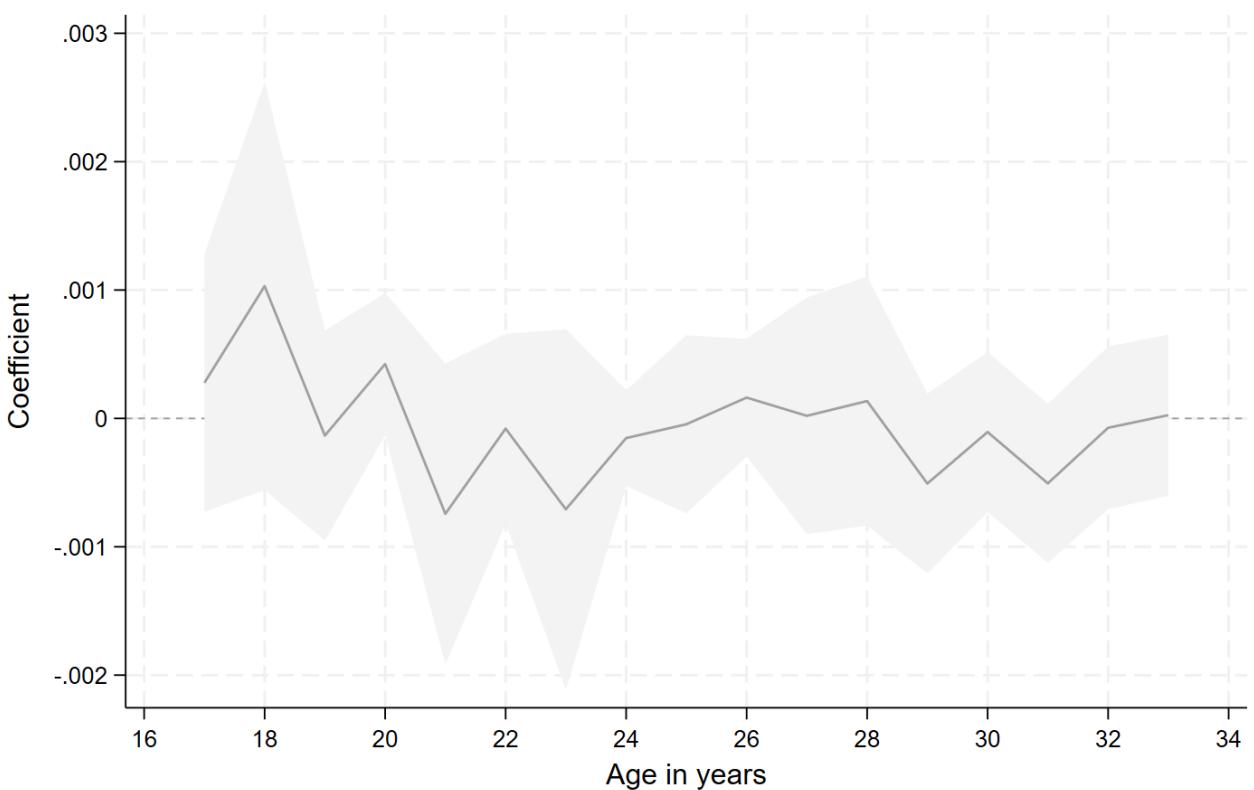
lection into motherhood rather than through increased general education. Because the reform did not increase years of schooling, as shown in Table 1 above, traditional theoretical channels linking increased years of education to fertility are unlikely to be at work.22 Still, the estimated health improvements could reflect compositional change rather than genuine gains from the reform. If increased exposure to general education enabled women to avoid unplanned pregnancies, the reform may have left a more positively selected pool of mothers whose children would have had better health outcomes regardless. Figure 6 plots DiD estimates from separate regressions of birth rates on LOGSE exposure for each maternal age.23 Across the entire age distribution, the coefficients fluctuate around zero and remain statistically indistinguishable from zero. Table A17 in the Appendix complements this evidence by showing no effect of the reform on the overall birth rate (column 1) or on the average age at first birth (column 2). Together, these results rule out compositional selection as an alternative explanation for the improvements in infant health.
Two additional checks support the interpretation that the reform improved infant health through increased general education rather than through alternative channels. Peer composition effects are unlikely to explain our results. The Spanish high school system did not track students by ability, vocational and general education were typically housed in the same schools, and high enrollment rates between ages 14 and 16 left little room for bringing students with lower academic motivation back into the classroom.24 Table A18 in the Appendix supports this interpretation, showing no differential effects on infant health across rural and urban areas or across mothers in high- and low-skilled occupations.25 Appendix Table A19 also shows that migration patterns across Spanish provinces are unrelated to the staggered rollout of the reform, alleviating concerns that interprovincial mobility confounds our estimates.
22Increases in women’s education may reduce fertility or delay motherhood through the quantity–quality tradeo! (Becker, 1965; Goldin, 2023), and additional schooling has been shown to delay pregnancies mechanically through the incarceration effect (Black et al., 2008; Cygan-Rehm and Maeder, 2013; Geruso and Royer, 2018).
23We construct a panel of annual birth rates by mothers’ age at the province level using administrative birth records and estimate an aggregate version of equation (2).
24The literature on peer effects shows that peers influence outcomes from academic performance to health behaviors (Sacerdote, 2011). Evidence from similar reforms increasing peer group heterogeneity points to negative rather than positive effects (Basu et al., 2018; B¨ockerman et al., 2021; Fischer et al., 2021; Galama et al., 2018).
Figure 6: Effects on Birth Rate by Mothers’ Age Notes. The figure plots DiD estimates of the effect of the LOGSE reform on birth rates by mothers’ age as indicated on the x-axis. Birth rates are calculated as the number of births divided by the number of women born in Spain per mother age and province. Each point corresponds to a separate regression based on eq. (2) for mothers aged 25–33, born 1975–1985. Shaded areas denote 95% confidence intervals. Standard errors are clustered at the province level. Source: Data were sourced from the Childbirth Microdata of Vital Statistics (INE) for the years 1975-1985 and 2000-2018.
6 Mechanisms
In what follows we examine how extending mothers’ general education maps onto improvements in infant health through better information-processing skills, healthier behaviors, and higher earning
25We interact the reform exposure index with indicators for municipality size and maternal occupation, exploiting the fact that peer composition changes should be more pronounced in urban areas and among lower-achieving mothers (Carrell et al., 2009).
potential.
Panel A of Table 4 shows that treated women scored 1.168 standard deviations higher on the PIAAC numeracy assessment (column 2), with no detectable effect on literacy (column 1). Given the small PIAAC sample, we cannot rule out that the absence of a detectable literacy effect reflects limited statistical power rather than a true differential impact of general education across domains. Because the LOGSE reform increased exposure to general education by roughly two years, this estimate corresponds to a numeracy gain of about 0.58 standard deviations per additional year of general schooling. This effect is somewhat larger than the 0.3–0.4 standard deviation gain typically estimated for an additional year of schooling in studies of the causal returns to schooling quantity, consistent with evidence that the cognitive returns to general education are particularly large at the vocational margin affected by LOGSE (Woessmann, 2016; Liu, 2018). More broadly, these findings align with dynamic models of skill formation in which early investments in general education increase the productivity of subsequent human capital accumulation. The fact that skills are measured in adulthood also makes larger estimated returns consistent with the cumulative effects of later educational and labor market investments (Heckman, 2007).26
Panel B of Table 4 examines whether the reform affected maternal substance use during pregnancy and broader patterns of alcohol, tobacco, and drug use. Women exposed to the reform were 8.7 percentage points less likely to report drinking alcohol during pregnancy (column 1), an effect that remains statistically significant after correcting for multiple hypothesis testing. Estimates for lifetime alcohol use (column 2), smoking (column 3), and drug use (column 4) are also negative, although less precisely estimated. To assess how much of the improvement in infant health the decline in drinking can explain, we apply estimates from Aliyu et al. (2010), who find that maternal alcohol use is associated with a 34% increase in spontaneous preterm birth and a 61% increase in very preterm birth. Applied to our baseline rates, the observed decline in drinking could account for approximately 0.19 percentage points of the reduction in preterm birth and 0.04 percentage points of the reduction in very preterm birth, roughly 33% of our estimated 0.58 percentage point decline in preterm birth and 14% of the 0.26 percentage point decline in very preterm birth. These figures should be read as illustrative since the Aliyu et al. (2010) estimates are observational, but the magnitudes suggest that reduced alcohol consumption is a meaningful contributor to the health gains we document.
26Because the PIAAC dataset only includes region of residence, we measure exposure to the reform at the regional level. This coarser variation reduces identifying precision relative to our main specification and introduces measurement error in treatment assignment. Consistent with this, our own robustness check in Appendix Table A20 shows that regional variation yields directionally consistent but smaller and less precisely estimated effects on infant health outcomes than provincial variation. The PIAAC estimates should therefore be read as suggestive evidence for the information-processing mechanism rather than stand-alone causal estimates of effect magnitude.
Panel C of Table 4 examines whether the reform affected family formation and its timing. The reform modestly shifted family formation before first birth. Column 1 shows that women exposed to LOGSE were 2.35 percentage points more likely to be married before the birth of their first child, corresponding to a 2.77% increase relative to the pre-reform baseline. Columns 2 and 3 show no statistically significant effects on the duration of marriage before birth or on the likelihood that the father is absent from the birth certificate, although both point estimates move in the same direction. Hence, the estimates are consistent with more stable family formation among treated women and with greater capacity to plan fertility.
Table 5 assesses whether the LOGSE reform affected maternal earning potential through changes in labor market participation and assortative mating patterns. Column 1 in Panel A reports that treated mothers were 3.08 percentage points more likely to work outside the home, a 3.6% increase relative to the pre-reform baseline. Column 2 shows no effect on high-skill occupation employment, suggesting the reform operated along the extensive margin rather than through occupational upgrading. Applying estimates from W¨ust (2015), who documents that maternal employment during pregnancy reduces preterm birth by 0.5 to 0.8 percentage points, the observed employment increase implies a reduction in preterm birth of 0.015 to 0.025 percentage points, roughly 3% to 4% of our estimated 0.58 percentage point decline.
This pattern of increased labor force participation without immediate occupational upgrading is consistent with economic theory on how general education affects women’s careers. Goldin (2001) emphasizes that general education raises women’s incentives to participate in the labor market by increasing their expected lifetime earnings from work, which explains our finding of higher employment along the extensive margin. Hanushek et al. (2017) document that general education generates long-term career flexibility and adaptability relative to vocational training, but these occupational gains emerge gradually as technological change rewards workers with broad skills. Our evidence of greater labor market participation without high-skill occupation entry at the time of the reform is therefore consistent with general education operating first through increased labor force participation, with upward occupational mobility potentially emerging later in the life cycle.
Panel B of Table 5 asks whether the reform altered assortative mating. General education may raise women’s likelihood of partnering with higher-earning spouses, amplifying household resources and improving infant health through that channel (Behrman and Rosenzweig, 2004). We find no evidence of differences in partner occupational status (columns 1 and 2), and baseline health estimates remain similar when controlling for fathers’ reform exposure (see Table A21 in the Appendix). These results suggest that the health gains from the LOGSE reform are not driven by changes in partner characteristics.
Taken as a whole, the evidence presented here suggests that general education improved infant health through multiple complementary channels. The reform improved women’s informationprocessing skills, reduced risky behaviors during pregnancy, increased maternal labor force participation, and was associated with more stable family formation patterns. These findings are consis tent with theoretical models in which general education raises women’s cognitive and information processing skills, alters labor market opportunities, and changes the incentives surrounding fertility and household formation (Grossman, 1972; Currie and Moretti, 2003; Cutler and Lleras-Muney, 2010).
Our results speak directly to the mechanisms highlighted in prior work on maternal education and infant health. Evidence from reforms that increase schooling quantity suggests that maternal education improves infant health through changes in maternal health behaviors, family circumstances, and household resources. Currie and Moretti (2003), for example, show that more educated mothers engage in healthier behaviors during pregnancy and experience more favorable family circumstances, while Lindeboom et al. (2009) highlight the role of improved socioeconomic conditions and household resources in shaping infant health. Our findings are also consistent with evidence from schooling expansions that document changes in maternal behaviors but more limited effects on birth outcomes and broader family circumstances (McCrary and Royer, 2011). At the same time, our findings suggest that the content of schooling matters. Reforms that expand general or academic skills appear to affect maternal decision-making differently from reforms that merely increase years of attendance without changing curriculum content, consistent with recent evidence that broader academic and quantitative training improves women’s economic self-sufficiency and subsequent life outcomes (Dursun et al., 2024). The results point to information-processing skills, healthier behaviors, and higher labor force participation as complementary channels through which general education shapes maternal decision-making. The fact that these intermediate outcomes move together in theoretically and empirically consistent directions makes the infant health effects more interpretable as consequences of increased maternal human capital, rather than as isolated correlations generated by the reform.
Table 4: Effects on Information Processing Skills, Health Behavior, and Family Planning
| (1) | (2) | (3) | (4) | |
| Panel A. Information Processing Skills | ||||
| Literacy Proficiency (std.) | Numeracy Proficiency (std.) | |||
| Reform exposure | 0.895(0.620) | 1.168**(0.575) | ||
| Pre-Reform Mean (1979 Cohort) | -0.022 | -0.018 | ||
| Observations | 410 | 410 | ||
| Panel B. Risky Health Behavior | ||||
| Mother Drinks During Pregnancy | Mother Drinks | Mother Smokes | Mother Consumes Drugs | |
| Reform exposure | -0.087**(0.039) | -0.425*(0.216) | -0.387**(0.180) | -0.061(0.236) |
| Wild bootstrap p-value | 0.034 | 0.095 | 0.045 | 0.795 |
| Romano-Wolf p-value | 0.036 | 0.090 | 0.160 | 0.801 |
| Pre-Reform Mean (1975 Cohort) | 0.030 | 0.847 | 0.706 | 0.280 |
| Observations | 2,314 | 1,003 | 1,003 | 1,003 |
| Panel C. Family Planning | ||||
| Marriage Before Birth | Duration of Marriage Before Birth | Father Absent | ||
| Reform exposure | 0.024**(0.011) | 0.149(0.778) | -0.002(0.002) | |
| Wild bootstrap p-value | 0.036 | 0.797 | 0.468 | |
| Romano-Wolf p-value | 0.103 | 0.780 | 0.672 | |
| Pre-Reform Mean (1975 Cohort) | 0.848 | 36.170 | 0.011 | |
| Observations | 1,521,770 | 980,853 | 1,521,770 | |
Notes. The table shows the estimates of the coefficient on reform exposure from equation (2). Reform exposure is a 0–1 index equal to the province–cohort share of 14-year-old students enrolled in the post-reform (LOGSE) general education system; a one-unit change corresponds to full exposure to the reform. The dependent variable is indicated in each column heading in each panel. The sample includes women aged 25–33 born between 1979 and 1985 in Panel A; mothers born between 1975 and 1985 in column 1 of Panel B; women aged 25–33 cohabiting with a child and born between 1975 and 1983 in columns 2–4 of Panel B; and first deliveries by mothers aged 25–33 and born between 1975 and 1985 in Panel C. Panel A includes birth year and region of residence fixed effects; standard errors are obtained via the eighty BRR replicate weights prescribed by the PIAAC technical standards, and literacy and numeracy scores are pooled across ten plausible values of latent proficiency following Rubin (1987)’s combining rules, which provides design-consistent variance estimation rendering wild bootstrap and Romano-Wolf corrections infeasible. The remaining specifications control for birth year and province of residence fixed effects. Wild bootstrap p-values are based on 1,000 wild cluster bootstrap replications clustered at the province level. Romano-Wolf p-values are based on 1,000 studentized bootstrap replications. Standard errors are shown in parentheses. Data sources: 2011 PIAAC Survey (Panel A), 2017 and 2007 Spanish Alcohol, Tobacco, and Illegal Drugs Surveys (Panel B), and 2000–2018 Vital Statistics (INE) (Panel C). *** Significant at the 1% level, ** Significant at the 5% level, * Significant at the 10% level.
Table 5: Effects on Women’s Earning Potential
| (1)Working Mother | (2)High-Skill Occupation | |
| Panel A. Labor Market Outcomes | ||
| Reform exposure | 0.031**(0.013) | -0.022(0.013) |
| Wild bootstrap p-value | 0.026 | 0.127 |
| Romano-Wolf p-value | 0.019 | 0.750 |
| Pre-Reform Mean (1975 Cohort) | 0.852 | 0.490 |
| Observations | 1,467,386 | 1,187,645 |
| Panel B. Assortative Mating | ||
| High-Skill Partner | Low-Skill Partner | |
| Reform exposure | -0.008(0.008) | 0.004(0.005) |
| Wild bootstrap p-value | 0.278 | 0.513 |
| Romano-Wolf p-value | 0.750 | 0.750 |
| Pre-Reform Mean (1975 Cohort) | 0.609 | 0.289 |
| Observations | 1,009,937 | 1,009,937 |
Notes. The table shows the estimates of the coefficient on reform exposure from equation (2). Reform exposure is a 0–1 index equal to the province–cohort share of 14-year-old students enrolled in the post-reform (LOGSE) general education system; a one-unit change corresponds to full exposure to the reform. The dependent variable is indicated in each column heading in each panel. The sample includes all mothers aged 25–33 and born between 1975 and 1985. All specifications control for birth year and province of residence fixed effects. Standard errors are shown in parentheses. Wild bootstrap p-values are based on 1,000 wild cluster bootstrap replications clustered at the province level. Romano–Wolf p-values are based on 1,000 studentized bootstrap replications. Data are from the 2000–2016 Vital Statistics (INE) childbirth microdata. *** Significant at the 1% level, ** Significant at the 5% level, * Significant at the 10% level.
7 Conclusions
This paper provides novel causal evidence on the intergenerational returns to general education. We take advantage of the staggered rollout across Spanish provinces of a major educational reform that extended the provision of general education in lower secondary school, while holding overall educational attainment constant. Linking newly digitized province-level enrollment records to population-wide birth certificate data, we find that increased maternal exposure to general education significantly improved infant health at birth. Exposure to the reform reduced the incidence of very preterm births by by approximately 16% per additional year of general schooling, with additional reductions in preterm birth and very low birth weight, though less precisely estimated. These effects are consistent with a nationwide reform operating across the full population of mothers, where health gains are concentrated at the lower tail of the gestational age distribution and largest for births at higher baseline risk.
The improvements in infant health are driven by women who shifted from vocational to general education as a result of the reform, with supporting evidence from improvements in information processing skills, healthier behaviors, and maternal labor force participation. Using linked administrative and survey data, we document improvements in mothers’ numeracy assessments, reductions in risky behaviors during pregnancy such as drinking during pregnancy, and increases in employment rates among affected cohorts. Additional analyses find no evidence that these results are explained by changes in fertility patterns or peer composition across provinces and cohorts. These findings indicate that the reform improved infant health through increased exposure to general education rather than through demographic or compositional changes, while pointing to information-processing skills, health behaviors, and labor force participation as plausible channels. This underscores the importance of the type of education, rather than its duration, in shaping intergenerational outcomes.
The health at birth gains induced by the reform translate into substantial economic returns, with our results suggesting that the medical cost savings associated with the LOGSE reform considerably exceed its implementation costs. Estimates from Spanish neonatal intensive care units (UCIN) indicate that the average medical cost per very preterm infant is approximately €90,000, due primarily to prolonged stays in intensive care and related interventions (Ministry of Health, 2022). We estimate that the reform reduced the incidence of very preterm births by approximately 0.26 percentage points (Panel A, Column 3, Table 2). This implies an estimated medical cost saving of €234 per child . The total implementation cost of the reform is estimated at €7.8 million (Marchesi, 2020). Given its staggered rollout, the reform affected approximately 1.06 million girls born between 1975 and 1985 (out of a total of 3.14 million female births). Of those exposed, about 60% became mothers and are included in our sample, implying an average cost of €12.21 per birth to an exposed mother ). This means that the health-related savings alone are almost 20 times greater than the per-child implementation cost. This simple cost-benefit calculation likely understates the full impact of the reform, as early-life health improvements are known to yield long-term gains in human capital and economic wellbeing.27 Our findings highlight that education policy can shape the early determinants of health, positioning general schooling as a driver of skill formation as well as a powerful tool for reducing inequality and promoting upward mobility across generations.
References
- Aizer, A. and Currie, J. (2014). The intergenerational transmission of inequality: Maternal disadvantage and health at birth. Science, 344(6186):856–861. Number: 6186.
- Aizer, A., Hoynes, H., and Lleras-Muney, A. (2022). Children and the us social safety net: Balancing disincentives for adults and benefits for children. Journal of Economic Perspectives, 36(2):149–
27Almond et al. (2018).
Aliyu, M. H., Lynch, O., Belogolovkin, V., Zoorob, R., and Salihu, H. M. (2010). Maternal alcohol use and medically indicated vs. spontaneous preterm birth outcomes: a population-based study. European journal of public health, 20(5):582–587.
Almond, D., Chay, K., and Lee, D. (2005). The costs of low birth weight. The Quarterly Journal of Economics, 120(3):1031–1083. Number: 3.
Almond, D. and Currie, J. (2011). Killing Me Softly: The Fetal Origins Hypothesis. Journal of Economic Perspectives, 25(3):153–172. Number: 3.
Almond, D., Currie, J., and Duque, V. (2018). Childhood Circumstances and Adult Outcomes: Act II. Journal of Economic Literature, 56(4):1360–1446. Number: 4.
Almond, D., Doyle, Jr., J. J., Kowalski, A. E., and Williams, H. (2010). Estimating Marginal Returns to Medical Care: Evidence from At-Risk Newborns. Quarterly Journal of Economics, 125(2):591–634. Number: 2.
Amuedo-Dorantes, C., Borra, C., and Rivera-Garrido, N. (2023). Fertility implications of familybased regularizations. Journal of Economic Geography, 23(2):449–484. Number: 2.
Barfield, W. D. (2018). Public Health Implications of Very Preterm Birth. Clinics in Perinatology, 45(3):565–577. Number: 3.
Basu, A., Jones, A. M., and Dias, P. R. (2018). Heterogeneity in the impact of type of schooling on adult health and lifestyle. Journal of Health Economics, 57:1–14.
Becker, G. S. (1965). A Theory of the Allocation of Time. The Economic Journal, 75(299):493. Number: 299.
Becker, G. S. (1973). A Theory of Marriage: Part I. Journal of Political Economy, 81(4):813–846.
Number: 4 Publisher: University of Chicago Press.
Behrman, J. R. and Rosenzweig, M. R. (2004). Returns to Birthweight. Review of Economics and Statistics, 86(2):586–601. Number: 2.
Bellés-Obrero, C. and Duchini, E. (2021). Who benefits from general knowledge? Economics of Education Review, 85:102122.
Bellés-Obrero, C. A. and Duchini, E. (2019). General versus Job-Specific Skills and Gender Gaps in the Labor Market. Austin, Texas.
Bertrand, M., Black, S. E., Jensen, S., and Lleras-Muney, A. (2018). Breaking the Glass Ceiling? The Effect of Board Quotas on Female Labour Market Outcomes in Norway. The Review of Economic Studies.
Black, S., Devereux, P., and Salvanes, K. (2007). From the Cradle to the Labor Market? The Effect of Birth Weight on Adult Outcomes. The Quarterly Journal of Economics, 122(1):409– 439. Number: 1.
Black, S. E., Devereux, P. J., and Salvanes, K. G. (2008). Staying in the Classroom and Out of the Maternity Ward? The Effect of Compulsory Schooling Laws on Teenage Births. The Economic Journal, 118(530):1025–1054. Number: 530.
B¨ockerman, P., Haapanen, M., Jepsen, C., and Roulet, A. (2021). School Tracking and Mental Health. Journal of Human Capital, 15(2):291–345. Number: 2.
Carrell, S. E., Fullerton, R. L., and West, J. E. (2009). Does Your Cohort Matter? Measuring Peer Effects in College Achievement. Journal of Labor Economics, 27(3):439–464. Number: 3.
- Chou, S.-Y., Liu, J.-T., Grossman, M., and Joyce, T. (2010). Parental Education and Child Health: Evidence from a Natural Experiment in Taiwan. American Economic Journal: Applied Economics, 2(1):33–61. Number: 1.
- Cunha, F. and Heckman, J. (2007). The Technology of Skill Formation. American Economic Review, 97(2):31–47. Number: 2.
- Cunha, F., Heckman, J., and Schennach, S. M. (2010). Estimating the Technology of Cognitive and Noncognitive Skill Formation. Econometrica, 78(3):883–931. Number: 3.
- Currie, J. (2011). Inequality at Birth: Some Causes and Consequences. American Economic Review, 101(3):1–22. Number: 3.
Currie, J. and Aizer, A. (2024). Program report: Children and families. The Reporter, (2). National Bureau of Economic Research.
Currie, J. and Moretti, E. (2003). Mother’s Education and the Intergenerational Transmission of Human Capital: Evidence from College Openings. The Quarterly Journal of Economics, 118(4):1495–1532. Number: 4.
Currie, J. and Moretti, E. (2007). Biology as Destiny? Short- and Long-Run Determinants of Intergenerational Transmission of Birth Weight. Journal of Labor Economics, 25(2):231–264. Number: 2.
Cutler, D. M. and Lleras-Muney, A. (2010). Understanding differences in health behaviors by education. Journal of Health Economics, 29(1):1–28.
Cygan-Rehm, K. and Maeder, M. (2013). The effect of education on fertility: Evidence from a compulsory schooling reform. Labour Economics, 25:35–48.
De Chaisemartin, C. and D’Haultfœuille, X. (2024). Difference-in-Differences Estimators of Intertemporal Treatment Effects. Review of Economics and Statistics, pages 1–45.
Dursun, B., Eren, O., and Nguyen, M. (2024). Curriculum Reforms and Infant Health. Review of Economics and Statistics, 106(2):394–408. Number: 2.
Felfe, C., Nollenberger, N., and Rodríguez-Planas, N. (2015). Can’t buy mommy’s love? Universal childcare and children’s long-term cognitive development. Journal of Population Economics, 28(2):393–422. Number: 2.
Felgueroso, F., Gutiérrez-Dom`enech, M., and Jiménez-Martín, S. (2014). Dropout trends and educational reforms: the role of the LOGSE in Spain. IZA Journal of Labor Policy, 3(1):9. Number: 1.
Fischer, M., Gerdtham, U.-G., Heckley, G., Karlsson, M., Kjellsson, G., and Nilsson, T. (2021). Education and Health: Long-Run Effects of Peers, Tracking and Years. Economic Policy, page eiaa027.
Galama, T., Lleras-Muney, A., and Kippersluis, H. v. (2018). The Effect of Education on Health and Mortality: A Review of Experimental and Quasi-Experimental Evidence. In Oxford Research Encyclopedia of Economics and Finance. Oxford University Press. Book Authors: :n1377.
Geruso, M. and Royer, H. (2018). The Impact of Education on Family Formation: Quasi-Experimental Evidence from the UK. Technical Report w24332, National Bureau of Economic Research, Cambridge, MA. Issue: w24332.
Goldin, C. (2001). The Human-Capital Century and American Leadership: Virtues of the Past. The Journal of Economic History, 61(2):263–292. Number: 2.
Goldin, C. (2006). The quiet revolution that transformed women’s employment, education, and family. American Economic Review, 96(2):1–21.
- Goldin, C. D. (2023). Career & family: women’s century-long journey toward equity. Princeton university press, Princeton.
Grossman, M. (1972). On the Concept of Health Capital and the Demand for Health. Journal of Political Economy, 80(2):223–255. Number: 2.
- Grytten, J., Skau, I., and Sørensen, R. J. (2014). Educated mothers, healthy infants. The impact of a school reform on the birth weight of Norwegian infants 1967–2005. Social Science & Medicine, 105:84–92.
Guryan, J., Ludwig, J., Bhatt, M. P., Cook, P. J., Davis, J. M., Dodge, K., Farkas, G., Fryer Jr, R. G., Mayer, S., Pollack, H., et al. (2023). Not too late: Improving academic outcomes among adolescents. American Economic Review, 113(3):738–765.
- Hanushek, E. A., Schwerdt, G., Woessmann, L., and Zhang, L. (2017). General Education, Vocational Education, and Labor-Market Outcomes over the Lifecycle. Journal of Human Resources, 52(1):48–87. Number: 1.
- Heckman, J. J. (2007). The economics, technology, and neuroscience of human capability formation. Proceedings of the National Academy of Sciences, 104(33):13250–13255. Number: 33.
Larroque, B. (2004). Survival of very preterm infants: Epipage, a population based cohort study. Archives of Disease in Childhood - Fetal and Neonatal Edition, 89(2):139F–144. Number: 2.
Lindeboom, M., Llena-Nozal, A., and van der Klaauw, B. (2009). Parental education and child health: Evidence from a schooling reform. Journal of Health Economics, 28(1):109–131. Number: 1.
Liu, H. (2018). Education systems, education reforms, and adult skills in the survey of adult skills (piaac). Technical Report 182, OECD Publishing, Paris.
Marchesi, (2020). La LOGSE en la educación española. Breve relato de un cambio histórico. Avances en Supervisión Educativa, (33). Number: 33.
McCrary, J. and Royer, H. (2011). The Effect of Female Education on Fertility and Infant Health: Evidence from School Entry Policies Using Exact Date of Birth. American Economic Review, 101(1):158–195. Number: 1.
Ministry of Health (2022). RAE-CMBD - PESOS Y COSTES APR-GRD V38 ANO 2022. Technical report.
- Ohuma, E. O., Moller, A.-B., Bradley, E., Chakwera, S., Hussain-Alkhateeb, L., Lewin, A., Okwaraji, Y. B., Mahanani, W. R., Johansson, E. W., Lavin, T., Fernandez, D. E., Domínguez, G. G., De Costa, A., Cresswell, J. A., Krasevec, J., Lawn, J. E., Blencowe, H., Requejo, J., and Moran, A. C. (2023). National, regional, and global estimates of preterm birth in 2020, with trends from 2010: a systematic analysis. The Lancet, 402(10409):1261–1271. Number: 10409.
Oreopoulos, P., Page, M. E., and Stevens, A. H. (2006). The Intergenerational Effects of Compulsory Schooling. Journal of Labor Economics, 24(4):729–760. Number: 4.
Robles-Zurita, J. A. (2017). Cognitive skills and the LOGSE reform in Spain: evidence from PIAAC. SERIEs, 8(4):401–415. Number: 4.
- Rosenzweig, M. R. and Schultz, T. P. (1989). Schooling, Information and Nonmarket Productivity: Contraceptive Use and Its Effectiveness. International Economic Review, 30(2):457. Number: 2.
- Rubin, D. B. (1987). Multiple Imputation for Nonresponse in Surveys. John Wiley & Sons, New York.
- Sacerdote, B. (2011). Peer Effects in Education: How Might They Work, How Big Are They and How Much Do We Know Thus Far? In Handbook of the Economics of Education, volume 3, pages 249–277. Elsevier.
- Servicio de Estudios Estadísticos (1994). Estadística de la enseñanza en España 1991/92: niveles de Preescolar, General Básica y EE. Medias. Centro de Publicaciones, Ministerio de Educación y Ciencia, Madrid. OCLC: 1348840540.
- Thomas, D., Strauss, J., and Henriques, M.-H. (1991). How Does Mother’s Education Affect Child Height? The Journal of Human Resources, 26(2):183. Number: 2.
- WHO-UNICEF (2023). Born Too Soon: Decade of Action on Preterm Birth. World Health Organization, Geneva, 1st ed edition.
- Woessmann, L. (2016). The Importance of School Systems: Evidence from International Differences in Student Achievement. Journal of Economic Perspectives, 30(3):3–32.
- Wolpin, K. I. (1997). Determinants and consequences of the mortality and health of infants and children. In Rosenzweig, M. R. and Stark, O., editors, Handbook of Population and Family Economics, volume 1A, pages 483–557. Elsevier.
- W¨ust, M. (2015). Maternal employment during pregnancy and birth outcomes: evidence from danish siblings. Health Economics, 24(6):711–725.
Appendix A Figures and Tables
Table A1: Data Overview
| Register Name | Unit | Data Description | Outcomes |
| Panel A: Main Datasets | |||
| Enrollment Records(1989/1990–1999/2000) | Province by school year | Administrative records on all 14-year-old students. Sample: students born 1975–1985. Link: province and school year. | Total enrollment; LOGSE and LGE shares; general and vocational education shares. |
| Vital Statistics(2000–2018) | Child | Administrative records on all births in Spain. Sample: first-borns; mothers born 1975–1985, aged 25–33. Link: birth cohort and province of residence. | Gestational age; birth weight; parents’ demographics and occupation. |
| Panel B: Other Datasets | |||
| Spanish Labor Force Survey (1991–2018) | Mother | Representative survey of the Spanish population. Sample: women born 1975–1985, aged 17–24 and 25–33. Link: birth cohort and province of residence. | Enrollment and degree completion outcomes. |
| Program for the International Assessment of Adult Competencies (2011) | Mother | Representative survey of the Spanish population. Sample: women born 1979–1985, aged 25–33. Link: birth cohort and region of residence. | Numeracy and literacy assessments. |
| Alcohol, Tobacco, and Illegal Drugs Survey (2007, 2017) | Mother | Representative survey of the Spanish population. Sample: women born 1975–1983 in 2007 and 1975–1985 in 2017, aged 25–33. Link: birth cohort and province of residence. | 2007: alcohol, smoking, and drug use; 2017: drinking during pregnancy. |
Notes: This table summarizes the administrative and survey data sources used to construct the key variables in our analysis.
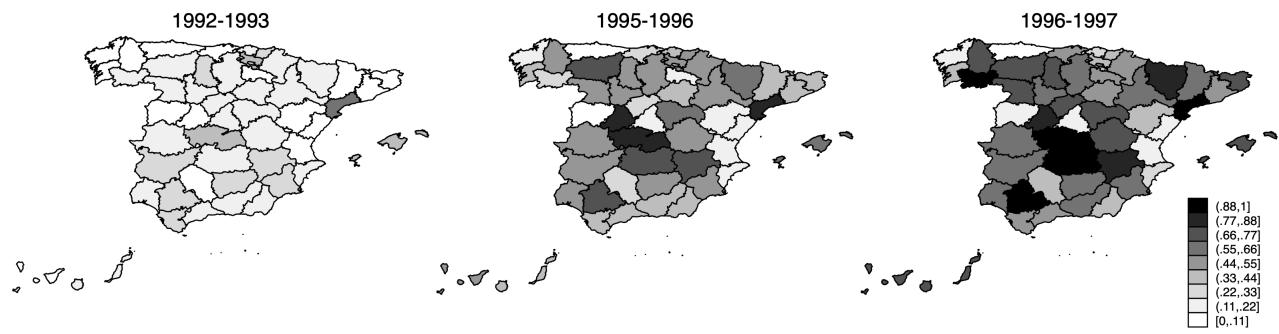
Notes: This figure depicts the LOGSE exposure index at different points during the transition period. Lighter colors correspond to lower levels of LOGSE implementation (captured by for cohort t in province k. The three panel reflect an increasing share of students exposed to LOGSE, illustrating the progressive rollout of the reform over time. At the beginning of the transition period for the 1979 birth cohort (1993–1994 school year), less than 10% of the 14-year-old student population was under the new system in almost all provinces. By the end of the transition for the 1983 birth cohort (1997–1998 school year), over 60% of 14-year-old students were enrolled under LOGSE. Source: 1989/1990– 1999/2000 Enrollment Records (Education Ministry).
Table A3: Effects on Health at Birth (Mothers Aged 17–43)
| (1) | (2) | (3) | |
| Panel A: Gestational Age | |||
| Weeks | Preterm | Very Preterm | |
| Reform exposure | -0.0023 | -0.0008 | -0.0010 |
| (0.0206) | (0.0020) | (0.0008) | |
| Observations | 2,080,165 | 2,080,165 | 2,080,165 |
Panel B: Weight at Birth
| Weight | Low Weight | Very Low Weight | |
| Reform exposure | 6.7132(5.0530) | -0.0004(0.0024) | -0.0019**(0.0008) |
| Observations | 2,310,595 | 2,310,595 | 2,310,595 |
Notes. The table shows the estimates of the coefficient on reform exposure from equation (2). Reform exposure is a 0–1 index equal to the province–cohort share of 14-yearold students enrolled in the post-reform (LOGSE) general education system; a one-unit change corresponds to full exposure to the reform. The dependent variable is indicated in each column heading in each panel. The sample includes all mothers aged 17-43 and born between 1975 and 1985. All specifications control for birth year and province of residence fixed effects. Data are from the 2000–2018 Childbirth microdata of Vital Statistics (INE). *** Significant at the 1% level, ** Significant at the 5% level, * Significant at the 10% level.
Table A4: Health at Birth Summary Statistics
| Mean | Std.Dev. | Min | Max | N | Definition | |
| Weeks of Gestation | 39.158 | 1.8974 | 19 | 46 | 1,296,160 | Number of weeks of gestation of the first-born. |
| Preterm | 0.067 | 0.2495 | 0 | 1 | 1,296,160 | Dummy variable equals to 1 if the first-born is born under 37 weeks of gestation; 0 otherwise. |
| Very Preterm | 0.008 | 0.0911 | 0 | 1 | 1,296,160 | Dummy variable equals to 1 if the first-born is born under 32 weeks of gestation; 0 otherwise. |
| Weight | 3202.492 | 513.3490 | 42 | 6580 | 1,446,005 | Weight at birth in grams of the first-born. |
| Low Weight | 0.072 | 0.2583 | 0 | 1 | 1,446,005 | Dummy variable equals to 1 if the weight at birth of the first-born is under 2500 grams; 0 otherwise. |
| Very Low Weight | 0.008 | 0.0886 | 0 | 1 | 1,446,005 | Dummy variable equals to 1 if the weight at birth of the first-born is lower than 1500 grams; 0 otherwise. |
Notes. Sample: mothers aged 25–33 at their first birth and born between 1975 and 1985. Data are from the 2000–2018 Vital Statistics (INE) childbirth microdata.
Table A5: Education Summary Statistics
| Mean | Std.Dev. | Definition | |
| Panel A: High School Enrollment | |||
| No Degree | 0.010 | 0.099 | Dummy variable equals to 1 if the highest educational degree is lower than primary school; 0 otherwise |
| Lower Secondary General Education | 0.331 | 0.471 | Dummy variable equals to 1 if the highest educational degree is compulsory general education; 0 otherwise. |
| Upper Secondary General Education | 0.453 | 0.498 | Dummy variable equals to 1 if the highest educational degree is general secondary (post-compulsory) education or college; 0 otherwise. |
| Vocational Education | 0.157 | 0.364 | Dummy variable equals to 1 if the highest educational degree is vocational secondary education; 0 otherwise. |
| N | 109,339 | ||
| Panel B: Degree Completion | |||
| No Degree | 0.011 | 0.106 | Dummy variable equals to 1 if the highest educational degree is lower than primary school; 0 otherwise |
| High School Degree | 0.337 | 0.473 | Dummy variable equals to 1 if the highest educational degree is lower or upper secondary education; 0 otherwise. |
| College Degree | 0.361 | 0.480 | Dummy variable equals to 1 if the highest educational degree is college; 0 otherwise. |
| Vocational Degree | 0.255 | 0.436 | Dummy variable equals to 1 if the highest educational degree is lower or upper vocational education; 0 otherwise. |
| Age at Highest Qualification | 20.209 | 4.258 | Age in years at completion of highest qualification. |
| N | 85,348 | ||
Notes. Panel A presents summary statistics on high school enrollment among women aged 17-24 and born between 1975 and 1985. Panel B presents summary statistics on degree completion for sample of women within the age range of 25 to 33. Source: 1991-2018 Spanish LFS.
Table A6: Information Processing Skills and Health Behavior Summary Statistics
| Mean | Std.Dev. | N | Definition | |
| Panel A: Information Processing Skills | ||||
| Literacy Assessment | 256.780 | 43.147 | 410 | Score on the 2011 PIAAC Survey of Adult Skills literacy assessment (scale: 0–500); measures the ability to understand, evaluate, use, and engage with written texts. Averaged across ten plausible values of latent proficiency; standardized to mean zero and unit standard deviation for the main analysis. |
| Numeracy Assessment | 245.434 | 44.921 | 410 | Score on the 2011 PIAAC Survey of Adult Skills numeracy assessment (scale: 0–500); measures the ability to access, use, interpret, and communicate mathematical information and ideas. Averaged across ten plausible values of latent proficiency; standardized to mean zero and unit standard deviation for the main analysis. |
| Panel B: Health Behavior | ||||
| Mother Drinks During Pregnancy | 0.067 | 0.250 | 2,314 | Dummy = 1 if the woman consumed alcohol during pregnancy; 0 otherwise. |
| Mother Drinks | 0.837 | 0.369 | 1,003 | Dummy = 1 if the woman has ever consumed alcohol; 0 otherwise. |
| Mother Smokes | 0.652 | 0.476 | 1,003 | Dummy = 1 if the woman has ever smoked; 0 otherwise. |
| Mother Consumes Drugs | 0.293 | 0.455 | 1,003 | Dummy = 1 if the woman has ever used substances (alcohol, tobacco, hypnosedatives, illegal or new drugs); 0 otherwise. |
Notes. Panel A is based on the 2011 PIAAC and includes women born 1975–1985 aged 25–33. Panel B reports data from the 2007 and 2017 Spanish Alcohol, Tobacco, and Illegal Drugs Surveys. “Mother Drinks During Pregnancy” is from 2017 survey (cohorts 1975–1985), while the remaining variables are from 2007 survey (cohorts 1975–1983).
Table A7: Maternal Background Characteristics Summary Statistics
| Mean | Std.Dev. | N | Definition | |
| Panel A: Labor Market Outcomes | ||||
| Working Mother | 0.860 | 0.347 | 1,467,386 | Dummy = 1 if the mother is actively engaged in paid work outside the home, even if not currently working; 0 otherwise. |
| High-Skill Occupation | 0.560 | 0.496 | 1,187,645 | Dummy = 1 if the mother works a highly trained job (managerial position, scientific or academic profession, administrative or office worker, high skill personnel in primary sector, high skill personnel in secondary sector and construction) conditional on being employed, 0 otherwise. |
| Panel B: Assortative Mating | ||||
| High-skill Partner | 0.562 | 0.496 | 1,009,937 | Dummy = 1 if the mother's partner works in a highly trained job (managerial position, scientific or academic profession, administrative or office worker, high skill personnel in primary sector, high skill personnel in secondary sector and construction) conditional on being employed, 0 otherwise. |
| Low-skill Partner | 0.375 | 0.484 | 1,009,937 | Dummy = 1 if the mother's partner works in a non-skilled job (catering, personal, protection and sales workers, plant and machinery operators and assemblers, or elementary occupations) conditional on being employed, 0 otherwise |
| Panel C: Family Planning | ||||
| Marriage Before Birth | 0.644 | 0.479 | 1,521,770 | Dummy = 1 if the mother was married before first birth (conditional on registered partner); 0 otherwise. |
| Duration of Marriage Before Birth | 34.244 | 24.835 | 980,853 | Months between marriage and first birth (conditional on being married). |
| Absent Father | 0.014 | 0.116 | 1,521,770 | Dummy = 1 if father's name is missing on birth register at childbirth; 0 otherwise. |
Notes. Sample includes mothers aged 25–33 at their first birth, born between 1975 and 1985. Data in Panel A and B are derived from the Vital Statistics childbirth microdata (INE) for the years 2000-2016, while data in Panels C cover the years 2000-2018.
Figure A2: Effects along the Distribution of Weight at Birth
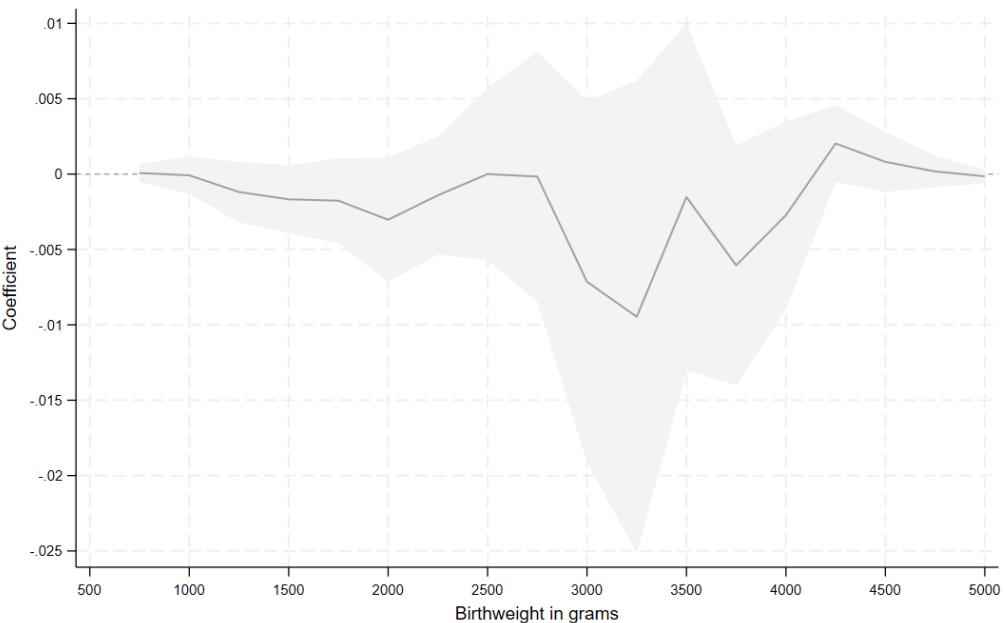
Notes. The figure plots DiD estimates of the effect of the LOGSE reform on the probability that birth weight is less than or equal to the value shown on the x-axis. Each point corresponds to a separate regression based on eq. (2) for mothers aged 25–33, born 1975–1985. Shaded areas denote 95% confidence intervals. Data are from the 2000–2018 Childbirth microdata of Vital Statistics (INE)
Table A8: Previous Literature on Education Interventions and Health at Birth Outcomes in Developed Countries
| (1)Paper | (2)Source of Education Change | (3)Country (years) | (4)Health at Birth Outcomes |
| Currie and Moretti(2003) | County-level college openingsGeneral education: Increase (tertiary)Years of schooling: +0.950 | US(1970–1999) | Gestational age (in weeks) √Preterm (<37 weeks) √Very preterm ×Birth weight (in grams) √Low birth weight (<2,500 g) √Very low birth weight × |
| Lindeboom et al. (2009) | Nationwide 1947 Education ActGeneral education: No changeYears of schooling: +0.708 | UK(1974–1999) | Gestational age (in weeks) ×Preterm ×Very preterm ×Birth weight (kg) √Low birth weight (<3,000 g) √Very low birth weight ×Other: Illness at birth √ |
| McCrary and Royer(2011) | State-level school entry policiesGeneral education: No changeYears of schooling: +0.187 | Texas (1989-2001)California (1989-2002) | Gestational age (weeks) ×Preterm (<37 weeks) √Very preterm ×Birth weight ×Low birth weight (<2,500 g) √Very low birth weight ×Other: Infant death √ |
| Grytten et al. (2014) | Nationwide 1959 comprehensiveschool reformGeneral education: Increase (secondary)Years of schooling: +0.535 | Norway(1967–2005) | Gestational age (weeks) ×Preterm ×Very preterm ×Birth weight (grams) √Low birth weight (<2,500 g) √Very low birth weight × |
| Dursun et al. (2024) | State-level curriculum reforms (1980–1985)General education: Increase (secondary)Years of schooling: 0 | US(1982–1994) | Gestational age (weeks) √Preterm (<37 weeks) √Very preterm ×Birth weight (grams) √Low birth weight (<2,500 g) √Very low birth weight ×Other: Fetal growth √ |
| This paper | Nationwide 1990 comprehensiveschool reformGeneral education: Increase (secondary)Years of schooling: 0 | Spain(2000–2018) | Gestational age (weeks) √Preterm (<37 weeks) √Very preterm (<32 weeks) √Birth weight (grams) √Low birth weight (<2,500 g) √Very low birth weight (<1,500 g) √ |
Notes: Papers are ordered chronologically. See further notes in Appendix Appendix B.
Table A9: Effects on Health at Birth: Excluding the Early-Adopting Province (Alava)
| (1) | (2) | (3) | |
| Panel A: Gestational Age | |||
| Weeks | Preterm | Very Preterm | |
| Reform exposure | 0.0265(0.0327) | -0.0058**(0.0029) | -0.0028***(0.0010) |
| Observations | 1,286,309 | 1,286,309 | 1,286,309 |
| Panel B: Weight at Birth Measures | |||
| Weight | Low Weight | Very Low Weight | |
| Reform exposure | 11.4263(7.1087) | -0.0012(0.0030) | -0.0020*(0.0010) |
| Observations | 1,436,143 | 1,436,143 | 1,436,143 |
Notes: The table shows the estimates of the coefficient on reform exposure from equation (2). Reform exposure is a 0–1 index equal to the province–cohort share of 14-year-old students enrolled in the post-reform (LOGSE) general education system; a one-unit change corresponds to full exposure to the reform. The dependent variable is indicated in each column heading in each panel. The sample includes all mothers aged 25–33 born between 1975 and 1985, excluding observations from the province of Alava, where more than 25 percent of the 14-year-old population was already enrolled in the new system for cohorts born prior to 1975. All specifications control for birth year and province of residence fixed effects. Standard errors are shown in parentheses. Data are from the 2000–2018 Childbirth microdata of Vital Statistics (INE). *** Significant at the 1% level, ** Significant at the 5% level, * Significant at the 10% level.
Table A10: Placebo Test Ruling Out Pre-Reform Trends in Enrollment and Degree Completion
| (1) | (2) | (3) | (4) | (5) | |
| Panel A: Secondary Education Enrollment | |||||
| No Degree | Lower Secondary General Educ | Upper Secondary General Educ | Vocational Education | ||
| Reform exposure t+5 | 0.001(0.008) | 0.026(0.027) | 0.009(0.031) | 0.008(0.020) | |
| Observations | 148,370 | 148,370 | 148,370 | 148,370 | |
| Panel B: Degree Completion | |||||
| Age at Highest Qualification | No Degree | Secondary Degree | Vocational Degree | College Degree | |
| Reform exposure t+5 | 0.582*(0.320) | 0.002(0.010) | -0.036(0.031) | 0.026(0.024) | 0.037(0.027) |
| Observations | 106,171 | 126,764 | 126,764 | 126,764 | 126,764 |
Notes. The table shows the estimates of the coefficient on reform exposure from equation (2). Reform exposure is a 0–1 index equal to the province–cohort share of 14-year-old students enrolled in the post-reform (LOGSE) general education system; a one-unit change corresponds to full exposure to the reform. The dependent variable is indicated in each column heading in each panel. The sample includes all female Spanish nationals aged 17-24 in Panel A and
Este texto se ha extraído automáticamente del documento original. Para citarlo o leerlo con su maquetación, descargue el PDF.
Descargar en PDF